40 works in this view — arrow keys or swipe to move between them.
Dance in Art
The polka is the dance for me
Unknown artist
- Dance:
- Polka
- Era:
- Late 1800s (Victorian Ballroom)
- Source:
- New York Public Library
- Rights:
- Public domain — free to use, share and adapt.
- Recorded as:
- public_domain
The polka is one of the few nineteenth-century social dances still widely practiced today, and images like this show how it was actually performed and taught. Sheet music covers are often overlooked in dance history, but they are among the most widely distributed and therefore culturally influential records of how people moved in their own time.
What you are looking at
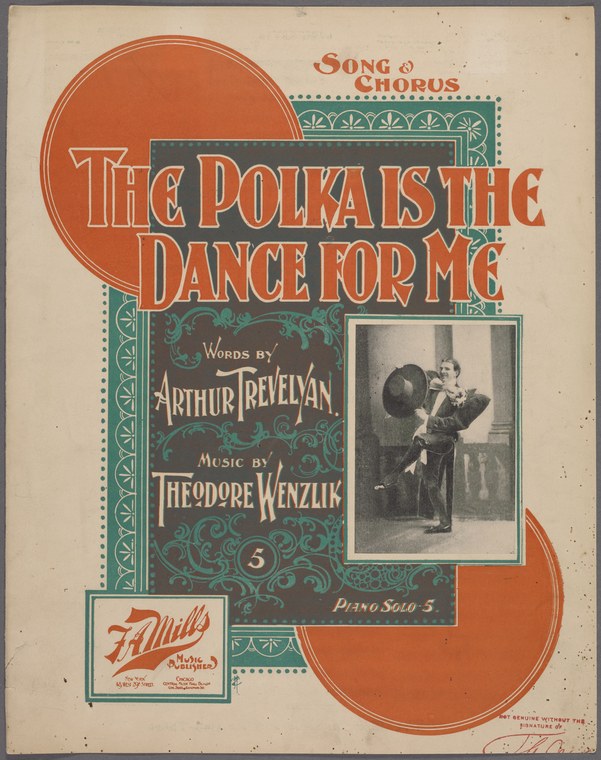
A sheet music cover for a polka with decorative art nouveau border design in orange and teal green. The central image shows a couple in formal late-nineteenth-century dress: a man in a dark coat and light-colored trousers holds a woman in a pale dress with a full skirt. They are captured mid-dance, the woman's body leaning back slightly as the man supports her, suggesting the characteristic rotational momentum of the polka. The photograph or illustration is small and placed within an ornate rectangular frame. Large semicircles in orange anchor the composition at top left and bottom right. The text identifies this as a song and chorus with words by Arthur Trevelyan and music by Theodore Wenziuk. The publisher's mark for F. Mills appears in the lower left, and "Piano Solo 5" is marked in the lower right, indicating this was sold as a piano reduction of the orchestral work.
The dancing
The couple dances in a closed position typical of ballroom polka: the man's right arm encircles the woman's waist, her left hand rests on his shoulder, and their free hands meet at roughly shoulder height. The woman's body is slightly reclined away from her partner, her weight appearing to be on her back foot—a characteristic polka posture that allows for the vigorous turning and hopping that defines the dance. Both figures are upright and formal, reflecting the social dance conventions of the period. The distance between them and the formal arm carriage suggest a respectable ballroom context rather than folk exuberance.
The dance depicted
This is unambiguously a polka, one of the most popular social dances of the late nineteenth century. The closed position, the woman's reclined frame, and the formal dress are all consistent with ballroom polka as it was danced in drawing rooms and dance halls of the 1880s–1900s. The polka originated in Bohemia in the 1840s but became a fixture of European and American ballroom dance by mid-century, and it remained fashionable well into the twentieth century. The title—'The Polka is the Dance for Me'—explicitly celebrates the form, suggesting this was a popular song to accompany or commemorate the dance rather than dance music itself.
How it was made
This is a lithographed sheet music cover, a common commercial format for popular songs of the period. Lithography allowed for the integrated use of color (here, orange and teal) and enabled mass reproduction, making this an affordable commodity for middle-class households with pianos. The decorative border and the integrated photographic or highly detailed illustrative image of the dancing couple are typical of turn-of-the-century sheet music design, which treated the cover as both advertisement and art. The technique allowed for the simultaneous circulation of visual imagery and music, shaping how people learned about fashionable dances.
About this work
This is a lithographed sheet music cover for a polka published by F. Mills, likely in the 1890s. It documents a moment of social dance in formal dress and a closed ballroom hold, paired with commercial popular music designed for amateur pianists. The cover image serves both as a record of how the polka was actually danced—showing the characteristic frame and posture—and as marketing, promising the buyer a fashionable, pleasurable experience. Sheet music covers of this kind are primary documents of dance history: they show which dances were commercially viable, how they were choreographed, what bodies and dress were considered proper, and how visual and musical cultures intertwined.
The work belongs in a dance gallery as evidence of the polka's status as a major social dance form in the late Victorian ballroom. It shows the dance not as a folk form or a theatrical spectacle, but as a domestic leisure activity for respectable people. The anonymous photographer or illustrator recorded the actual body mechanics of the dance—the frame, the lean, the positioning—not as documentary but as commercial imagery, and in doing so created an unusually clear visual record of ballroom technique.
How to look at it
Look closely at the frame of the dancing couple: the distance between their bodies, the angle of the woman's spine, the height at which their hands meet. These details are not romantic invention but accurate notation of how the polka was danced. The artist chose the moment of rotation, capturing the couple mid-turn—a choice that emphasizes the polka's characteristic fast, spinning action. Notice also the formality of their dress and posture: there is nothing wild or transgressive here, but rather a visualization of respectable leisure. The ornamental border in art nouveau style dates the cover to the 1890s–1900s, and the combination of chromolithography and photographic realism was a distinctive feature of commercial design in this period.
The artist
The cover credits Arthur Trevelyan for lyrics and Theodore Wenziuk for music, but the designer and photographer/illustrator of the image are not credited and remain unknown. This was standard practice for sheet music covers, where visual and musical labor were often uncredited and subsumed into the publisher's brand. The F. Mills publishing house was active in popular song publication in the late nineteenth and early twentieth centuries, particularly in New York.
The period
The polka was at the height of its fashionable popularity in the 1880s and 1890s, when this cover was likely produced. By this period the polka had been a staple of ballroom dancing for nearly fifty years, having spread from Prague across Europe and to America. However, by the early twentieth century, new dances—the foxtrot, the turkey trot, and others—would begin to displace it. This cover dates from the polka's mature period, when it was so familiar that a song could celebrate it with simple delight. The formal dress, the closed position, and the orderly domestic context all reflect the social codes of the Victorian and Edwardian ballroom. Sheet music published during this period often targeted female pianists and mixed-gender social dancing in the home, reinforcing the polka's role as a respectable leisure activity for the middle class.
Where it lives
This cover is held in the New York Public Library's collection of popular printed ephemera, from which it was digitized. Sheet music covers were once treated as disposable commercial objects and are now rare; surviving examples form an important archive of visual culture and dance practice.
Dance in this work
Questions about this work
When did the polka first become popular in America?
The polka originated in Bohemia in the 1840s and spread to Western Europe within a decade. It reached America by the 1850s and was already a staple of ballroom dancing by the Civil War. It remained fashionable through the 1890s and early 1900s, when this cover was published, though it gradually lost ground to newer dances like the foxtrot.
What does 'Piano Solo 5' mean at the bottom of the cover?
This indicates that the piece was available in multiple arrangements—likely full orchestra, vocal score, and piano reduction. 'Piano Solo 5' suggests this is the fifth piece in a series or collection of piano-only reductions, making it affordable and accessible for domestic use. Many middle-class homes had pianos, and sheet music in piano reduction was a major commercial product.
Was the polka considered a respectable dance?
Yes, by the time this cover was published, entirely. The polka had been integrated into ballroom dancing and the social conventions of the drawing room for decades. It was danced by men and women in formal dress, in mixed company, and under parental supervision. Earlier dances like the waltz had also faced moral criticism when first introduced, but by the Victorian era they were fully normalized.
Who would have bought this sheet music?
Middle-class households with pianos, particularly those with daughters. Sheet music was marketed as both entertainment and a form of musical education and self-improvement for women. A song 'The Polka is the Dance for Me' would appeal to people who danced socially and wanted music to accompany their practice or performances in the parlor.
More Polka artwork