41 works in this view — arrow keys or swipe to move between them.
Dance in Art · 2019
The celebrated polka dances
Unknown artist
- Medium:
- Lithograph
- Dance:
- Polka
- Era:
- Late 1800s (Victorian Ballroom)
- Source:
- New York Public Library
- Rights:
- Public domain — free to use, share and adapt.
- Recorded as:
- public_domain
The polka was a watershed moment in ballroom dance history: it displaced the rigid formality of earlier dances and introduced the bouncy, hip-driven, couple-centered style that would dominate social dancing into the 20th century. This print is primary evidence of how the dance looked and felt to contemporaries, and of how the print industry turned dance into a commodity and spectacle. For historians of dance, fashion, and 19th-century popular culture, it documents the nexus where choreography, costume, publishing, and social aspiration intersected.
What you are looking at
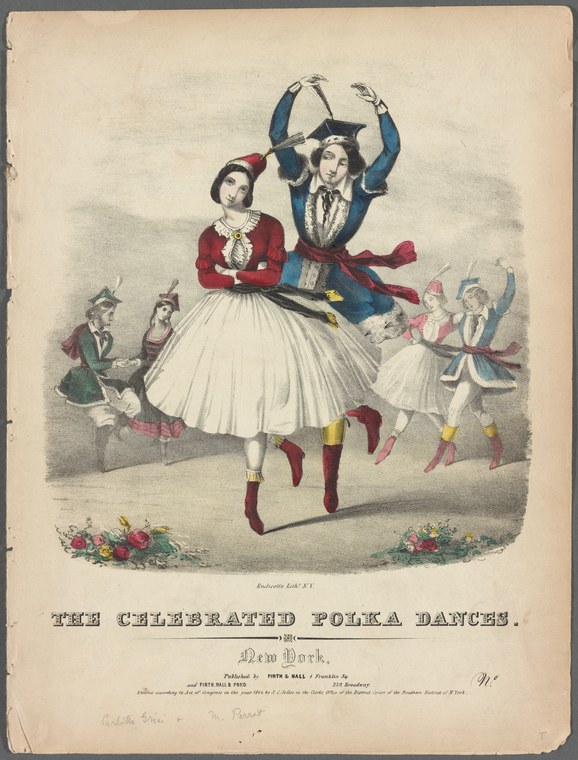
A hand-colored lithograph depicts a chaotic celebratory scene of polka dancing. In the center, a couple executes an exuberant polka: the woman wears a white skirt with a red velvet jacket trimmed in white lace, her dark hair adorned with a red hat, while the male partner wears a blue coat with ornate frogging and holds aloft what appears to be a large plumed object or headdress. Around them, four smaller figures—some in folk or military dress—gesture wildly with raised arms, their movements suggesting music and revelry. The background is rendered in soft wash, creating atmospheric depth. At the bottom of the composition, a garland of roses frames the scene. The print bears the title "THE CELEBRATED POLKA DANCES" and is credited as "New York" with publisher information for Firth & Hall.
The dancing
The central female dancer is captured mid-leap, her legs slightly bent beneath a voluminous skirt that balloons outward, suggesting rapid rotational movement. Her male partner supports her at the waist while raising one arm high, typical of the polka's characteristic lifting and turning figures. The surrounding figures have raised arms and bent knees in attitudes of exuberant jumping, their bodies angled to suggest rapid, bouncy motion. All five figures wear period dress and are positioned in a roughly circular composition that emphasizes centrifugal, energetic movement radiating outward from the couple.
The dance depicted
This is a representation of the polka, the fashionable couple-dance of the 1840s–1860s that dominated European and American ballrooms. The dance is characterized by a fast 2/4 tempo with a distinctive hop-step-close pattern, and this image captures that essential bouncy quality through the lifted postures and raised heels visible in several figures. The surrounding attendants suggest the social excitement the polka generated—it was an innovation that displaced more formal, controlled dances and was notorious for its energy and comparative informality. The print was likely issued as sheet music cover art or a separate parlor print to capitalize on the dance's enormous popularity in mid-19th-century America.
How it was made
This is a hand-colored lithograph, a reproductive process that allowed cheap, rapid distribution of topical imagery. The artist drew the design on a prepared stone, which was then inked and printed; individual impressions were subsequently colored by hand, usually by a workshop. Lithography was the dominant medium for popular prints and sheet music covers in the 1840s–1860s because it could produce thousands of impressions at low cost while retaining fine detail. The soft tonal washes in the background and the precise delineation of costume and facial feature demonstrate the technique's capacity for both atmospheric effect and commercial clarity. The presence of hand-coloring confirms this is a popular print intended for a middle-class domestic market rather than a fine-art audience.
About this work
This is a mid-19th-century lithographic print celebrating the polka, the transatlantic dance craze that transformed ballroom culture in the 1840s–1860s. The composition freezes a moment of peak exuberance: a fashionably dressed couple executing the dance's characteristic bouncing figures while attendants gesture in enthusiasm. The print serves both as documentary evidence of how the polka was performed and as artifact of the media ecology that amplified the dance's cultural reach—sheet music covers, parlor prints, and illustrated newspapers made the polka visible to people who might never attend a ball. The work belongs in a gallery of dance art because it captures not just the movement itself but the social excitement and democratic accessibility that made this dance historically significant.
How to look at it
Look at the arrested moment the lithographer chose: the couple is mid-bounce, caught at the peak of a jump with heels lifted and knees bent, the woman's skirt suspended in a balloon of fabric. This is not a static pose but a frame from motion, which was difficult to capture in print and suggests the artist understood the polka's kinetic character. Notice also the surrounding figures with raised arms and bent knees—they are not dancing the polka themselves but are participating in the spectacle, which tells you something about how the dance was socially experienced: as a performance for witnesses as much as for the dancers. The hand-coloring is uneven and sometimes crude, typical of workshop production, but the red jacket, white skirt, and blue coat read clearly against the pale wash background—color was a tool for commercial legibility.
The artist
The artist is unrecorded. The print bears the imprint of Firth & Hall, a major New York music publisher and print seller based in lower Manhattan, active from the 1820s through the Civil War. Firth & Hall commissioned hundreds of lithographs as covers for sheet music and as standalone prints, often from anonymous or now-unidentifiable artists. The quality of draftsmanship and hand-coloring suggests a competent commercial workshop rather than a named artist of independent reputation. The anonymity is typical of popular print production in this era.
The period
The polka arrived in Europe from Bohemia around 1835 and reached the American ballroom by 1844, where it ignited a frenzy of adoption and moral anxiety. Unlike the stately waltz or the complex geometry of the quadrille, the polka was fast, athletic, close-hold, and required vigorous hip and knee action—contemporaries found it simultaneously exhilarating and unseemly. The 1840s–1860s were the peak of the polka's dominance; it generated polka-themed fashion, polka-themed visual merchandise (like this print), polka-themed literature, and polka-themed moral panic. In fine art, the polka occasionally appeared in academic salon paintings of ballroom scenes, but it was the commercial print industry—publishers like Firth & Hall—that circulated polka imagery most widely and made the dance a truly mass-cultural phenomenon. The print's publication in New York reflects the dance's rapid transatlantic reach and American embrace.
Where it lives
The print is held in the New York Public Library collection, which acquired broad holdings of 19th-century American prints, sheet music covers, and ephemera documenting popular culture and commercial visual production. It is catalogued as a lithograph from the late 1800s, though the style, costume, and publication history (Firth & Hall) suggest a date in the 1840s–1860s, the height of the polka craze.
Dance in this work
Questions about this work
How do I know this is the polka and not another dance?
The title on the print says 'The Celebrated Polka Dances.' The costumes, the close-hold couple position, the lifted heels and bent knees, and the energetic bouncing postures are all consistent with the polka's visual signature. The surrounding figures' gestures suggest the social excitement the polka specifically generated. If the title were absent, the image alone would suggest a fast, bouncy, couple-centered dance of the 1840s–1860s, which narrows it almost certainly to the polka.
What does the artist want me to feel about this dance?
The composition is celebratory and exuberant. The central couple is rendered with romantic idealization—fashionable, energetic, and admirable. The surrounding figures are enthusiastic rather than disapproving. There is no visual irony or critique. The work is promotional material, designed to make the polka look fun and socially desirable. This reflects the print's commercial purpose: to sell sheet music and to circulate the polka as a desirable cultural commodity.
Who would have bought this print?
Middle-class households, particularly those with access to pianos and an interest in fashionable social dancing. It was likely sold as a sheet music cover, a parlor print, or as part of a series of dance-themed merchandise. The hand-coloring and the cost of production made it an affordable but not cheap purchase—a marker of genteel leisure and cultural aspiration. The prevalence of such prints in auction records and private collections suggests they were common in American homes.
Why does the man hold that feathered thing over his head?
It is unclear. It may be a comic prop, a plumed hat, or an imaginative flourish added for visual interest. Polka dancers did not characteristically brandish such objects. It is possible the artist added it for compositional balance or to amplify the sense of exuberant festivity. Without documentary evidence or a signature on the print, it is difficult to determine whether this is a misunderstanding of polka custom, a deliberate embellishment, or a reference to a specific theatrical or ball performance.
More Polka artwork