49 works in this view — arrow keys or swipe to move between them.
Dance in Art · 1898
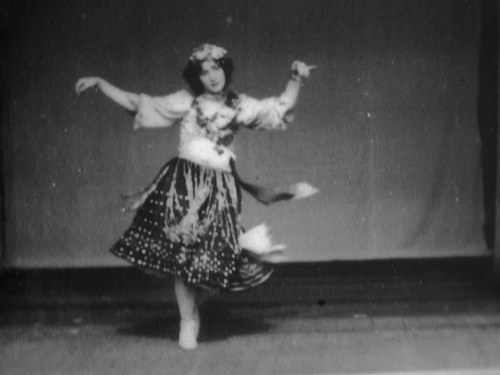
Turkish dance, Ella Lola
Unknown artist
- Source:
- Library of Congress
- Rights:
- Public domain — free to use, share and adapt.
- Recorded as:
- Public Domain
This is documentary evidence of a specific performer and a specific moment in the history of Middle Eastern dance on the American stage. It shows how belly dance entered Western theatrical markets and how it was visually presented, costumed, and marketed to audiences in the 1890s—a crucial period in the global circulation and adaptation of these forms.
What you are looking at
A solo female dancer stands center stage in a black-and-white photograph, captured mid-performance against a plain dark backdrop. She wears a white blouse with full sleeves pulled off the shoulders and a dark skirt with a geometric patterned lower section that appears heavily pleated or paneled. Her skirt is caught in motion, swirling around her as she executes a turning movement. A decorative headpiece adorns her hair. Her arms are raised and extended outward at shoulder height in an open, expansive frame, with her body angled in three-quarter view. The lighting is stark and frontal, characteristic of early theatrical photography, creating sharp definition between the performer and the background.
The dancing
The dancer's weight appears to be supported on one leg while the other leg drives the turn, typical of rotational movements in Middle Eastern or belly dance vocabulary. Her arms maintain an open, lifted frame with palms generally facing forward or outward—a gesture of presentation rather than closed partnering. The raised shoulders and extended arms suggest buoyancy and control. Her torso remains relatively upright and centered, with movement articulated primarily from the hips downward and through the turn.
The dance depicted
The title identifies this as a 'Turkish dance' performed by Ella Lola, likely a stage performer of the late 1890s. The costume, arm positions, and turning movement are consistent with Orientalist belly dance (Raqs Sharqi) or Turkish-inflected theatrical dance of the period. The open, presentational frame and geometric patterned skirt suggest a stage version of traditional Middle Eastern dance adapted for American or European theatrical audiences. Without additional context, it is difficult to specify the exact dance form, but the visual evidence points to some form of global-middle-eastern dance as performed in early commercial theater.
How it was made
This is a photographic print, likely a gelatin silver print or similar early photographic process given the black-and-white tonality and the grain visible in the image. The photograph was taken in a controlled studio setting with posed lighting, suggesting it was made for theatrical publicity or documentation purposes rather than captured live. The static single exposure freezes a moment of movement, making this a valuable record of early stage dance costuming and gesture at the moment of performance.
About this work
This photograph documents Ella Lola performing a Turkish-themed dance on the American stage in 1898, during the height of Orientalism in theatrical entertainment. The work captures the costume, physicality, and aesthetic conventions of late-19th-century belly dance and Middle Eastern-inspired performance as it was staged for Western audiences. The image is significant as evidence of how non-Western dance forms were both celebrated and transformed through the commercial theater of the period.
How to look at it
Notice how the photographer has frozen the dancer mid-turn, capturing the swirl of the skirt and the dynamic extension of the arms. This moment of rotation and lift was chosen to convey energy and grace while remaining decorous enough for the theatrical publicity market. The plain background keeps all focus on the performer's body and costume, a convention of late-19th-century theatrical portraiture. The open, symmetrical arm position and three-quarter pose are designed to display the body and costume to the viewer frontally.
The period
The 1890s saw the emergence of belly dance and other Orientalist dance forms in American and European popular theater. Performers like Little Egypt and Ella Lola became celebrities by offering audiences an exotic, eroticized vision of Middle Eastern culture at world's fairs, circuses, and theatrical venues. These performances were simultaneously celebrated as artistic innovation and criticized as scandalous or primitive. The period marks the beginning of belly dance's long history in Western entertainment, though usually presented through a lens of fantasy and exoticization rather than cultural authenticity.
Where it lives
The photograph is held in the Library of Congress and is catalogued as part of their dance documentation materials. It entered the collection as a record of early American theatrical dance, likely preserved from theatrical archives or performers' collections.
Dance in this work
Questions about this work
Who was Ella Lola?
Ella Lola was a stage performer active in the 1890s who specialized in theatrical renditions of Middle Eastern and Turkish dance. She was one of many performers who capitalized on the American fascination with Orientalism during this period. Beyond this photograph, little is currently documented about her career or life.
What is the skirt she is wearing?
The skirt appears to be a hybrid garment designed for theatrical effect rather than a reproduction of traditional Turkish or Middle Eastern dress. The geometric patterning and heavy pleating were intended to catch light and create visual drama during performance, particularly in the swirling motion captured here.
Is this authentic Turkish dance?
No. This is a theatrical interpretation created for Western audiences, blending elements of Turkish and Middle Eastern aesthetics with American and European entertainment conventions. The costume, staging, and framing are designed for the Broadway stage rather than for cultural or religious purposes.
Why was Middle Eastern dance so popular in America at this time?
The 1890s fascination with Orientalism reflected broader Western appetite for exoticized views of non-Western cultures. World's fairs, circuses, and theatrical venues presented these performances as both artistic and ethnographic spectacle. The form offered performers like Ella Lola economic opportunity and celebrity status, though within frameworks that often exoticized and distorted the cultures represented.
More dance artwork





