49 works in this view — arrow keys or swipe to move between them.
Dance in Art · 1897
Dance of the cupids
Unknown artist
- Source:
- Library of Congress
- Rights:
- Public domain — free to use, share and adapt.
- Recorded as:
- Public Domain
For historians of nineteenth-century theatrical dance, this work exemplifies the traffic between stage and parlor: a composition created for a specific theatrical spectacle was marketed and sold as an autonomous piece. For dance historians, the work represents the kind of character or specialty dance that punctuated farce and musical comedy performances, a genre less documented than ballet but equally important to live performance.
What you are looking at
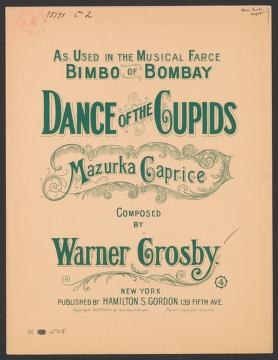
This is a printed cover for sheet music, showing the title and credits for a musical farce composition. The page is dominated by ornamental typography in two sizes of green serif font. At the top in smaller letters runs the line "As Used in the Musical Farce"; below it in much larger decorative capitals is "BIMBO OF BOMBAY"; beneath that in elaborate script lettering is "Dance of the Cupids" with "Mazurka Caprice" on the line below. At the bottom, smaller text identifies the composer as "Warner Crosby" and the publisher as "Hamilton S. Gordon" of New York. The entire composition is centered and symmetrical, printed on cream-colored paper stock. The design employs no figurative imagery—no dancers appear—relying instead on typography and ornamental spacing to convey the work's theatrical and musical identity.
The dancing
No human figures or dancers are depicted on this cover. The work is purely typographic and textual.
The dance depicted
The cover advertises a composition titled 'Dance of the Cupids' subtitled 'Mazurka Caprice.' The mazurka was a Polish folk dance in triple meter that became fashionable in European and American ballrooms and concert halls during the nineteenth century, particularly as a vehicle for piano compositions. The association with Cupids—traditionally represented as playful, diminutive figures from classical mythology—suggests a light, whimsical character piece rather than a virtuosic concert work. As part of the score for the musical farce 'Bimbo of Bombay,' the piece would have served theatrical performance, likely as an instrumental interlude or choreographed sequence. The specific choreography and performance style cannot be determined from the cover alone.
How it was made
This is a letterpress-printed cover, a standard format for sheet music of the period. The design uses multiple type sizes and weights in green ink on cream stock, a common commercial printing practice of the 1890s. The ornamental lettering—particularly the flowing script of 'Dance of the Cupids'—was set from display type faces available to commercial printers. This format was the primary means of circulating music to amateur musicians, music students, and theater orchestras; the visual prominence of the title and composer's name was crucial to commercial success, as these covers served as both product packaging and advertisement.
About this work
This is a printed cover for the sheet music of 'Dance of the Cupids: Mazurka Caprice,' composed by Warner Crosby and performed in the 1897 musical farce 'Bimbo of Bombay.' The work belongs to a long tradition of character dances written for theater, where composers created short orchestral or piano pieces with titles evoking particular moods, narratives, or mythological figures to accompany staged action. The mazurka framework and the theatrical context suggest a piece designed for visual performance—likely a solo turn or ensemble interlude rather than social-dance instruction.
As a historical artifact, the cover documents the mechanical reproduction and commercial circulation of theatrical music in the 1890s. The choice to publish and advertise the piece separately from the full score suggests it had appeal beyond the theater—possibly to piano-playing amateurs or to other theatrical productions seeking repertoire.
How to look at it
A viewer should attend to the typography itself as a design choice: the use of multiple scales and the ornamental script lettering were conventions of theatrical advertising and sheet-music marketing that signaled entertainment, spectacle, and commercial appeal. The balanced, centered composition and the emphasis on the composer's name (printed prominently at the base) reflect the commercial logic of sheet-music production, where each title competed for notice on a crowded piano bench or music-shop counter. The subtitle 'Mazurka Caprice' indicates the formal framework—a caprice is a light, fanciful piece—suggesting the performer or choreographer would recognize the basic dance structure and meter but expect playful, individual interpretation.
The artist
Warner Crosby was a composer and music publisher working in New York in the 1890s, associated with the publication and composition of theatrical music. Beyond this single documented work, his individual biographical record is sparse in readily available sources. He typifies the working composer of the period: a creator of functional music for theater and entertainment rather than a concert-hall figure, whose works circulated through performance and sheet-music sales rather than archival preservation.
The period
The 1890s were a boom period for musical theater in America, particularly the comic operetta and farce forms that offered lighter entertainment than grand opera. The mazurka had been fashionable as a concert and ballroom dance for much of the nineteenth century, and character-dance pieces built on familiar dance forms were standard theatrical repertoire. The publication of individual numbers from musical shows as sheet music for home performance was a major commercial enterprise and a primary way music reached domestic audiences before recording technology. 'Bimbo of Bombay' belongs to a current of Orientalist farce that was prevalent on American and European stages in this period, often featuring exoticized settings and comic complications around colonial or imperial themes.
Where it lives
The source is listed as the Library of Congress. This is a printed ephemeral object—sheet-music cover—of the type collected in large numbers by academic libraries and music archives.
Dance in this work
Questions about this work
What is a mazurka?
A mazurka is a Polish folk dance in triple meter (3/4 time), characterized by a particular accent and lilt. It became fashionable across Europe and America in the nineteenth century both as a social dance and as a concert form, particularly in piano literature. Composers from Chopin onward wrote mazurkas as concert pieces, and the form also appeared in theatrical music as a vehicle for character dances and specialty numbers.
What was a musical farce?
A musical farce was a light theatrical entertainment combining spoken comedy, songs, and often dances, popular in the late nineteenth and early twentieth centuries. It was distinct from operetta by its emphasis on comedy and topical humor rather than musical continuity. These shows typically featured specialty performers and interpolated musical numbers that could be showcased or even replaced depending on the touring production.
Why is this just a cover with no pictures of dancers?
Sheet-music covers were primarily commercial products designed to be eye-catching on a music rack or counter. Most relied on typography, ornamental lettering, and sometimes printed illustrations—but many theatrical publishers, particularly for popular farce numbers, printed simple title pages with minimal illustration, prioritizing legibility and the prominence of the composer's and publisher's names over visual spectacle.
More dance artwork





