49 works in this view — arrow keys or swipe to move between them.
Dance in Art · 1971
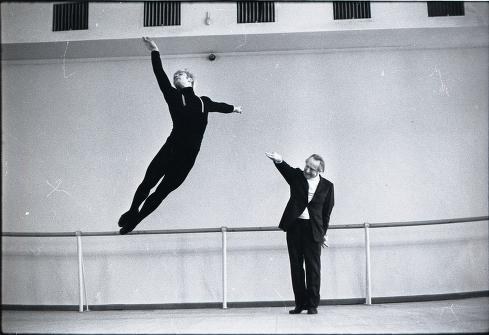
Teacher and Student. Alexei Yermolaev and Vladimir Vasiliev.
Unknown artist
- Source:
- Library of Congress
- Rights:
- Public domain — free to use, share and adapt.
- Recorded as:
- Public Domain
For ballet historians and teachers, this image documents the Soviet pedagogical method at the moment of its global dominance, capturing the precision of extension and line that defined Vaganova training. For those studying Vasiliev's career, it preserves evidence of his training with one of the Soviet tradition's key figures.
What you are looking at
A black-and-white photograph captures two figures in a gymnasium or studio space with a high ceiling fitted with ventilation grilles. The room is spare and institutional, with a simple white railing running horizontally across the middle distance. On the left, a figure in dark clothing is captured mid-leap, body extended in a horizontal line with one arm raised and the other extended, legs stretched in the air—a moment of maximum extension and weightlessness. On the right, a second figure in a dark suit stands upright and still, one arm raised in a gesture of attention or direction, watching the airborne dancer. The lighting is even and clinical, casting minimal shadow, which emphasizes the geometry of the bodies and the stark geometry of the space itself.
The dancing
The leaping figure demonstrates exceptional balletic extension: the body is stretched nearly horizontal in mid-air, with the legs in a clean line and arms positioned to frame the jump. The torso is elongated, the head positioned with the classical balletic port de tête. The standing figure maintains an upright posture with formal bearing—shoulders back, one arm raised with fingers extended in what appears to be a teaching or demonstrating gesture. The spatial relationship suggests instruction or evaluation: the airborne dancer is the subject of attention; the standing figure is the observer or guide.
The dance depicted
This is almost certainly a moment of classical ballet instruction, depicting a master teaching an advanced student. The catalogue identifies the figures as Alexei Yermolaev (standing) and Vladimir Vasiliev (jumping), both prominent Soviet ballet figures. The jump appears to be a grand allegro movement—possibly a grand jeté or saut de chat—executed with the controlled, extended line characteristic of the Vaganova method that dominated Soviet ballet training. The formal, observational posture of the teacher and the precision of the student's extension suggest this is documentation of a teaching moment rather than performance.
How it was made
This is a black-and-white photograph, likely a documentary photograph from a rehearsal or teaching session. The even, somewhat harsh lighting and the institutional framing suggest a working photograph rather than a posed studio portrait—it may have been made by a photographer documenting Soviet ballet practice. The sharp focus and clear detail allow precise reading of the dancers' positions and the geometry of their bodies, which is essential for a teaching or training context.
About this work
This photograph documents a moment of classical ballet pedagogy in 1971, capturing the relationship between master teacher and advanced student through the captured instant of a grand allegro jump. It is an image of Soviet ballet at the height of its international influence, when the Vaganova-trained dancers of the Bolshoi and Kirov were setting the technical standard for the world. The photograph is valuable not as performance documentation but as evidence of how ballet technique was transmitted: the teacher's stillness and attention, the student's extended line, the clinical space in which mastery was measured and refined.
How to look at it
Attend to the arrested moment of the jump: the photograph freezes the movement at the apex, when the dancer's weight is entirely airborne and the body is maximally extended. Notice how the teacher's raised arm and frontal stance position him as a witness to this peak moment—he is not correcting mid-movement but observing and evaluating the result. The railing behind them divides the space and frames the action. The stark lighting eliminates distraction and makes the geometry of the extended body the sole focus.
The artist
The photograph is attributed to an unknown photographer and appears to be part of a documentary or archival record held by the Library of Congress. It is not a signed art photograph but rather a working document of Soviet ballet practice.
The period
In 1971, Soviet ballet was at a peak of international prestige following decades of state investment in training and performance. The Vaganova Academy in Leningrad and the ballet academies attached to the Bolshoi and Kirov theatres were the world's most rigorous ballet schools, producing dancers of exceptional technical precision. This was the era of Mikhail Baryshnikov and other Soviet defectors who would reshape international ballet. The photograph reflects the scientific, systematic approach to ballet training that characterized Soviet pedagogy—technique as measurable, perfectible, transmissible.
Where it lives
The photograph is held by the Library of Congress and was created in 1971. It is documented as part of their dance photography collection.
Dance in this work
Questions about this work
Who were Alexei Yermolaev and Vladimir Vasiliev?
Alexei Yermolaev (1910–1975) was a celebrated Soviet ballet dancer and later teacher at the Bolshoi Ballet. Vladimir Vasiliev (born 1940) is a principal dancer of the Bolshoi Ballet and one of the most acclaimed male dancers of his generation. The photograph documents a teaching moment between a senior figure and a rising star of Soviet ballet.
What jump is being performed?
The jump appears to be a grand allegro movement—possibly a grand jeté or a saut de chat—executed with the extended, controlled line that is central to classical ballet technique. The full horizontal extension and the positioning of the limbs are characteristic of the Vaganova method.
What does the Vaganova method emphasize?
The Vaganova method, developed in early-20th-century Russia and formalized by Agrippina Vaganova, emphasizes clean, extended line; strong épaulement (shoulder movement); and systematic progression through defined levels. Soviet dancers trained in this method were known for their exceptional extension, turnout, and precision.
Why is this photograph in a dance gallery rather than a history archive?
Because it documents dance itself—the technique, the moment, the relationship between teacher and student—rather than merely recording historical fact. It shows how ballet bodies move and how ballet knowledge passes from one generation to the next.
More dance artwork





