49 works in this view — arrow keys or swipe to move between them.
Dance in Art
The dance
Unknown artist
- Medium:
- Source:
- New York Public Library
- Rights:
- Public domain — free to use, share and adapt.
- Recorded as:
- public_domain
This is a primary visual document of African ceremonial or social dance as observed and recorded in the 19th century, preserving a moment and style of movement that might otherwise be lost to written history alone. It demonstrates both the accuracy and the biases of ethnographic art of the period—a reminder that every historical image of dance reflects the eye, intent, and cultural position of the observer.
What you are looking at
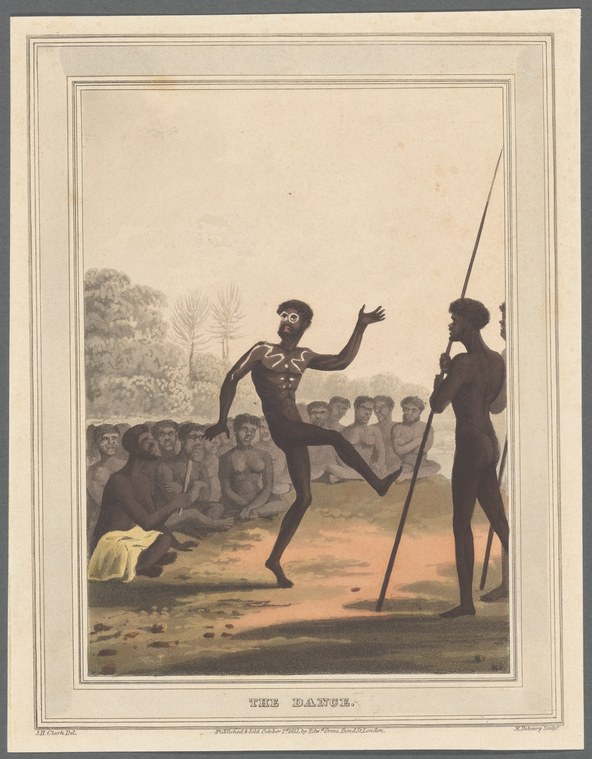
A figure in dark skin tone, entirely unclothed except for ornamental body paint or scarification, executes a dynamic leap or bound in the center foreground. The dancer's body is caught mid-motion, one leg extended upward and back, the torso twisted, one arm raised in an expansive gesture while the other extends toward the ground. The pose suggests either a moment of celebration or the execution of a specific movement in a ceremonial or social dance. A second figure stands to the right, similarly unclothed, holding a long thin staff or spear nearly vertical—possibly a dance partner, musician, or spectator. Behind them a large crowd of seated and standing figures watches intently, their faces dark, their postures attentive. The setting appears to be an open clearing or village space with trees visible in the left background and warm earth tones dominating the ground plane. A piece of yellow cloth or fabric lies on the ground in the lower left. The light is soft and diffuse, characteristic of hand-colored engraving or aquatint.
The dancing
The central dancer's body demonstrates remarkable anatomical specificity and dynamic tension. The weight appears to be passing through a moment of full suspension, with the right leg driving upward in a controlled arc, the spine arched, and the right arm extended outward and upward in an open gesture. The left arm is less clearly defined but appears to reach downward or across the body. The figure's musculature is rendered with attention to definition. The second figure's stance is upright and still, the long staff held nearly vertical, suggesting a role distinct from the jumping dancer—possibly a drummer, chanter, or bearer of a ceremonial object. The crowd composition uses perspective recession and size diminution to suggest depth.
The dance depicted
This appears to document a social or ceremonial dance from an African community, likely from a 19th-century ethnographic or travel illustration. The explosive verticality of the jump, the full-body engagement, the presence of a staff-bearer, and the seated audience all suggest this may be a celebration dance, a coming-of-age ceremony, or a martial display dance. The title *The Dance* offers no specificity, and without documentation of the artist's sources or the date of observation, the precise regional or cultural origin cannot be determined with confidence. The rendering treats the movement as a moment of high energy and formal control rather than as exotic spectacle, though the framing and composition reflect 19th-century European conventions of ethnographic representation.
How it was made
This is a hand-colored engraving or aquatint, evident from the fine line work, the subtle gradation of tone in the background and figures, and the visible plate mark. The coloring—applied after printing—uses ochre, brown, and black washes to model the figures and ground, while leaving much of the paper visible to create light and atmosphere. The technique allowed for wide circulation as a print and suggests this was made for a European audience interested in ethnographic documentation or travel narratives. The hand-coloring gives it the character of a finished artwork rather than a commercial print, implying it may have been part of a portfolio or bound series.
About this work
This is a 19th-century hand-colored engraving documenting a ceremonial or social dance from an African community. A single figure executes a high, energetic jump while watched by a large crowd and accompanied by a staff-bearer, capturing a moment of collective participation and celebration. The print belongs to a long tradition of European ethnographic art—both scientific documentation and exotic entertainment—that coincided with the expansion of colonial contact. What distinguishes it here is the artist's attention to the actual mechanics of the movement and the formal dignity of the composition, rather than caricature or denigration.
The work sits at the intersection of dance history and visual culture history: it is evidence of how European observers recorded African movement, what they chose to emphasize, and how prints like this circulated as objects of knowledge, curiosity, and collection in the 19th-century art market. For dance historians, it is a rare visual document of how a specific moment of group celebration was perceived and rendered for a European audience.
How to look at it
Attend first to the arrested moment of the jump itself: the full extension, the control, the way the dancer's body organizes the explosion of energy into a sustained, readable gesture. Notice the staff-bearer's stillness and the crowd's rapt attention—this is not a casual moment but a focal point of community practice. The composition frames the dancer against the gathered community, emphasizing dance as a social and collective act rather than an individual performance. Consider what the artist chose to render with precision (the anatomy, the posture) and what remained generic or flattened (the crowd's faces, the background setting)—these choices reveal what the artist understood and what remained foreign or unimportant to the European viewer's gaze.
The period
This print was made during the height of the European ethnographic art movement, roughly 1800–1880, when travel narratives, colonial encounters, and the growth of natural history museums created intense demand for illustrated accounts of non-European peoples and practices. Dance and music were frequently chosen as subjects because they were visually dynamic and could be framed as expressions of cultural character or 'primitive' emotional life. At the same time, serious artists and naturalists were increasingly attempting accurate documentation of human movement and costume, leading to a complex coexistence of scientific interest and exoticist fantasy in the same print tradition. The hand-colored engraving was the primary vehicle for this knowledge and entertainment, making prints like this essential to how European audiences imagined the world.
Where it lives
This print is part of the New York Public Library collections, which hold extensive 19th-century travel narratives and ethnographic prints. It likely originated as part of a bound volume or series of plates documenting a specific voyage or region, though the catalogue record does not specify which collection or publication it derives from.
Dance in this work
Questions about this work
What region or people is this dance from?
The print does not identify the community or location. The style of the rendering and the absence of identifying captions suggest it was part of a 19th-century travel or ethnographic publication, but without access to the original source document or the artist's name, the specific regional origin cannot be determined with certainty. The presence of a staff and the form of the jump might offer clues to specialists in African dance, but the image alone is not sufficient.
Why is the figure unclothed?
In ethnographic art of this period, nudity or near-nudity was often rendered as documentation of 'natural' or 'primitive' peoples, reflecting both European conventions of artistic representation and colonial-era assumptions about cultural difference. It may also reflect the actual practice of certain ceremonial dances. Without the original caption or source, it is impossible to know whether this represents observed fact, artistic convention, or both.
Who is the staff-bearer?
The figure holding the staff may be a drummer or musician, a ceremonial leader, or another participant in the dance. The staff's length and vertical orientation suggest a symbolic or functional role distinct from the jumping dancer. The image does not clarify the specific role or relationship between the two figures.
How was this printed and colored?
This is a hand-colored engraving, a technique in which a finely detailed image is first engraved on a copper plate, printed on paper, and then colored by hand using watercolor or ink washes. This process allowed for both precision in the line work and variation in the coloring, making each print slightly unique. Hand-colored engravings were expensive and time-consuming, so they were typically produced for educated or wealthy audiences interested in travel, natural history, or art.
More dance artwork