49 works in this view — arrow keys or swipe to move between them.
Dance in Art · 1934
Ballet Fedre
Unknown artist
- Source:
- Library of Congress
- Rights:
- Public domain — free to use, share and adapt.
- Recorded as:
- Public Domain
This image documents the aesthetic transition in 1930s ballet away from Romantic linearity toward expressionist and modernist approaches to classical themes. For dance historians, it provides evidence of how choreographers like Milloss staged ensemble work in the pre-war European avant-garde, when psychology and dramatic atmosphere took precedence over technical virtuosity.
What you are looking at
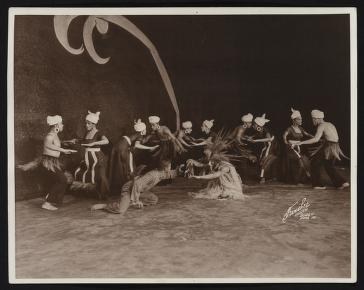
A stage scene with approximately twelve dancers arranged in two loose groups, seated and standing on what appears to be sandy or earthen ground. The dancers wear dark, draped costumes suggesting classical or mythological dress. A large decorative curved prop or set piece—possibly representing a ship's prow or architectural element—dominates the upper left, rendered in light tones against the dark background. The lighting is theatrical, with the figures emerging from deep shadow. The composition suggests a moment of stillness or tableau within a dramatic narrative, with dancers attending to or gathered around a central action. The photograph is grainy and the contrast is high, typical of early 20th-century theatrical documentation.
The dancing
The dancers are disposed in a naturalistic arrangement rather than formal corps de ballet lines. Some sit on the ground with bent knees; others stand or recline. The poses suggest weight distributed downward and inward, with torsos angled toward a shared focus. Arms are relaxed or gently curved rather than extended in classical positions. The overall frame is closed and gathered rather than open or lifted—the bodies occupy a compressed stage space. This arrangement and these postural qualities are inconsistent with the upright carriage and turn-out of classical ballet.
The dance depicted
The title *Ballet Fèdre* (or *Fedre*) refers to the classical myth of Phaedra, which was the subject of multiple twentieth-century ballet productions, most notably Aurel Milloss's *Fedra* (1931). The image shows a dramatic ensemble scene rather than a solo or pas de deux, and the costumes and staging suggest a modernist or expressionist approach to the mythological subject rather than Romantic or classical ballet vocabulary. The dancers' poses and the earthbound, psychologically charged tableau suggest a choreography concerned with dramatic storytelling and emotional weight rather than technical display.
How it was made
This is a photograph, likely a documentary still from a theatrical performance, printed in gravure or gelatin silver. The high contrast, grainy texture, and limited tonal range are consistent with 1930s theatrical photography, which often used available stage lighting and orthochromatic or panchromatic film. The image was likely shot from the house during performance or from rehearsal, and its survival in the Library of Congress collections suggests it was preserved as theatrical documentation rather than as art photography.
About this work
This photograph documents a dramatic ensemble tableau from a classical mythological ballet made in the early 1930s, a period when ballet was increasingly influenced by expressionist and modernist visual language. The work title references Phaedra, the classical tragic heroine, and the staging shows dancers in dark drapery arranged in a psychologically charged group rather than in the linearity and elevation of classical ballet technique. The photograph is a rare record of how twentieth-century choreographers staged classical mythology for the stage, and of the aesthetic shift from Romantic ballet toward a more earthbound, psychologically intense modernism.
How to look at it
Observe how the photographer has chosen a moment of stillness and congregation rather than a moment of movement or lift. The pose and arrangement tell a story—of gathering, grief, or deliberation—without requiring visible technical skill or virtuosity. Notice how the curved architectural prop frames the human figures below, creating a composition of weight and enclosure rather than openness. The theatrical lighting does not illuminate the dancers' faces clearly; instead it models their bodies as sculptural forms within a dramatic space.
The artist
Unknown. The photograph is part of the Library of Congress performing arts collections and was likely taken by a staff photographer or a theater's house photographer during performance.
The period
The 1930s saw European ballet under profound artistic and political pressure. Ballets Russes model had fractured; new choreographers in Paris, Berlin, and Italy were experimenting with modernism, expressionism, and Neue Sachlichkeit. Mythological subjects remained popular but were now treated with darker psychology and social realism. The USSR was developing Socialist Realism in dance; Germany and Italy were exploring neoclassical and expressionist forms. Fedra/Phaedra ballets appeared in multiple versions during this decade, often stressing tragic emotion over classical virtuosity. This photograph's aesthetic—dark, grounded, psychologically weighted—reflects those currents.
Where it lives
Photograph held by the Library of Congress Prints and Photographs Online Catalog. The image appears to be part of theatrical documentation from a European production, likely preserved as a record of dance practice and design rather than as an artwork in its own right.
Dance in this work
Questions about this work
Is this classical ballet?
Not in the Romantic or academic sense. While the title *Ballet Fèdre* claims the ballet category, the choreography and staging shown here reflect modernist and expressionist innovations of the 1930s. The dancers' posture, the earthbound grouping, and the emphasis on psychological atmosphere over virtuosity suggest a radical departure from classical technique.
Who choreographed this?
The catalogue record does not name the choreographer. The title suggests a connection to Aurel Milloss's *Fedra* (1931), but without additional documentation, attribution cannot be confirmed from the photograph alone.
What are the dancers wearing?
Dark, loosely draped costumes in the manner of classical or Greco-Roman dress. The fabrics appear heavy and the cuts intentionally unglamorous—consistent with 1930s expressionist and modernist theater aesthetics, which rejected the tutus and jeweled costumes of earlier ballet.
More dance artwork





