43 works in this view — arrow keys or swipe to move between them.
Dance in Art
La polka
Unknown artist
- Medium:
- Lithograph
- Dance:
- Polka
- Era:
- Late 1800s (Victorian Ballroom)
- Source:
- New York Public Library
- Rights:
- Public domain — free to use, share and adapt.
- Recorded as:
- public_domain
This print is a rare visual record of how the polka was actually danced in its heyday—the body position, the energy, the social setting, and the audience response all matter to historians of nineteenth-century ballroom practice. Because few people moved with quite the exaggeration shown here, the image also reveals how artists exaggerated for dramatic effect, making visible the culture's fascination with the dance as a symbol of modernity and social change. For dancers today, it is evidence that the polka was performed with far more dynamic, forward-traveling energy than many reconstructions suggest.
What you are looking at
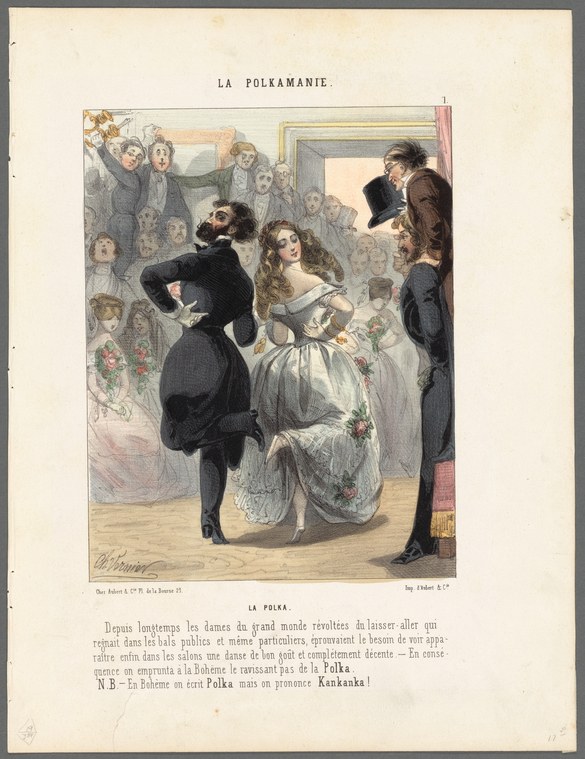
A young couple performs the polka in an elegant interior before an absorbed audience. The man, in dark formal dress with his jacket buttoned and one hand at his hip, leans back with dynamic energy; the woman in a white ball gown with a fitted bodice and full skirt that catches the movement turns toward him, their bodies angled and engaged. Behind them a crowd of fashionably dressed onlookers—men in dark coats, women in bonnets and elaborate dress—watches intently from a doorway and along the walls, their faces animated with interest. The setting is a grand reception room with classical architectural details: a gilt-framed doorway, paneled walls, and warm ochre and cream tones that suggest gaslight or candlelit evening. The composition captures a moment of spirited motion, with the dancers' weight transferred and the woman's skirt in full flare, suspended between steps.
The dancing
The couple stands in a closed ballroom hold characteristic of mid-nineteenth-century social dance: the man's right hand at the woman's waist, her left hand on his shoulder, their outer hands (his left, her right) joined and raised. Both bodies tilt away from the vertical in a forward-and-back opposition typical of the polka's traveling action, with the man's torso inclined back and the woman's forward. The woman's full skirt flares outward, indicating rapid turning or traveling steps; her posture is upright but animated. The man's stance shows clear weight transference—one leg extended, the other supporting—suggesting the characteristic polka hop or traveling step. The surrounding spectators are stationary, their attention fixed on the dancers, establishing a clear performer–audience divide.
The dance depicted
This lithograph depicts the polka, the energetic couple-dance that swept European and American ballrooms from the 1840s onward. The polka was a Bohemian dance in quick 2/4 time, characterized by a traveling hop-step that propelled couples rapidly around the floor in closed position. The image captures the essential performance style: the woman's full skirt in motion, the couple's shared forward-and-back tilt, and the gathering of spectators typical of a ballroom evening where new dances were still social events. The French title *La Polka* and the notation below (referencing Édition J. Arnout) suggest this was a popular print documenting a fashionable craze. The polka was danced by the middle and upper classes throughout Europe and North America by the 1850s–1880s, and prints like this circulated widely to promote and document the style.
How it was made
This is a hand-colored lithograph, a printing technique that allowed rapid reproduction of images for mass circulation. The artist drew the composition on lithographic stone, and the print was then hand-tinted with watercolor or gouache to add the flesh tones, fabric colors, and architectural detail visible here—the pale cream walls, the warm ochre tones, the red panel at the frame's edge, and the soft coloring of the figures' skin and clothing. Lithography was the dominant technology for popular ballroom prints in the mid-to-late nineteenth century because it combined the artist's fluid linework with the capacity to reach thousands of viewers cheaply. The hand-coloring made each impression unique and gave it a painting-like finish despite mechanical reproduction. This technique was essential to the spread of dance fashion and the documentation of ballroom life during the Victorian era.
About this work
This is a French lithograph from the mid-nineteenth-century ballroom, depicting the polka at the moment of its widest social success. The polka was one of the most important couple-dances of its era—a fast, hoppy Bohemian import that became the defining social dance of the 1850s and 1860s before being gradually displaced by the waltz. The print captures both the physical signature of the dance (the rapid traveling steps, the forward-and-back lean, the woman's skirt in motion) and its social context (the formal interior, the assembled audience, the sense of spectacle and novelty). The image belongs in a dance history collection because it is both a primary source for how the polka was performed and dressed, and a document of how dance was circulated and celebrated in visual culture: prints like this one taught people what the polka looked like, making them agents in the spread of the dance itself.
How to look at it
Note the moment the artist has chosen: not a static pose, but the instant of travel and turn, with the woman's skirt in full motion and both dancers' bodies tilted in the characteristic polka lean. This choice emphasizes the dance's energy and novelty—the artist wants you to feel the speed and lift of the hop-step. The surrounding spectators are crucial: they frame the dancers as a performance, and their rapt attention tells us this was still a remarkable sight, worthy of viewing and of circulating as a print. The woman's dress is as important as her body; the full skirt and tiny waist are ballroom fashion of the 1850s–1860s, and the skirt's motion is one of the primary visual pleasures the polka offered, making the woman's movement visible to the entire room. Look also at the architectural setting—the grand interior, the candlelit warmth, the gilt—which places the polka in the context of elite social aspiration, even though the polka itself was originally a popular dance.
The artist
The artist is not identified in the catalogue record. The print carries a publisher's mark (Édition J. Arnout, suggesting a French publisher active in the mid-nineteenth century) and the signature "G. Ranoul" or similar in the lower left, but the figure cannot yet be positively identified. The work belongs to a substantial tradition of French ballroom genre prints, in which artists documented fashionable dances, social scenarios, and courtship narratives for middle-class consumption. Such prints were often produced in series and sold individually or in bound collections.
The period
The polka entered European consciousness around 1844 and spread to Paris, London, and Vienna by 1845–1846. It was the subject of intense social and moral commentary: praised as modern, energetic, and democratic (a dance from the Bohemian countryside, not an aristocratic invention), but also condemned as undignified, sexually suggestive, and a threat to the stately waltz that had dominated the ballroom for decades. By the time this print was made—likely in the 1850s or 1860s, at the height of the polka's fashion—the dance had been fully domesticated into respectable ballroom practice. French lithographs of ballroom scenes were a major art form: artists including Honoré Daumier, Paul Gavarni, and others used ballroom scenes to satirize social pretension and to document the manners of the emerging middle class. This print is part of that tradition: it records a real social practice while also celebrating it as spectacle.
Where it lives
This work is held in the New York Public Library collection. It is listed as a lithograph from the holdings without further attribution or accession information in the catalogue record provided.
Dance in this work
Questions about this work
What is a polka, and when was it danced?
The polka is a fast couple-dance in 2/4 time, characterized by a hoppy traveling step, that originated in Bohemia (now the Czech Republic) in the early 1840s. It spread rapidly to Vienna, Paris, London, and North America and was the dominant ballroom dance of the 1850s and 1860s, before being superseded by the waltz and later dances. It is still danced today, particularly in Central European folk tradition and in some ballroom and country-western contexts.
How was the polka different from the waltz?
The waltz is a smooth, continuous turning dance in 3/4 time, with a gliding motion and minimal vertical movement. The polka is faster, in 2/4 time, with a pronounced hop or bounce that gives it upward energy, and the couple travels forward and back rather than spinning constantly. The polka was seen as more energetic, playful, and even slightly risqué, while the waltz was stately and graceful. By the 1870s, the waltz had regained dominance, and the polka was relegated to comic or folk contexts.
Why are there so many spectators watching?
In the mid-nineteenth-century ballroom, new or fashionable dances were often watched with intense interest, and accomplished dancers might perform for an assembled company as much as they danced socially. The polka was still relatively new and exciting in the 1850s and 1860s, so a skilled couple dancing it would attract an audience. The print captures this social ritual: the dancers are performers and style-setters, not just ordinary guests.
Why was the woman's skirt so important?
The full, multi-layered skirt of the 1850s–1860s was one of the primary visual attractions of the polka. The hoppy, traveling movement of the dance made the skirt flare and swirl dramatically, creating a spectacular visual effect. Fashion and dance were intimately connected; a dress's motion was part of its beauty and its appeal. The artist has emphasized the woman's skirt in this print because it was a major reason audiences found the polka visually thrilling.
More Polka artwork