49 works in this view — arrow keys or swipe to move between them.
Dance in Art · 1934
Federal Ballet
Unknown artist
- Source:
- Library of Congress
- Rights:
- Public domain — free to use, share and adapt.
- Recorded as:
- Public Domain
The Federal Ballet was part of the Federal Theatre Project (1935–1939), a New Deal cultural initiative, and this 1934 poster documents the ambitions of American artists to build indigenous ballet institutions rather than remain dependent on Russian imports. Ruth Page's prominence here marks the emergence of women choreographers as builders of ballet institutions, not merely dancers within them.
What you are looking at
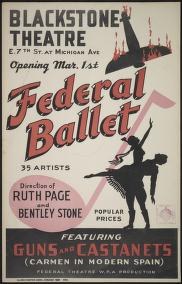
A theatrical poster for the Federal Ballet's opening performance on March 1st at the Blackstone Theatre. The composition is dominated by two female figures in classical ballet positions against a stylized background. The larger figure in the foreground is captured mid-leap or in an elevated arabesque, her body arched gracefully with one leg extended behind and arms positioned in balletic frames. She wears a pale tutu and pointe shoes. A smaller figure appears below or behind, also in classical ballet dress. The design employs bold Art Deco typography and a color palette of red, black, and cream, with geometric elements suggesting stage curtains or architectural forms. The poster announces 39 artists and features Ruth Page as a principal dancer, with additional text promoting modern Spanish dance elements.
The dancing
The dominant figure demonstrates the vertical line and extension characteristic of classical ballet, with the body elongated through a jump or sustained lift. Her port de bras shows the open, expressive arm positions of early 20th-century ballet pedagogy—neither the tight classical lines of the Cecchetti method nor the fluid modernism that would come later. The second figure maintains a similar classical frame. Both dancers are en pointe, and their positioning suggests lifted, buoyant movement rather than grounded or contemporary gestural vocabulary.
The dance depicted
This is classical ballet, most likely in the Romantic or early 20th-century theatrical tradition. The Federal Ballet was a short-lived American company, and the poster's emphasis on Ruth Page—a pioneering American choreographer and dancer—suggests the work occupied a transitional moment between European classical ballet and American modern dance innovation. The subtitle 'Carmin in Modern Spain' hints at thematic content drawn from Spanish cultural material, a common source for early modern ballet narratives. The style appears to be formal classical ballet rather than the character dance or folk movement that 'Spanish' material sometimes invoked.
How it was made
This is a lithographic poster, evident from the bold graphic design, flat color fields, and strong outlines characteristic of commercial theatrical printing in the 1930s. Lithography allowed rapid, inexpensive reproduction suitable for publicity and distribution. The design shows skilled handling of the medium's potential for dramatic contrast and integrated typography—text and image share the same formal language rather than competing. This was the dominant medium for theatrical promotion in this era.
About this work
A 1934 lithographic poster announcing the opening of the Federal Ballet at Chicago's Blackstone Theatre. The work captures American ballet at a crucial moment: the company was an early institutional effort to establish classical ballet in the United States, and its principal dancer Ruth Page was among the first American-born choreographers to claim the classical tradition as her medium rather than importing European choreographers wholesale. The poster's visual strategy—emphasizing the vertical lift and extension of the classical line while announcing modern thematic material—reflects the cultural negotiation the company undertook: rooting itself in established European forms while claiming American identity and contemporary relevance. The work belongs in a dance archive as evidence of how ballet was marketed and understood in Depression-era America.
How to look at it
Attend to the frozen moment of elevation: the artist has chosen to show the dancer at the peak of a jump or in sustained height, emphasizing weightlessness and control—the core achievement of classical ballet training. Notice how the lithographic line maintains clarity even at the edges of the figure; the medium allows crisp definition of the tutu, the line of the leg, and the arm frame. The contrast between the large foreground figure and the smaller background figure creates spatial recession and suggests ensemble or hierarchical relationships. Read the typography as design element, not mere text: 'Federal Ballet' and the theater name integrate with the figural composition rather than sitting outside it, which was a hallmark of modernist poster design.
The artist
The artist is not recorded in the catalogue. The poster's design quality and the Blackstone Theatre's status as a major Chicago venue suggest a professional theater designer, likely based in Chicago or brought in from New York. The graphic vocabulary—the Art Deco geometry, the bold sans-serif type, the streamlined figural representation—was the dominant commercial style of the period and would have been executed by a skilled commercial artist or in-house theater design department.
The period
In 1934, classical ballet in the United States was entering a period of rapid institutional growth. The Ballets Russes, under Sergei Diaghilev, had toured North America and kindled appetite for the form, but American companies remained rare. Ruth Page and other American dancers and choreographers were beginning to assert that ballet could be an American art form, not merely a European import. Simultaneously, American modern dance—under Martha Graham, Doris Humphrey, and others—was consolidating its rejection of ballet as insufficiently American or contemporary. This poster sits in that tension: it claims classical ballet as the company's foundation while reaching for modern and American thematic material. The reference to Spanish dance reflects the period's appetite for exoticized 'character' material; European ballet had long drawn on stereotyped national dances for divertissement. The Federal Theatre Project, which would fund the Federal Ballet from 1935 onward, represented New Deal investment in the arts and the first sustained federal support for American dance institutions.
Where it lives
The poster is held in the Library of Congress collections, identified in the record as coming from LOC's theatrical and performing arts archives. It is a commercial theatrical ephemera object—designed for display outside the theater and in publications—rather than a fine art print.
Dance in this work
Questions about this work
Who was Ruth Page and why is she featured on this poster?
Ruth Page (1899–1991) was an American dancer and choreographer who was among the first to build a career in classical ballet in the United States. By 1934, she was already known as a solo dancer and was beginning to establish herself as a choreographer. Her appearance on this poster announces her as a principal artist and draws on her growing reputation to market the company. Page went on to found the Ballet Russe de Monte Carlo's American contingent and later the Ruth Page Foundation, making her one of the most significant figures in American ballet history.
What was the Federal Ballet?
The Federal Ballet was part of the Federal Theatre Project, a New Deal program (1935–1939) that funded performing arts institutions during the Great Depression. The company was based in Chicago and represented an early effort to establish permanent, institutional classical ballet in America. It was short-lived, closing when the Federal Theatre Project ended in 1939, but it was historically significant as one of the first American ballet companies to operate outside the auspices of European impresarios.
What does 'Carmen in Modern Spain' mean?
This subtitle suggests the opening ballet was a new or reworked version of Bizet's opera Carmen, a popular source for ballet since the 19th century. The reference to 'modern Spain' likely indicates the choreography drew on Spanish flamenco or folk dance vocabulary, a convention of the era; European ballet often incorporated character dances from specific nations as local color or divertissements. The emphasis on 'modern' suggests the choreographer sought to refresh the material rather than restaging a classical version.
Is this a lithograph or another type of print?
This is a lithographic poster, as evidenced by the flat color fields, bold outlines, and integration of type and image characteristic of commercial lithographic printing. Lithography was the dominant method for theatrical posters in the 1930s because it was economical, allowed vibrant color, and produced durable, weather-resistant prints suitable for exterior display.
More dance artwork





