49 works in this view — arrow keys or swipe to move between them.
Dance in Art · 1956
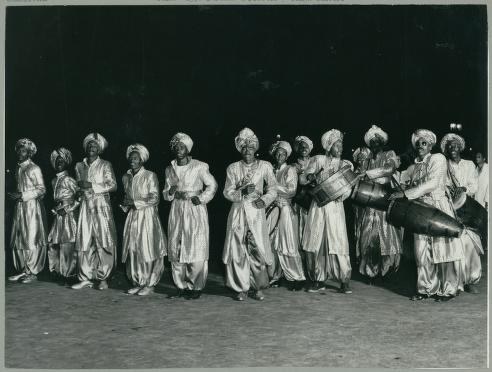
Conga Dancers.
Unknown artist
- Source:
- Library of Congress
- Rights:
- Public domain — free to use, share and adapt.
- Recorded as:
- Public Domain
This photograph documents how conga moved from Cuban social dance into American theatrical and commercial entertainment in the mid-twentieth century, and how that transition was marked by standardized costuming and staged formation. For historians of Caribbean diaspora dance in the United States, the image is evidence of how the dance was adapted, costumed, and presented to American audiences—a process that often obscured its origins and social function in favor of spectacle.
What you are looking at
A line of approximately twenty dancers stands against a dark background, arranged in a loose horizontal formation that suggests a choreographed group. All wear voluminous white or cream-colored costumes with balloon sleeves and high necklines; the garments are full-skirted and appear to be made of cotton or muslin, gathered at the waist. Most dancers wear white head wraps or turbans. The photograph is black and white, likely a studio or stage shot taken from a frontal vantage point. The dancers stand with arms at various positions—some at their sides, some raised, some bent—creating a lively, varied silhouette across the group. The formation is informal rather than strictly linear; dancers at different depths suggest the group occupies real stage space. The lighting is even, typical of mid-twentieth-century stage photography.
The dancing
The dancers are standing upright rather than in motion, though their arm positions and body angles suggest readiness or the freeze-frame of a moving sequence. Arms are held in a range of positions: some extended to the side, some raised to shoulder height, some bent at the elbow with hands at chest or hip level. The postures are generally open and expansive rather than contained. There is no visible close partnering or couple work; this is a group formation in which individuals occupy their own space. The weight appears distributed evenly through both feet, consistent with standing poses rather than active stepping.
The dance depicted
The title 'Conga Dancers' identifies this as a depiction of conga, a Cuban line dance in which participants form a chain, typically with hands on the shoulders or hips of the person in front, moving in a syncopated rhythm with characteristic three-step and kick pattern. However, the photograph shows the dancers in a static line formation rather than in the chain-holding posture and forward-moving motion conga requires. The costumes—particularly the white wraps and full skirts—suggest either a formal theatrical staging of conga or a representation of it in a revue or cabaret setting. The all-white dress may reflect 1950s performance conventions for tropical or Caribbean-themed numbers in American entertainment. The image captures the dancers in a moment of pause or assembly rather than active dance.
How it was made
This is a black-and-white photograph, likely taken from a negative original. The image shows the characteristics of mid-twentieth-century stage or studio photography: even overhead lighting, a plain dark backdrop, and the shallow depth of field typical of flash photography from that era. The print quality and grain suggest professional documentation, possibly a publicity still or performance archive photograph. The Library of Congress holding indicates this is part of an institutional collection, likely created for promotional, archival, or journalistic purposes rather than as fine art.
About this work
This photograph documents a staged performance of conga, a Cuban social and ballroom dance that became popular in the United States during the 1930s and remained a staple of nightclub entertainment and theatrical revue through the 1950s. The conga entered American ballrooms and performance venues via Cuba and Caribbean tourism, and by the 1950s was a familiar spectacle in nightclubs, orchestras, and theatrical productions—often performed in exoticized or Americanized versions that emphasized costume and spectacle over authentic social practice. The image is a professional photograph of dancers in costume, suggesting this is a theatrical or commercial production rather than social dancing. The 1956 date places it at the height of conga's popularization in mid-century American entertainment.
How to look at it
Notice the variation in arm positions across the line—some dancers reach outward, others hold arms bent or raised—suggesting a moment in a choreographed sequence rather than a static pose. The full skirts and the turbans or wraps are key to the theatrical presentation: they mark this as a produced entertainment spectacle rather than social dancing. The photograph's frontal, documentary approach treats the group as a unit to be catalogued and displayed, characteristic of how theatrical ensembles were promoted and archived in the 1950s. The dark background and formal staging suggest a professional venue or publicity context rather than casual or social dancing.
The period
The conga achieved peak popularity in the United States during the 1950s, a decade in which Caribbean and Latin American dances underwent intense commercialization in nightclubs, Broadway revues, and orchestral entertainment. The Mambo, Cha-Cha, and Rumba competed for attention alongside the conga, and all were subject to Americanization through costume, partnering conventions, and theatrical staging. By 1956, the conga was established in both social ballrooms (where it appeared in competition formats) and theatrical settings. The white costume with head wraps seen here reflects the tropical exoticism marketed to mid-century American audiences, a convention visible across nightclub and revue photography of the period.
Where it lives
The photograph is held by the Library of Congress, which indicates it was likely created for archival, journalistic, or promotional purposes rather than as autonomous artwork. The 1956 date appears in the catalogue record.
Dance in this work
Questions about this work
What is the conga and where did it come from?
The conga is a Cuban line dance that emerged in Havana in the early twentieth century, originating in Afro-Cuban carnival traditions. It became a popular social and ballroom dance, and by the 1930s had entered North American nightclubs and orchestral entertainment. Dancers form a chain, typically with hands on the shoulders or hips of the person in front, and move in a characteristic three-step-and-kick pattern to syncopated music. In theatrical and competition contexts, particularly in the 1950s, the conga was often performed with elaborate costumes and staged formations quite different from its social origins.
Why are all the dancers in white?
The all-white costumes, along with the turbans or head wraps, reflect 1950s theatrical conventions for representing the Caribbean or the 'tropics' to American audiences. This exoticized costume was typical of nightclub revues, Broadway productions, and other commercial entertainment venues of the period. It distinguished the performance as theatrical spectacle rather than social dance, and responded to mid-century American marketing of Caribbean culture as vacation fantasy and exotic entertainment.
Why are they standing still if this is supposed to be conga?
The photograph captures a moment of pause, assembly, or choreographed stillness—likely either before the dance begins or at a moment when the choreography holds the group in formation. Conga is fundamentally a moving dance, but theatrical versions often included static tableaux, formations, and pauses as part of their staged presentation. This image may be a publicity still taken between movements or a deliberate freeze-frame chosen to display the ensemble and costumes.
More dance artwork





