49 works in this view — arrow keys or swipe to move between them.
Dance in Art · 1920
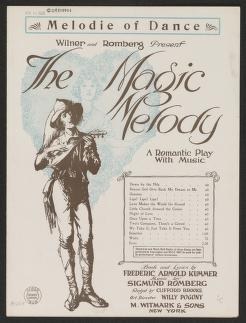
Melodie of dance
Unknown artist
- Source:
- Library of Congress
- Rights:
- Public domain — free to use, share and adapt.
- Recorded as:
- Public Domain
This image bridges two histories: the practice of Romantic ballet itself and the commercialization of dance through graphic design. For dancers and historians, it documents the living vocabulary of early twentieth-century professional ballet—the poses, the costumes, the aesthetic ideals—frozen in a moment of public promotion. For scholars of theater history and design, it exemplifies how lithography democratized access to performance culture, allowing theaters to reach mass audiences through economical, aesthetically sophisticated imagery.
What you are looking at
A single male figure dominates the composition, posed in a dramatic contrapposto against a plain background. He wears period costume—a fitted tunic or doublet with tights and what appears to be a feathered or plumed hat—suggesting early twentieth-century theatrical dress or a romanticized historical fantasy. His body is twisted at the torso, one leg extended in arabesque or attitude, the other supporting his weight, while one arm reaches upward in an expressive gesture and the other is positioned across the body. The figure's elongated, attenuated form and the tension in his pose suggest a moment of lyrical emotion or narrative climax. The image is printed text laid over the figure: it appears to be a playbill or program cover for a work titled *The Magic Melody*, identifying this as theatrical promotion material rather than fine art.
The dancing
The single dancer displays a classical ballet vocabulary: his supporting leg appears straight and engaged, while the working leg extends high behind him in what reads as an arabesque or attitude derrière. The upper body is lifted and rotated, creating a spiral through the torso. His arms frame the movement—one rising expressively while the other stabilizes the line—in a manner consistent with Romantic-era ballet port de bras. The pose suggests controlled virtuosity and emotional expressiveness rather than naturalism.
The dance depicted
This is almost certainly a Romantic ballet or an early twentieth-century theatrical ballet styled after Romantic conventions. The elongated silhouette, the dramatic single-figure composition, the arabesque position, and the emotional intensity of the gesture all point to the aesthetic vocabulary of mid-nineteenth-century ballet—works like *La Sylphide* or *Giselle*. The costume with its historical or fantastical styling and the theatrical context of a stage playbill confirms this is a professional theatrical dance work, not social dance. The title *The Magic Melody* suggests a narrative work with romantic or supernatural themes typical of the Romantic repertory.
How it was made
This is a lithographic print, evident from the characteristic line quality, the way type integrates with the drawn image, and the flat color palette. Lithography allowed for economical mass production of playbills and promotional posters, making this form of theatrical advertising accessible and widespread in the early twentieth century. The technique enabled the integration of text and image in ways that posters of this era exploited fully—the typography and the figure are conceived as a unified graphic composition rather than as separate elements. This was standard practice for theater promotion across Europe and America in this period.
About this work
This is a theatrical playbill or poster for *The Magic Melody*, a Romantic or Romantic-revival ballet from 1920. It promotes a professional stage work to the public through a lithographic image that synthesizes text and figure into a single graphic statement. The dancing male figure, posed in high Romantic ballet technique—the arabesque, the expressive port de bras, the elongated line—would have been instantly recognizable to audiences familiar with classical ballet. The work belongs in a gallery of dance imagery because it documents both how ballet was performed in the early twentieth century and, crucially, how it was *marketed*: the theatrical poster is a primary historical record of which works were in repertory, who danced them, and what values—virtuosity, pathos, narrative—the promoters wanted audiences to associate with the art form.
How to look at it
Observe the precise moment the artist chose: not a moment of balance or rest, but one of dynamic extension—the dancer caught mid-phrase, the body twisted and reaching. This is characteristic of Romantic ballet imagery, which valued the impression of weightlessness and emotional transport over static perfection. Notice how the attenuated proportions of the figure—the long lines, the delicate limbs—reinforce the aesthetic of the ballet itself. The text integrated into the composition is not incidental decoration: the dance poster as a form merged commercial typography with fine drawing, and learning to read the image means learning to see how both worked together to create desire for the spectacle.
The period
In 1920, Romantic ballet was not a historical curiosity but a living tradition. The great Russian Imperial Ballet companies, which had preserved and refined the Romantic repertory throughout the late nineteenth century, were at the height of their international influence; Diaghilev's Ballets Russes, founded in 1909, had already begun its experiments with modernism and primitivism, yet Romantic works remained central to the repertory. In Western Europe and America, ballet was experiencing a renaissance of professional performance after decades of relative eclipse, with many new works created in Romantic idiom alongside modernist experiments. The theatrical poster, as a form, was at its artistic peak in this era—Art Nouveau and Art Deco designers were competing to make playbills and posters objects of aesthetic ambition as well as commercial necessity.
Where it lives
This lithographic print comes from the Library of Congress collections. It is a theatrical playbill or poster—a form of ephemeral promotional material produced in quantity for public distribution. Such materials survive unevenly, making them valuable historical documents of what was actually performed and how it was publicly presented.
Dance in this work
Questions about this work
Is this a real ballet or a fictional one?
*The Magic Melody* appears to have been a real theatrical work performed in 1920, as evidenced by the professional production credits printed on the poster. However, it does not appear to have entered the standard modern repertory or achieved lasting fame. Early twentieth-century theaters produced many works that were performed for a season or two and then vanished from the stage, leaving only playbills and newspaper reviews as evidence of their existence.
How can you tell this is a lithograph?
Lithography produces a characteristic visual quality: the way the line flows, the integration of type and image on the same printing surface, the limited but consistent color palette, and the slight irregularities in ink coverage that distinguish it from later photomechanical processes. The grainy texture visible in areas of solid tone is also typical of lithographic crayon work. By 1920, lithography had been the dominant technology for theater posters for decades.
What does the arabesque pose tell us about the dancer?
The arabesque is one of ballet's fundamental vocabulary positions, requiring significant flexibility, strength, and control. Its presence in the promotional image suggests the work showcased technical virtuosity and that the dancer was trained in classical ballet technique. The artist's choice to show this specific pose—rather than a moment of stillness or a different movement—emphasizes the athletic and expressive capacities that defined professional ballet performance.
More dance artwork





