49 works in this view — arrow keys or swipe to move between them.
Dance in Art
L'Ag'Ya | Notes on Dunham's Work | Articles and Essays | Selections from the Katherine Dunham Collection | Digital Collections
Unknown artist
- Source:
- Library of Congress
- Rights:
- Public domain — free to use, share and adapt.
- Recorded as:
- Public Domain
This photograph documents Black theatrical dance in the early-to-mid 20th century at a moment when such documentation was rare in mainstream American culture. The Dunham Collection itself represents a deliberate effort to preserve and celebrate the work of Katherine Dunham and her contemporaries, and this image is part of that archival project. For dance historians and performers, the photograph offers concrete visual evidence of technique, aesthetic, and the virtuosity of dancers working in theatrical forms that blended modern dance, jazz, Caribbean, and African traditions.
What you are looking at
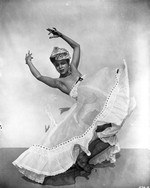
A solo female dancer is captured mid-leap in this black-and-white photograph, her body suspended against a neutral background in a moment of balletic flight. She wears a light, gauzy skirt that billows around her in the air, creating a luminous halo effect; her hair is styled in a period fashion typical of early-to-mid 20th century theatrical dance. Her arms are extended in an open, expressive frame—one arm reaching upward and the other extended to the side—creating a sense of weightless elevation and joy. The photographer has chosen an instant of maximum height and extension, freezing a moment that emphasizes the dancer's control and the ethereal quality of her movement. The absence of any setting or floor beneath her creates an illusion of pure elevation, a technique that focuses attention entirely on the body and its capabilities.
The dancing
A single dancer occupies the frame in a vertical axis. Her weight is fully committed to the leap; her legs are extended in flight beneath her, with pointed feet suggesting trained technique. Her torso is held upright and graceful, her head lifted. The arm positions are notably open and expressive rather than formally classical—suggesting a modern theatrical idiom rather than strict academic ballet. Her movement has a lyrical, upward-reaching quality, with the extended arms framing the body's ascent. The silhouette and carriage speak of years of trained movement.
The dance depicted
This appears to be a moment from early-to-mid 20th century theatrical dance, most likely modern dance or a jazz-inflected theatrical form rather than classical ballet, based on the arm styling and the overall aesthetic. The dancer's technique—the quality of the jump, the elongation of the line, the expressive upper-body port de bras—suggests training in a rigorous system, but the open, reaching quality of the movement suggests the modern or contemporary idiom that emerged in the early 20th century. The image records a moment of exuberant, virtuosic elevation. Without additional documentation, the specific work cannot be identified, but the style and photographic technique place it in the theatrical dance world of the 1930s–1950s.
How it was made
This is a black-and-white photograph, likely from the 1930s–1950s based on the photographic quality, printing technique, and fashion. The photographer has employed a technique of lighting and framing that isolates the figure against a plain background, a common practice in dance photography of the era. The sharp focus and the ability to freeze mid-leap suggest a fast shutter speed and controlled studio lighting. The ethereal quality of the gauzy skirt and the luminous print quality indicate careful darkroom technique or printing process. As a photograph from a major institutional collection, this would have circulated among dance professionals, students, and audiences with access to archives or exhibitions.
About this work
This photograph documents a moment of theatrical dance in the mid-20th century, capturing a solo leap that exemplifies the virtuosity and expressive reach of modern or jazz-influenced theatrical dance of the era. The image is part of the Katherine Dunham Collection at the Library of Congress, which holds extensive documentation of Dunham's own practice and the wider African American and Caribbean dance traditions she championed and developed. The photograph represents the kind of documentation—professional, elegant, and focused on the body's capabilities—that was used to circulate images of Black dancers' artistry during a period when such representation was limited in mainstream American media.
The work belongs in a gallery of dance in art because it represents both a specific moment in dance history and the power of the photograph as a tool for celebrating and preserving dance. It is a record of a particular body, a particular moment, and a particular aesthetic—the reach and grace of theatrical dance as it was being defined and redefined in the mid-20th century.
How to look at it
Attend to the moment the photographer chose: the instant of maximum height and suspension, a fraction of a second that conveys the dancer's command of her body and the weightlessness that is the hallmark of virtuosic leap work. Notice the relationship between the extended arms and the upward momentum of the body—this is not a classical ballet position but an expressive, modern one. The billowing skirt creates a visual echo of the body's upward trajectory. The plain background is not incidental; it was a deliberate choice to isolate the body and its movement from any distraction, a convention that emerged in theatrical dance photography of the era.
The artist
The photograph is held in the Katherine Dunham Collection at the Library of Congress. Dunham (1909–2006) was a dancer, choreographer, and anthropologist who developed a distinctive technique blending Caribbean and African dance forms with ballet and modern dance. She was a pioneering figure in bringing Black dancers and Caribbean dance traditions to the concert stage and to Hollywood film. Her collection at the Library of Congress includes photographs, manuscripts, films, and other materials documenting her own work and the wider world of African American and Caribbean performance in the 20th century. The identity of the photographer is not recorded in the catalogue.
The period
This photograph dates from a moment when theatrical dance was expanding in scope and audience. The 1930s–1950s saw the flourishing of modern dance as an American art form, pioneered by figures like Martha Graham, Lester Horton, and Katherine Dunham. Dunham's work was distinctive in centering Caribbean and African dance vocabularies as sources of concert-stage technique. Simultaneously, jazz and vernacular forms were increasingly being formalized into theatrical idioms. The photograph itself reflects the professionalization of dance documentation during this period—the deliberate use of photography to document and circulate images of dancers' work, a practice that was especially important for Black performers navigating limited access to mainstream media representation.
Where it lives
The photograph is held in the Katherine Dunham Collection, Performing Arts Reading Room, Library of Congress. The collection is available in the Library of Congress Digital Collections and includes photographs, films, manuscripts, and other materials related to Dunham's work and the broader history of African American and Caribbean dance in the 20th century.
Dance in this work
Questions about this work
Is this Katherine Dunham?
The photograph is held in the Katherine Dunham Collection, but the dancer is not identified in the catalogue record. It may or may not depict Dunham herself; the collection includes photographs of many dancers who worked with or were influenced by her. Without additional documentation, the dancer's identity cannot be confirmed.
What dance form is this?
The photograph documents what appears to be concert-stage theatrical dance, likely modern or jazz-influenced, from the mid-20th century. The technical control, the expressive arm styling, and the quality of the leap suggest training in a rigorous system. The movement does not appear to be classical ballet, and the context of the Dunham Collection suggests a connection to modern dance, jazz, or Caribbean-influenced forms.
When was this photo taken?
The catalogue record does not provide a date. Based on the photographic technique, film stock, the fashion of the dancer's hair and costume, and the style of theatrical dance photography, the image likely dates from the 1930s–1950s.
Who took this photograph?
The photographer is not identified in the catalogue record. Dance photography of this era was often created by professional or semi-professional photographers commissioned to document theatrical performances and rehearsals, but the specific identity of this photographer is unknown.
More dance artwork





