49 works in this view — arrow keys or swipe to move between them.
Dance in Art · 1901
Tango
Unknown artist
- Source:
- Library of Congress
- Rights:
- Public domain — free to use, share and adapt.
- Recorded as:
- Public Domain
This is one of the earliest documentary images of Argentine tango in its European context, capturing the dance at the moment of its transformation from a Buenos Aires vernacular form into a Paris salon practice. For dance historians, it is crucial evidence of how tango was understood, taught, and performed in elite European society in 1901—the hold, the posture, the formal setting, and the integration into fashionable social life. For art historians, it exemplifies the chromolithographic poster tradition and the role of commercial printing in disseminating dance instruction and establishing cultural fashion.
What you are looking at
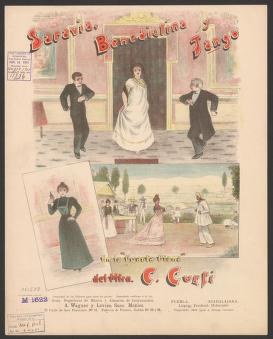
This is a chromolithographic poster or broadside advertising tango, likely from a dance instruction manual or promotional publication. The composition is divided into two registers: an upper panel shows three figures in formal evening dress—two men in tailcoats and a woman in a white gown—posed in a parlour or ballroom setting with classical architectural details (doorway, decorative wall); a lower panel depicts an outdoor garden party scene with multiple figures in Edwardian dress, some seated and some standing, suggesting a social gathering. The upper scene isolates the dance itself, presenting it as a formal, intimate technique worthy of study. The lower scene contextualizes tango within fashionable society. The hand-coloured or printed palette employs soft pinks, creams, and earth tones characteristic of early 1900s popular printing. French text at the top reads 'Service d'Argentines Tango' and credits the image to 'de Mme C. Everit' (or similar), suggesting this may be instructional material or promotional literature distributed by a dance teacher or salon.
The dancing
The central couple in the upper panel are positioned in what appears to be a closed ballroom hold: the woman faces the man, her body angled, one arm raised. The man's posture is upright and formal. Their relative positions and the woman's trailing skirt suggest the characteristic close embrace and forward-moving progression of tango, though the image captures a stationary pose rather than mid-movement. The two flanking male figures appear to be observers or demonstrators, adding to the instructional quality. The bodies are elongated and elegant in the Art Nouveau manner typical of early 1900s commercial illustration.
The dance depicted
This is explicitly Argentine tango, as indicated by the French title and the Edwardian-era dating. The image is instructional or promotional material, likely part of a dance manual or studio advertisement. Tango was a relatively new and fashionable dance from Argentina in 1901, having recently arrived in Paris and beginning its penetration into European salon culture. The formal dress, the isolated upper panel showing technique, and the social context below all reflect tango's status as a highly codified social dance taught in studios and danced in fashionable society. The close embrace and the man's leading posture are consistent with early Argentine tango as it was understood in Paris.
How it was made
This is a chromolithograph—a colour lithographic print produced by printing multiple stone plates in succession, each contributing one colour layer. The technique allowed for soft tonal gradations, delicate rendering of fabrics and architectural detail, and relatively affordable mass production. Chromolithography was the dominant technology for colour commercial printing in 1901 and was widely used for posters, sheet music covers, instructional materials, and popular ephemera. The presence of printed text and the poster's format suggest it was produced for distribution to dance studios, salons, or as part of a published instructional series. The quality of the printing and the precision of the composition indicate a professional commercial printer.
About this work
This is an early chromolithographic advertisement or instructional image for Argentine tango, dated 1901 and credited to a Mme C. Everit. It presents tango at the moment of its emergence as a fashionable social dance in Paris, where the craze had recently begun following the arrival of the style from Buenos Aires. The image serves both as technical instruction (the formal upper register) and social documentation (the garden party below), showing tango not merely as a technique to be learned but as a marker of modern, cosmopolitan sociability.
The work is significant as a primary document of tango's early European reception and as evidence of how the dance was being taught and promoted in the early 1900s. It shows tango already codified into an instructional system within two years of its first documented appearance in Paris, indicating the speed with which the style was absorbed into bourgeois culture.
How to look at it
Attend first to the upper register: note the woman's body position relative to the man, the angle of her arm, the orientation of their bodies. This is a moment of stillness chosen to display the hold and frame of the dance rather than a frozen moment of stepping. Then look at the lower scene: the scattered groupings, the garden setting, the presence of spectators—this tells you that tango was understood as a social spectacle, a practice of elite leisure, not a folk form. The French title and the formal printing signal that this is an object of instruction and promotion, aimed at a paying public in Paris. The split composition—technique above, social context below—was a common pedagogical strategy in dance manuals of the period.
The artist
The credit reads 'de Mme C. Everit' or similar, suggesting a woman dance teacher or studio operator who may have authored the instructional text or sequence. The print was produced by a commercial lithographic firm, not identified in the catalogue record. No further information on Mme Everit or the printer is available from the record.
The period
In 1901, Argentine tango had only recently arrived in Paris, carried by migrant musicians and dancers from Buenos Aires. The dance was initially perceived as scandalous and low-class—associated with brothels and lower-class dance halls—but by the early 1900s it was being rapidly assimilated into elite and bourgeois social practice, taught in studios, and danced at fashionable social events. This coincided with a broader European fascination with 'exotic' dances from the Americas and the colonies. The chromolithographic poster was the dominant medium for dance instruction, promotion, and social communication in 1901, and this image sits within a massive popular production of tango materials—instruction manuals, sheet music, photographs, and promotional images—that flooded Paris and Europe between 1900 and 1910. The Edwardian fashion visible in the dress and the Art Nouveau aesthetic of the composition are consistent with this dating.
Where it lives
The work is held in the Library of Congress, accessed through their digital collections. It is catalogued as a chromolithograph or colour print, dated 1901, and is part of the Library's collection of dance instruction materials, popular ephemera, and early tango documentation. The source indicates it was produced in France and distributed for instructional or promotional purposes.
Dance in this work
Questions about this work
Is this the earliest image of tango?
Not definitively—tango arrived in Paris around 1900, and several images and documents from 1900–1902 exist. But this is among the earliest systematic instructional images, showing tango already codified for teaching within a year or two of its arrival in Europe. Earlier images of tango in Buenos Aires do exist but are rarer.
What does the hold tell us about tango in 1901?
The closed ballroom frame visible here—the partners facing one another with arms connected—is consistent with the formal European ballroom style that tango was rapidly adopting as it moved upmarket. The tight embrace characteristic of Argentine tango is not fully visible in this formal pose, but the basic frame is recognisable and shows tango being regularised according to European ballroom conventions.
Who was Mme C. Everit?
She is identified as the author or proposer of this instructional material, likely a dance teacher or studio owner in Paris. No other information is available from the catalogue record. She may have been among the early European teachers of tango, though she is not widely documented in surviving dance histories.
Why is this a chromolithograph rather than a photograph?
Chromolithography was the mass-production colour printing technology of 1901. It was cheaper and faster than colour photography for instruction and promotion, allowed for stylised and clarified rendering of poses and dress, and was the standard medium for dance posters, sheet music, and instructional materials. Photograph-based illustration existed but was less common in popular dance materials.
More dance artwork





