49 works in this view — arrow keys or swipe to move between them.
Dance in Art · 1968
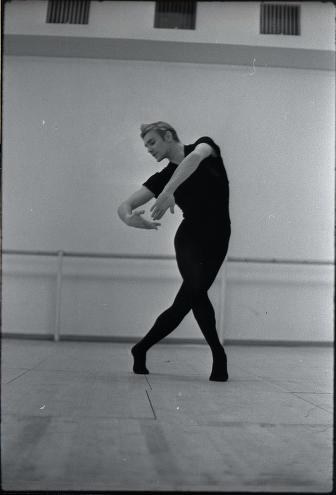
First among Equals. Vladimir Vasiliev.
Unknown artist
- Source:
- Library of Congress
- Rights:
- Public domain — free to use, share and adapt.
- Recorded as:
- Public Domain
Vasiliev was one of the most significant male ballet dancers of the twentieth century, celebrated for his technical perfection, dramatic intensity, and partnership work with Ekaterina Maximova. This photograph documents the physical reality of Soviet classical ballet at a moment when Soviet training and performance had become the global standard, influencing how male ballet dancers trained and moved worldwide. For historians of dance and particularly of Bolshoi Ballet, this image preserves the physical evidence of one of the era's defining artists.
What you are looking at
A male dancer in black practice attire stands alone in a studio with a pale wooden floor and white walls, photographed in black and white. He is captured mid-movement in a classical balletic pose, with his body twisted at the torso and his arms positioned asymmetrically—one arm bent inward toward his chest while the other extends outward. His weight appears centered but dynamic, suggesting the moment between steps rather than a fixed position. The studio setting is minimal and austere, with a pale horizontal stripe visible on the wall behind him and what appears to be ventilation grilles at the top. The lighting is even and bright, typical of a dance studio photographed under studio conditions, which reads as a documentary or promotional photograph rather than a theatrical image.
The dancing
A single male dancer occupies the frame, clearly captured at a moment of rotation or directional change. His pelvis is squared forward while his torso twists sharply, creating a spiral line through his body—a characteristic shape in classical ballet's turns and sustained rotational poses. His arms are held with control but without the full extension or ethereal quality of Romantic-era ballet; instead there is an angular, almost contemporary quality to the arm placement. His legs are straight and aligned, weight seemingly in a demi-plié or through-the-foot standing position. The musculature visible in his arms and legs suggests both strength and training in a codified technique.
The dance depicted
This is a photograph of classical ballet, most likely Russian ballet of the mid-twentieth century given both the date (1968) and the identification of Vladimir Vasiliev as the subject. Vasiliev was a principal dancer with the Bolshoi Ballet, one of the most celebrated male dancers of the Soviet era. The pose suggests a moment from a classical or neoclassical variation—the twisted, rotational line is characteristic of male ballet vocabulary in the Vaganova/Soviet tradition, which emphasized épaulement (shoulder and upper-body articulation), clean geometry, and masculine control. The photograph appears to have been taken during rehearsal or in a studio setting rather than during a performance.
How it was made
This is a black-and-white photograph, almost certainly taken with film stock standard to dance documentation in the 1960s. The clarity and even lighting suggest studio conditions, likely with multiple light sources to eliminate shadow and ensure the body's line is legible. The photograph's technical quality and documentary purpose indicate it was made by a professional photographer, possibly for Bolshoi Ballet archives or Soviet state media documentation. The choice of black and white removes all distraction from line and form, emphasizing the geometry of the pose in a way consistent with how dance bodies were photographed for technique study and promotional purposes during this period.
About this work
This is a photograph of Vladimir Vasiliev, one of the Bolshoi Ballet's greatest male principals, photographed in a studio in 1968 at the height of his career. The image documents a moment of classical ballet in the Soviet tradition—a twisted, rotational pose that showcases the épaulement and controlled muscularity that defined Russian male ballet technique. The stark studio setting and black-and-white medium isolate the body as an object of study, making the photograph both a document of individual artistry and a record of a particular moment in twentieth-century ballet history when Soviet dancers dominated the international stage.
How to look at it
Note the twisted spiral of the body—how the pelvis faces forward while the torso rotates, and how the arms articulate that rotation without becoming decorative. This épaulement (shoulder and upper-body movement) is the signature of Russian ballet and distinguishes it visually from Western European classical ballet, where the body line tends to be longer and less articulated through the torso. The photograph is taken at a moment of stillness within movement, likely a pose held briefly during a step or turn. Watch how the weight seems to travel through the legs into the floor; there is no lightness or lift suggested here, but rather grounded, muscular control.
The artist
The photographer is not recorded in the catalogue. The photograph bears the hallmarks of mid-twentieth-century Soviet dance documentation, likely produced by the Bolshoi Ballet's photographic archive or by state-sanctioned media. Such photographs were created for multiple purposes: documentation of rehearsal and technique, promotion of the company and its dancers, and as study material for other dancers and choreographers. The professional execution and studio setting suggest this was an official documentation rather than an incidental snapshot.
The period
In 1968, Soviet ballet was at the apex of its international influence. The Bolshoi and Kirov ballets had been touring the West since 1956, and dancers like Vasiliev, Maximova, and Mikhail Baryshnikov were becoming international celebrities. The Soviet emphasis on the male dancer as a virtuoso—strong, technically flawless, and dramatically commanding—represented a fundamental shift from early twentieth-century European ballet, where the ballerina had dominated. This photograph, taken during Vasiliev's peak years, documents that moment when Soviet male ballet had redefined what was possible for the male body in classical ballet. Concurrently, Western ballet was beginning to fragment into competing aesthetics (Balanchine's neoclassicism, Ashton's lyricism, the emerging contemporary ballet), but the Soviet classical tradition remained the dominant technical standard.
Where it lives
The photograph is held by the Library of Congress. It appears to be part of a larger documentary archive of Soviet ballet and international dance in the mid-twentieth century. The source is listed as 'loc' (Library of Congress), suggesting it entered the American public archive, possibly through a gift or acquisition related to international cultural exchange during the Cold War period.
Dance in this work
Questions about this work
Who was Vladimir Vasiliev?
Vladimir Vasiliev (1940–2018) was a principal dancer with the Bolshoi Ballet and one of the most celebrated male ballet dancers of the twentieth century. He was known for his technical perfection, dramatic intensity, and long partnership with ballerina Ekaterina Maximova. He danced leading roles in the classical repertory and in new works by Soviet choreographers, and his performances helped establish the Soviet male dancer as a virtuoso capable of both technical display and dramatic characterization.
What is épaulement?
Épaulement is the articulation of the shoulders, upper back, and head in relation to the lower body. It is characteristic of Russian ballet training (the Vaganova method) and is visible in this photograph in the way Vasiliev's torso twists and his arms position relative to his pelvis. This technique distinguishes Russian ballet from other classical traditions and gives it a distinctive look of controlled rotation and upper-body expressiveness.
Was this photograph taken during a performance?
No. The studio setting, even lighting, and the pose itself all suggest this was a studio photograph, likely taken during rehearsal or as a formal documentation photograph. It was not captured during a stage performance.
Why is this photograph in black and white?
Color film was available in 1968, but black-and-white photography remained the standard for dance documentation because it removed color distraction and made the body's line and geometry maximally legible. This was both a practical choice for technique study and an aesthetic convention of the period.
More dance artwork





