49 works in this view — arrow keys or swipe to move between them.
Dance in Art · 1924
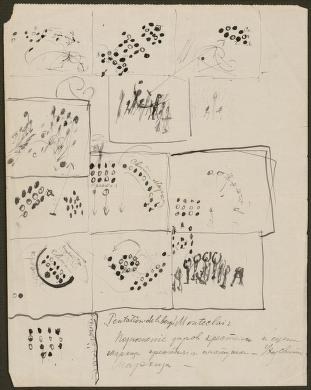
Choreographic notes for Bronislava Nilinska's Les Tentations de la Bergère, 1924
Unknown artist
- Source:
- Library of Congress
- Rights:
- Public domain — free to use, share and adapt.
- Recorded as:
- Public Domain
This document captures the choreographic working method of one of the twentieth century's most important ballet makers at the height of the Ballets Russes era. For historians and dancers, it demonstrates how complex ensemble choreography was actually created, recorded, and transmitted before video documentation—a crucial gap in dance history. It also reveals the labor of supporting figures (rehearsal directors, ballet masters, assistants) whose work was essential but rarely archived or credited.
What you are looking at
This is a page of choreographic notes—a working notation system for recording dance movement and stage formations. The sheet shows multiple small diagrams arranged in a grid, each depicting dancers viewed from above as clustered dots or small circles with directional marks. Some diagrams show tight groupings of figures; others scatter them across the page. The notation appears to document spatial relationships, group configurations, and possibly directional orientation of dancers on stage. A hand-written note in what appears to be Russian Cyrillic script runs along the bottom of the sheet, suggesting these are working notes by a company member or choreographer's assistant recording the piece during rehearsal or for future reference.
The dancing
The dancers are represented schematically as dots or simple circle-marks, not drawn naturalistically. No individual body position, arm hold, or footwork is legible from these abstract marks. The diagrams seem to record only spatial positioning and group size—how many dancers occupy a space, their rough distribution on stage, and occasionally a directional indication. This is notation for large-scale stage blocking and ensemble formations rather than individual technique or movement quality.
The dance depicted
These are rehearsal or documentation notes for Bronislava Nijinska's *Les Tentations de la Bergère* (The Temptations of the Shepherdess), a 1924 ballet. Nijinska was a major choreographer of the Ballets Russes era and known for innovative group choreography. The diagrams appear to be a record system developed to track dancer positions and formations during complex ensemble scenes—likely the work of a ballet master, rehearsal pianist, or assistant documenting the piece for repeatability and teaching. The notation method is pragmatic rather than a standardized system like Labanotation, suggesting these are working notes created for immediate company use.
How it was made
This is a pen-and-ink drawing or notational sketch on paper, made by hand during or immediately after rehearsal. The medium allowed quick, repeatable diagramming—circles and marks could be drawn rapidly and revised. The Cyrillic inscription suggests this sheet was produced within a Russian or Russian-émigré company context (the Ballets Russes was based in Paris but drew heavily on Russian dancers and staff). The sketch-like quality and working notation make this a document of the creative process rather than a finished artwork for public viewing.
About this work
This is a working choreographic document from one of the most innovative periods of twentieth-century ballet. Nijinska's ballets were marked by radical ensemble work, geometric formations, and a move away from the solo-dominated Romantic ballet tradition. *Les Tentations de la Bergère* was part of the Ballets Russes output, a company that revolutionized modern dance and theater. This page reveals the practical means by which complex group choreography was recorded, taught, and preserved in an era before video or standardized notation systems. It shows dance as a collective, spatial art form negotiated through working notes and collaboration.
How to look at it
Study how the density and groupings of dots change across diagrams. Notice which formations recur and which appear once—this suggests a structure of repeated refrains and variations, typical of ballet composition. The occasional directional marks (small lines or arrows attached to clusters) may indicate facing, entry, or exit direction. The Cyrillic text at the bottom likely keys the diagrams or notes corrections and timing. This is a document designed for insiders—a dancer or rehearsal director reading this could reconstruct positions and transitions, but an outsider needs to learn the notation system first.
The artist
The hand is not identified in the record. The notes were likely made by a member of Nijinska's company—possibly a rehearsal director, ballet master, or the choreographer herself. Nijinska (1891–1972) was one of the few major choreographers of her era and created over 30 ballets. She was known for her interest in geometric abstraction, classical technique reformed through modern sensibility, and complex group work that challenged the hierarchies of nineteenth-century ballet.
The period
The Ballets Russes (1909–1929) was at its height in 1924. Nijinska had recently become the company's principal choreographer after Vaslav Nijinsky's retirement. The period was marked by formal experiment: Cubism and Constructivism influenced stage design and movement vocabulary. *Les Tentations de la Bergère* premiered in May 1924 with music by Jean Taudin-Chabot and sets by Juan Gris, placing it at the intersection of modern visual art and dance. Choreographic notation remained informal and proprietary—each company developed its own systems. The Russian Imperial Ballet had used notation, but Western ballet companies relied on memory, rehearsal masters, and documents like this one.
Where it lives
The source is listed as the Library of Congress. The exact holding collection within LC is not recorded, nor is an accession number or catalog identifier provided in the record. The sheet appears to be part of archival materials related to the Ballets Russes, possibly acquired as part of a larger collection of company papers, designs, or dancer files.
Dance in this work
Questions about this work
How did choreographers document dance before video?
Companies used working notes like this one—schematic diagrams, written descriptions, and the memory of trained rehearsal directors. Each company often developed its own notation shorthand. These documents were kept in company archives and used to revive ballets or teach new dancers the roles. Standardized notation systems like Labanotation came later, in the 1950s. Most ballet was preserved through the bodies of dancers who learned it and passed it to the next generation.
Why are the dancers drawn as dots, not figures?
This notation is recording only spatial information—where dancers stood on stage, their proximity, grouping, and direction. Individual body position, arm placement, and movement quality are recorded elsewhere, if at all, or held in the dancers' memories. Dot notation is fast to draw and easy to revise, making it practical for active rehearsal. It is a spatial map, not a movement score.
What was *Les Tentations de la Bergère*?
A one-act ballet choreographed by Bronislava Nijinska for the Ballets Russes in 1924. The title translates as *The Temptations of the Shepherdess* and suggests a plot drawn from Rococo pastoral tradition. The music was by Jean Taudin-Chabot and the set by Juan Gris, the Cubist painter. It was part of the company's experimental output and reflects Nijinska's interest in formal, geometric group choreography.
Is this page Nijinska's own handwriting?
The record does not identify the hand. It could be Nijinska's own notes, but more likely it was made by a ballet master, rehearsal director, or company member under her direction. Such documents were collaborative products of the choreographic process, made by multiple people and not necessarily signed or attributed to a single author.
More dance artwork





