49 works in this view — arrow keys or swipe to move between them.
Dance in Art · 2025
The (Effortless) Now: Dances of Erick Hawkins and Lucia Dlugoszewski
Unknown artist
- Source:
- Library of Congress
- Rights:
- Public domain — free to use, share and adapt.
- Recorded as:
- Public Domain
Hawkins's influence on postmodern and contemporary dance is foundational but often overshadowed by Graham and Balanchine; this image is direct evidence of his movement philosophy in practice. The collaboration between Hawkins and Dlugoszewski—composer and choreographer in true partnership—represents an approach to avant-garde dance that was influential but is now rarely performed, making photographs like this essential to understanding mid-century American dance innovation.
What you are looking at
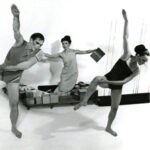
Four dancers in mid-leap against a white background, captured in a moment of weightless suspension that suggests contemporary modern dance rather than classical technique. The composition is dynamic and asymmetrical: two figures occupy the upper portion of the frame, their bodies arched and extended; two others below them create depth and movement through the space. The dancers wear simple, minimal costumes—dark leotards or fitted clothing that allows full visibility of the body line. Their hair, skin tones, and body types are varied. The lighting is even and bright, characteristic of studio photography, with no shadow or scenery to anchor the figures to ground. The overall effect is one of effortlessness and flight, as the title suggests—the bodies appear buoyant, the musculature engaged but not strained, the spatial relationship between the dancers carefully composed to suggest harmony rather than competition or narrative drama.
The dancing
All four dancers are airborne, with extended limbs and elongated spines that suggest trained contemporary or modern dance technique rather than ballet vocabulary. One dancer (upper left) arches backward with arms raised; another (upper right) extends forward with one leg lifted high; the lower two show varied positions—one with torso twisted, another with limbs gathered. The spacing between them is deliberate: they do not touch or form a recognizable ballroom or classical ensemble frame, but instead occupy separate zones of the photograph's space. The weight distribution in each body suggests controlled suspension rather than explosive jumping.
The dance depicted
This is unmistakably modern dance or contemporary dance, most likely from the mid-20th-century American lineage. The title references Erick Hawkins and Lucia Dlugoszewski, two central figures in American postmodern dance: Hawkins was a student of Martha Graham who developed his own technique emphasizing ease, efficiency, and natural movement (he called his approach 'the body is a clear medium'), and Dlugoszewski was an avant-garde composer who collaborated closely with choreographers. The image's emphasis on effortlessness, the suspension of weight, and the absence of strain align directly with Hawkins's aesthetic philosophy and the experimental concert dance of the 1950s–60s. The four dancers moving independently but in spatial relationship suggests the kind of ensemble work typical of that era's non-narrative modern dance.
How it was made
This is a black-and-white photograph, likely gelatin silver print or similar studio photography process. The crisp focus, even lighting, and clean white background indicate professional dance photography—a documentation of a live performance or a posed study made for publicity or archival purposes. The technique allows for the freezing of a moment of flight that would be invisible to the live eye, making the dancers' technique and alignment visible. Such photographs were the primary way contemporary dance companies circulated their work before video, and they served both as publicity and as a form of notation, preserving the visual memory of ephemeral performance.
About this work
This is a studio photograph documenting the aesthetic of American modern dance in the era of Erick Hawkins and Lucia Dlugoszewski, circa mid-20th century. The four dancers suspended in mid-air embody Hawkins's philosophical approach to movement: the body as a clear medium, stripped of theatrical embellishment, moving with apparent ease and inevitability. The photograph itself is a primary historical document, capturing not a narrative or a virtuosic moment but a state of being—a dance philosophy made visible through the bodies in space. It belongs in a dance history context as evidence of a major shift in American dance aesthetics away from both classical ballet and the emotional intensity of Graham-influenced modern dance toward a more austere, contemplative, physics-based approach.
How to look at it
Notice the distribution of weight in each body and the absence of strain or impact: Hawkins's technique prioritized moving with the body's natural weight rather than fighting against gravity. Observe how the four dancers relate spatially without touching or forming a traditional group—this reflects the postmodern move away from narrative hierarchy and toward democratic ensemble work. The photograph's choice to capture them airborne rather than on the ground emphasizes Hawkins's interest in suspension and ease; a viewer should notice how different this is from the more explosive or grounded aesthetic of other modern dance schools.
The period
This photograph dates to the era of American modern dance expansion (1950s–early 1960s), when the field was fragmenting into distinct schools and philosophies. Martha Graham's dominance was being challenged by choreographers like Hawkins, Merce Cunningham, and Paul Taylor, who each proposed different answers to the question of what modern dance should be. Dlugoszewski's involvement signals the period's deep engagement with avant-garde music and sound, particularly the exploration of unconventional instruments and sonic textures. The aesthetic of the photograph itself—the studio setting, the formal composition, the emphasis on body line—reflects the intersection of dance with visual modernism and the influence of photographers like Barbara Morgan and Imogen Cunningham, who had defined the visual language of modern dance documentation.
Where it lives
Held by the Library of Congress. This is a documentary photograph, likely part of a collection related to dance performance or publicity materials from the period.
Dance in this work
Questions about this work
Who were Erick Hawkins and Lucia Dlugoszewski?
Erick Hawkins (1909–1994) was an American modern dance choreographer and a student of Martha Graham who broke from her movement vocabulary to develop his own technique emphasizing ease and natural use of the body's weight. Lucia Dlugoszewski (1925–2000) was an avant-garde composer known for extending the piano and other instruments into new sonic territories; she collaborated extensively with Hawkins and others. Their partnership was one of the most important artist-composer collaborations in American modern dance.
What does 'effortless' mean in the context of Hawkins's dance?
Hawkins used the term to describe movement that appeared to cost nothing—that flowed with rather than against the body's natural weight and structure. This was a philosophical stance against what he saw as the strain and unnecessary effort of other modern dance techniques. The effortlessness was an ideal, demanding precise technical training to achieve.
How is this different from ballet or Graham technique?
Ballet emphasizes turned-out legs, lifted spine, and a sense of defying weight; Graham technique emphasizes contraction and release, grounded movement, and emotional intensity. Hawkins's approach stripped away both the turned-out line and the emotional drama, aiming instead at a kind of neutral, efficient movement that came from understanding skeletal and muscular anatomy.
Why photograph dance in a studio rather than on stage?
Studio photography allows for controlled lighting, composition, and framing that stage photography cannot achieve. It also permits the capture of moments of weightlessness or alignment that might be lost in the theater's distance and stage lighting. For the modern dance field, such photographs were primary documentation of the work and a form of publicity.
More dance artwork





