49 works in this view — arrow keys or swipe to move between them.
Dance in Art · 1926
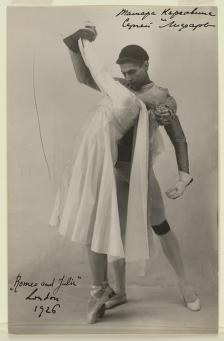
Photograph of Tamara Karsavina and Serge Lifar in Romeo and Juliet, London, 1926, no photographer
Unknown artist
- Source:
- Library of Congress
- Rights:
- Public domain — free to use, share and adapt.
- Recorded as:
- Public Domain
Karsavina was one of the greatest dramatic ballerinas of the early 20th century, a founder of Russian Imperial Ballet's international reputation; this image documents her in one of her last professional roles, five years after her nominal retirement. Lifar, by contrast, was at the height of his early fame as a danseur noble, and this portrait is contemporary evidence of how male dancers of this period were posed for the camera—centered, formal, without the virtuosic spectacle later generations of photographers would emphasize.
What you are looking at
A studio photograph of two dancers in costume against a plain background. The male dancer, in dark tights and a tunic, stands in profile at center-right with his weight on his back leg, his left arm extended upward and slightly back, his right arm bent at the elbow across his body. The female dancer, in a pale knee-length shift dress with a draped shawl or cape over her shoulders, stands slightly forward and to the left, her posture elegant and composed. Both wear soft ballet pointe shoes. The photograph is taken in bright, even studio light that casts minimal shadow, typical of theatrical documentation photography. The composition emphasizes the formal elegance of the pose and the relationship between the two figures, with their spatial arrangement suggesting a moment of dramatic interaction or tableau rather than active movement.
The dancing
The male dancer demonstrates a balletic frame with controlled placement: his supporting leg is straight, his free leg slightly bent and relaxed, his upper body upright with arm positions suggesting classical vocabulary. The female dancer's posture is similarly balletic—upright, composed, with weight centered over her supporting leg; her arms frame the drape of her shawl. Both stand in soft-focus positions rather than dynamic extension, suggesting a posed moment for the camera rather than the peak of a movement phrase. Their relative positioning—she nearer the viewer, he further back and to the side—creates a triangular composition that reads as one figure acknowledging or attending to the other.
The dance depicted
This is a studio portrait documenting a moment from a classical ballet production. The record identifies this as Romeo and Juliet, London, 1926, with the two principals identified in the inscription as Tamara Karsavina and Serge Lifar. Karsavina, a legendary prima ballerina who retired from the stage in 1922, was known for Romantic and early neoclassical repertory; Lifar was a leading danseur noble of the Ballets Russes. The pose—formally composed, intimate in spatial relation, neither figure in extreme extension—is consistent with how ballet of this period represented dramatic partnership: the focus is on presence and connection rather than virtuosic display. The soft shoes and balletic carriage confirm classical ballet technique.
How it was made
This is a gelatin silver print, a black-and-white photograph on paper. The record does not identify the photographer, but the technique and lighting are consistent with professional studio portraiture of the 1920s: the even, frontal illumination, the plain background, and the sharp focus indicate a controlled studio setup, likely with arc lights or north-facing window light. The print quality and composition suggest this was made for circulation among dance aficionados, reviewers, and the theatrical community—photographs of this kind were the standard way of documenting and promoting ballet performances before film was common.
About this work
This is a studio portrait documenting the principal dancers of a 1926 London production of Romeo and Juliet. Tamara Karsavina and Serge Lifar, two of the finest classical dancers of the era, are shown in a moment of formal, composed elegance—the kind of still-life choreography that photographers preferred, and that ballet studios used for publicity and record-keeping. The image captures not the climax of a movement but the quality of partnership and presence that defined the classical ballet aesthetic of the mid-1920s, when the Ballets Russes and its successors were the dominant force in European dance. For historians of ballet and of theatrical portraiture, this photograph is a primary source for how elite classical dancers presented themselves and were presented to the public.
How to look at it
Attend to the stillness of the pose. This is not a photograph of a jump, a turn, or an extension—it is a formal studio arrangement designed to communicate partnership and presence. Note how Karsavina's age is apparent in her posture: she is composed and elegant but not dancing with the extreme extension or lightness her earlier roles required. The photograph's composition emphasizes the theatrical moment over the technical feat, which was the convention of dance photography in this era. The shawl—likely part of the Juliet costume—is as much a subject as the bodies; the drapery and fabric are recorded with the same care as the dancers' frame.
The period
In 1926, the Ballets Russes and its related companies dominated European ballet. Sergei Diaghilev's company was at a turning point: the Romantic revivals and avant-garde experiments of the 1920s were giving way to new literary and dramatic ballets. Romeo and Juliet was one of several narrative ballets created during this period to showcase classical technique in a dramatic context. Karsavina had been Diaghilev's leading ballerina in the Ballets Russes' founding years (1909–1914), and her appearance in this 1926 production would have been a significant event—a return by an aging legend to the stage. Lifar represented the new generation of male dancers Diaghilev was cultivating. Studio portraiture of this kind was the primary visual record of ballet performance until the 1960s; these photographs were reproduced in theatre programs, arts journals, and publicity materials.
Where it lives
This photograph is held by the Library of Congress. It is part of documentary evidence of the 1926 London production and exists alongside other photographs and materials from this period of Karsavina and Lifar's careers.
Dance in this work
Questions about this work
Was Tamara Karsavina still dancing professionally in 1926?
Karsavina officially retired from the Ballets Russes in 1922, though she continued to perform occasionally in London throughout the 1920s. This 1926 Romeo and Juliet was one of her last professional roles. She spent her later years teaching, writing, and advocating for classical ballet.
Who was Serge Lifar?
Lifar (1905–1986) was a Russian-born danseur who became one of the greatest male dancers of the 20th century. He joined the Ballets Russes in 1923 and became Diaghilev's leading male dancer. After Diaghilev's death in 1929, Lifar became ballet master of the Opéra in Paris and remained a major figure in European dance for decades.
How do I know this photograph was taken in 1926?
The inscription on the photograph itself identifies it as Romeo and Juliet, London, 1926, and names the two dancers. This dating is supported by historical records of the production and Karsavina's performance calendar.
Why is Karsavina in a simple shift dress rather than a elaborate Elizabethan-style costume?
This photograph appears to be a studio portrait made separately from a performance rather than a costume documentation photo. The pale shift dress is likely a practice or studio garment chosen for its simplicity and light color, which would photograph well. The draped shawl adds a theatrical element without the bulk of full scenery or costume.
More dance artwork





