49 works in this view — arrow keys or swipe to move between them.
Dance in Art · 1934
Federal Ballet
Unknown artist
- Source:
- Library of Congress
- Rights:
- Public domain — free to use, share and adapt.
- Recorded as:
- Public Domain
The Federal Theatre Project (1935–1939) was a crucial moment in American dance history, bringing professional theatrical dance to communities that had no access to it and creating stable work for dancers during the Great Depression. This image documents that infrastructure and the kind of classical theatrical partnership—romantic, technically demanding, formally dressed—that the project valued and promoted. For historians, it is evidence of what federal dance looked like in practice.
What you are looking at
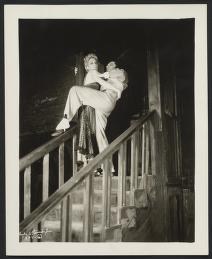
A man in white tie and tails carries a woman in a flowing white gown up a flight of stairs in what appears to be an interior space lit by strong overhead light. The woman is lifted high in his arms, her body arched and her gown falling dramatically around them both. The staircase has a dark wooden railing, and the composition emphasizes the vertical line of the stairs and the theatrical lift. The photograph is a black-and-white studio image with high contrast, the figures brilliantly lit against deep shadows that define the architectural setting. The moment captures a climactic point in the choreography—a dramatic lift that requires both strength and control, the kind of movement that would have been a signature moment in theatrical dance of the 1930s.
The dancing
The man stands on the stairs with his legs extended and braced, his arms supporting the woman's weight in a high overhead lift. The woman's body is nearly horizontal, her back arched, one arm extended, her legs in line with her torso. Their relative sizes and the security of the hold suggest this is a partnership built on trust and technique. The lift is a moment of suspension and apparent weightlessness, the woman's white gown creating a visual counterpoint to the man's formal dark suit.
The dance depicted
This is theatrical ballet or theatrical dance of the 1930s, captured at a moment of high technical difficulty—a sustained overhead lift that requires both partners to work in absolute synchronization. The title *Federal Ballet* suggests this may document a work from one of the New Deal-era federal dance programs, most likely the Works Progress Administration (WPA) Federal Theatre Project or a regional company it supported. The formal ballroom dress on the man (white tie and tails) and the classical white gown on the woman point to a romantic or classical ballet context. The staircase setting is unusual for ballet and suggests this may be from a narrative work or a dance created for film or theatrical production rather than the concert stage.
How it was made
This is a black-and-white photograph, likely a studio still or publicity photograph from the 1930s. The precise lighting, sharp focus, and controlled composition suggest professional studio work—the kind of image made for promotion or archival documentation. The photograph's high contrast and theatrical lighting are typical of dance photography from this period, designed to emphasize line, form, and the drama of the movement. Such images were circulated in dance magazines, programs, and archives to document and promote theatrical productions.
About this work
This photograph documents a moment from *Federal Ballet*, a dance work from the 1930s likely supported by the federal dance programs of that era. It captures a male dancer lifting his female partner in a high overhead hold on a staircase—a moment of technical virtuosity and dramatic staging. The image records not just a movement but a partnership and a moment of peak theatrical effect. It belongs in a gallery of dance because it shows how dance was understood as spectacle and technical achievement at a moment when American dance was being actively supported and promoted by the federal government, and because the photograph itself was a primary means by which such work reached audiences beyond the theater.
How to look at it
Look at how the photographer framed the bodies against the architecture: the staircase becomes part of the composition, emphasizing the height of the lift and the vertical challenge of what the dancers are doing. The lighting isolates the figures against shadow, making the white gown and the man's formal dress read clearly. Notice the woman's arched back and extended arm—she is not passive but complicit in the line of the lift, her body extended to create a shape. The moment chosen is the peak of the movement, when both dancers are fully committed and the lift appears effortless, which is the opposite of how it feels to execute it. This is a photograph made to persuade viewers that this was beautiful and worth their attention and tax dollars.
The period
This photograph dates to 1934, the year before the WPA Federal Theatre Project formally began, but during the period when federal arts funding was being organized and debated. American theatrical dance in the early 1930s was dominated by classical ballet, often performed by imported European companies or trained under European methods. The Federal Theatre Project, which would begin in 1935, aimed to democratize access to such work and to create American dance that could stand alongside European classical ballet. This photograph likely documents a work from that transitional moment or from one of the regional companies that preceded the formal federal programs. The choreography and costume suggest a romantic ballet aesthetic—the white classical tutu, the formal male dress, the emphasis on the lift as a moment of display.
Where it lives
The image is held by the Library of Congress and sourced from LODance, the Library of Congress's public digital collections of dance-related materials. It is catalogued as *Federal Ballet*, 1934, but the artist, photographer, holding collection details, and medium are not recorded in the current catalogue entry.
Dance in this work
Questions about this work
What is the Federal Ballet?
The Federal Ballet was likely a dance work from the 1930s, possibly associated with the WPA Federal Theatre Project, which employed dancers and choreographers during the Great Depression. The title suggests it was a work intended to represent or celebrate American (federal) dance or to be accessible to federal audiences. Without more documentation, the specific work cannot be identified, but the image places it firmly in the classical ballet tradition of the period.
Why is the man wearing a tuxedo if this is ballet?
In the 1930s, male ballet dancers performing in romantic or classical ballets often wore formal evening dress—white tie and tails, or military uniforms—as part of the narrative or aesthetic. This was particularly true in works with contemporary or social settings. The formal dress here suggests either a narrative context (a ballroom scene, a formal social dance) or an aesthetic choice to present the dance as elevated and refined.
Is this a still from a film?
It is likely a studio publicity photograph rather than a frame from a film, but the staircase setting and theatrical lighting suggest it may have been made to resemble a moment from a theatrical production or to promote a work that involved stagecraft. The photograph is a document of the dance, not a dance itself, and would have been used in programs, magazines, or archives.
What dance technique is this?
This is classical theatrical ballet, evidenced by the overhead lift (a standard ballet vocabulary element), the white classical tutu, the male dancer's formal dress, and the overall aesthetic of romantic partnership. The work appears to be from the European classical ballet tradition as it was being taught and performed in America in the 1930s.
More dance artwork





