49 works in this view — arrow keys or swipe to move between them.
Dance in Art
7me Saison des Ballets Russes
Unknown artist
- Source:
- Library of Congress
- Rights:
- Public domain — free to use, share and adapt.
- Recorded as:
- Public Domain
The Ballets Russes fundamentally changed twentieth-century dance by elevating design and male dancing to equal status with female virtuosity, and by treating the stage as a total artwork. This single costume design encapsulates that revolution: it shows how a male dancer's body could be dressed as spectacle, how non-Western visual traditions were (controversially) mined for theatrical effect, and how color, form, and the figure could be unified in service of a radical new vision. For historians of dance technology and training, it also documents the extraordinary physical demands placed on male dancers—the arabesque pose requires the control and extension that marked the Ballets Russes aesthetic.
What you are looking at
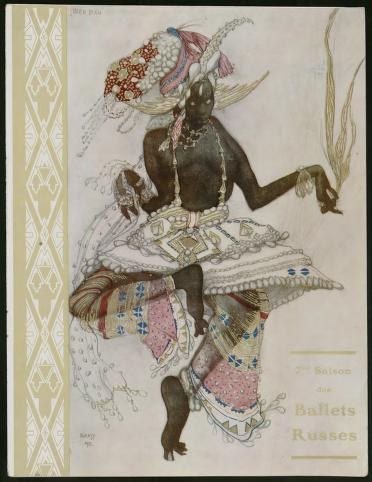
A solo male dancer in blackface performs a dynamic leap or turn against a cream background, his body angled dramatically with one leg extended and arms positioned with theatrical flourish. He wears an ornate costume comprising a short jacket in rich brown or burgundy, and an elaborate skirt or lower garment decorated with pink and white patterned fabric, geometric motifs, and what appears to be beaded or sequined embellishment. The skirt features layers of contrasting textiles and trim. Atop his head sits an elaborate headdress or crown in white and gold, adorned with feathered or textured ornaments and beaded details. A decorative geometric border in cream and gold runs down the left edge of the composition. The title, printed in the lower right in art nouveau lettering, reads "7me Saison des Ballets Russes" (Seventh Season of the Russian Ballets). The overall composition suggests this is a costume design or promotional artwork rather than a documentation of an actual performance moment.
The dancing
The single figure is captured mid-movement in a powerful arabesque or similar elevated position, with the supporting leg planted and the free leg extended upward and back, the torso twisted to face the viewer while the head tilts upward. Both arms are raised and actively positioned—one appears extended outward, the other bent—creating a sense of rotational momentum and theatrical drama. The dancer's weight appears lifted and suspended rather than grounded, suggesting the acrobatic or aerial quality prized in early twentieth-century theatrical dance. The proportions and construction of the figure suggest a trained body accustomed to extreme extension and turnout.
The dance depicted
This is almost certainly a costume design for a male principal dancer in the Ballets Russes, the revolutionary Russian dance company that premiered in Paris in 1909 and toured internationally throughout the early twentieth century. The costume itself—the exotic hybrid of European theatrical form with non-Western or 'Oriental' decorative vocabulary—is characteristic of the Ballets Russes aesthetic under Sergei Diaghilev, which drew on Russian imperial design, folk sources, and Western Orientalism to create a new theatrical language. The male figure's muscularity, the suspended arabesque, and the balletic vocabulary of the pose are consistent with the company's elevation of male dancing as a vehicle for virtuosity and dramatic spectacle. The specific ballet or role cannot be identified from the image alone, but the richness of the costume and the prominence of the solo suggest a principal role, possibly from an exotic or fantasy narrative—given the headdress, possibly an Eastern or mythological character.
How it was made
This is a hand-colored lithograph or pochoir (stencil-colored print), a technique characteristic of Ballets Russes publicity materials in the 1910s. The flat, bold color areas and the crisp definition of the design elements are consistent with pochoir technique, which allowed for precise, jewel-like color and made the image highly suitable for reproduction in dance magazines, programs, and promotional posters. The decorative border and art nouveau lettering indicate this was intended as a finished artwork in its own right, not merely a costume sketch. The technique permitted wide circulation of these designs across Europe and beyond, making them instrumental in the international marketing of the Ballets Russes and in disseminating a new visual vocabulary for dance.
About this work
This is a costume design from the Ballets Russes, the early twentieth-century Russian company that revolutionized European dance by synthesizing classical ballet technique with modernist design, non-Western aesthetics, and theatrical spectacle. The work documents the visual language of that moment—a moment when male dancing was reclaimed as a vehicle for virtuosity and drama, and when 'exoticism' became a primary source of theatrical innovation. The image represents not a single ballet but a whole aesthetic: the fusion of Russian imperial craft traditions, Western high art, and an often problematic appropriation of global visual cultures. It belongs in a dance gallery as evidence of how Diaghilev's company reshaped not just what people danced but what they imagined dance could look like, and as a document of the design practices that made dance into total theatre.
The work also serves as a historical record of the company's international reach—the title in French, the pochoir technique, and the circulation of such designs all attest to how thoroughly the Ballets Russes had captured the European imagination by the time this design was created.
How to look at it
Attend first to the moment the designer chose to capture: not a standing pose but a suspended, dynamic moment of rotation or leap. This choice emphasizes the airborne, weightless quality that the Ballets Russes prized and that set their male dancers apart from the grounded, earth-bound male dancer of the nineteenth-century ballet tradition. Second, observe how costume and body are unified: the costume is not extraneous decoration but integral to the figure's formal composition—the colors and shapes of the skirt amplify the line of the leg, the headdress extends the vertical lift of the pose. Finally, note the visual sources: the headdress and skirt vocabulary derive from non-European dress traditions (possibly Central Asian or Middle Eastern), but they are filtered through European art-nouveau design principles and balletic form. The image asks: what does it mean to put a classically trained European body into an 'exotic' costume?
The artist
The artist is not recorded in the catalogue. However, the style and execution are consistent with the design practices of the Ballets Russes under Sergei Diaghilev, which employed both established easel artists (including Pablo Picasso, Henri Matisse, and Léon Bakst) and specialist costume and set designers. Bakst in particular was known for such richly ornamented costume designs in an orientalist vocabulary. The work may be by a professional theatre designer, a visual artist working in the company's orbit, or a specialist in costume design whose name has not been preserved. The technique—pochoir coloring of a lithograph—was standard for Ballets Russes publicity materials of the period.
The period
The Ballets Russes premiered in Paris in 1909 and remained the most innovative and influential dance company in Europe until Diaghilev's death in 1929. The 1910s—the period this design likely dates to—saw the company at the height of its creative power, producing ballets that scandalized and thrilled audiences in equal measure. This was the era of Vaslav Nijinsky's revolutionary choreography and performances, of designs by Picasso and Matisse, and of the company's sustained engagement with modernist art. Simultaneously, early twentieth-century European theatre was in ferment: the Russian theatre director Konstantin Stanislavski was transforming acting through psychological realism; German Expressionism was emerging; and artists across media were experimenting with non-Western and folk sources. The Ballets Russes occupied the intersection of all these movements, and male dancers—long relegated to supporting roles in nineteenth-century ballet—were restored to dramatic and virtuosic prominence. The exotic costume vocabulary visible here reflects both the Orientalism that had saturated European culture since the nineteenth century and the company's genuine engagement with Russian and other non-Western visual traditions.
Where it lives
The work is held in the Library of Congress and is documented in their catalogue as a Ballets Russes design material. It appears to be a finished art print or costume design proposal, the kind of imagery that would have been circulated in dance magazines, used in program materials, or displayed in theatrical offices.
Dance in this work
Questions about this work
Is this an actual photograph of a dancer, or is it a design or artistic rendering?
This is a hand-colored lithographic print—a designed and illustrated artwork, not a photograph. It is a costume design or design proposal that documents how a dancer was to be dressed and posed, but it is not a record of an actual performance captured photographically. The bold, flat color areas and the stylized treatment of the figure are characteristic of theatrical design graphics from this period.
What is blackface doing in a work about dance history?
This costume employs blackface, a racist practice with deep roots in European and American entertainment. In the Ballets Russes context, it reflects the period's entrenched racism and the company's willingness to treat non-European and racialized bodies as visual spectacle and exotic props, even as it pioneered modernist aesthetics. Acknowledging this now—naming it as racist rather than overlooking it—is essential to honest dance history. The work belongs in a gallery because it reveals what that revolutionary company actually was: brilliant in design and dance innovation, but complicit in the racial hierarchies and colonial attitudes of its time.
Who danced this role, and in which ballet?
The catalogue record does not identify the specific ballet or dancer. The costume vocabulary—the headdress and patterned skirt—suggests a role in an exotic or non-European narrative, possibly drawn from Russian folklore, Oriental fantasy, or Greek mythology, but without additional information on this particular design, the specific work cannot be pinpointed. Scholars of the Ballets Russes might identify it through comparative analysis of known costume designs from the company's archive.
Why is the title in French?
The Ballets Russes, though a Russian company, was based in Paris from 1909 onward and operated in French cultural and linguistic space. Paris was the company's home, its primary audience, and the seat of European artistic authority at the time. Titling the work in French was a marker of its status as a Parisian theatrical object.
More dance artwork





