49 works in this view — arrow keys or swipe to move between them.
Dance in Art · 1926
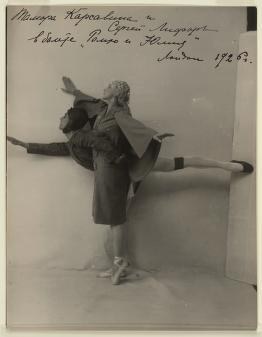
Photograph of Tamara Karsavina and Serge Lifar in Romeo and Juliet, London, 1926
Unknown artist
- Source:
- Library of Congress
- Rights:
- Public domain — free to use, share and adapt.
- Recorded as:
- Public Domain
Karsavina was a transformative figure in twentieth-century ballet, and this photograph documents her artistry in her mid-forties, still performing at the highest level. The image shows how the vocabulary and aesthetic of classical ballet were understood and performed during the Diaghilev era, when Russian ballet was at the center of European artistic life. For historians and dancers, this is a primary document of a specific moment in the evolution of ballet technique and style.
What you are looking at
A woman in a dark coat and light-colored stockings stands in a white studio space, her body tilted dramatically backward in an arabesque penché, one leg extended high behind her, her torso arched and one arm stretched forward for balance. A man in dark clothing stands beside and slightly behind her, his body angled to support and frame her line. The photograph is taken from a low angle that emphasizes the height and extension of the pose. The stark white walls and floor create a clean, theatrical backdrop typical of dance photography from this era. The lighting is even and frontal, characteristic of studio portraiture, throwing the dancers' forms into sharp relief against the featureless background.
The dancing
The female dancer holds an extreme penché arabesque—her supporting leg straight and turned, her working leg raised high behind her well above the level of her head, with a marked arch through the spine. The male dancer provides subtle support or spotting, positioned to frame rather than catch her, his own posture controlled and attentive. The woman's arms are positioned for balance and line, one forward and one in a supporting position. The pose demonstrates the classical ballet vocabulary of the 1920s: fully turned-out legs, pointed feet (visible in the extended leg), and an elongated upper body.
The dance depicted
This is a studio portrait of Tamara Karsavina and Serge Lifar in a moment from a 1926 London production of Romeo and Juliet. Karsavina was a legendary Russian prima ballerina of the Diaghilev era, and Lifar was her frequent partner and a major figure in twentieth-century ballet. The arabesque penché was a signature element of early-twentieth-century romantic and classical ballet vocabulary. The pose shown here—an extreme extension with a marked arch—reflects the aesthetic preferences of Russian Imperial ballet and the Ballets Russes, emphasizing virtuosity, elevation, and emotional intensity. The photograph documents not a moment within the narrative but rather a demonstration of technical and aesthetic mastery for the camera.
How it was made
This is a black-and-white photograph, likely gelatin silver print, evidently a professional studio portrait created for publicity or documentary purposes. The photograph's formal composition, controlled lighting, neutral background, and sharp focus are all standard for dance photography of the mid-1920s. Such photographs were widely circulated to promote performances and build the reputations of major dancers. The technical clarity and studio setting indicate this was not a candid theater shot but a carefully arranged portrait session, allowing the photographer to capture the dancers at their most controlled and visually commanding.
About this work
This is a studio photograph documenting two of the most celebrated dancers of the 1920s in a classical ballet pose. Tamara Karsavina and Serge Lifar were principal dancers with the Ballets Russes and among the most influential figures in dance history. The photograph captures them at the height of their powers, in a moment that displays the technical and aesthetic ideals of classical ballet as practiced in London in the mid-1920s—a period when Russian ballet was the dominant global force in theatrical dance. The work belongs to a large category of dance publicity photography that shaped how ballet was understood and consumed by the public during this pivotal moment in dance history.
How to look at it
The photograph freezes a single moment of extreme physical extension and control. Look at how the woman's body creates a nearly continuous curve from her supporting foot through her arched torso to her extended leg—a line that was highly valued in classical ballet aesthetics. Notice how the male dancer's position frames and supports this line without dominating it; his role is to make her look more powerful, not to claim equal space. The low camera angle is crucial: it makes the arabesque appear even more elevated and dramatic than it would from eye level. This is a pose held for the camera, not captured from a performance; the perfect lighting and sharp focus indicate the photographer was working in a studio with full control of the environment.
The artist
The photographer is not recorded. The photograph was created as part of a professional publicity or documentary effort around the 1926 London production of Romeo and Juliet, likely by a house photographer or commissioned dance photographer of the period. Such photographs were standard documentation of major theatrical productions and performances.
The period
In 1926, the Ballets Russes was in its final decade under Diaghilev's direction, and it remained the most influential force in avant-garde dance and choreography in Europe. Karsavina, though born in the Russian Imperial tradition, had become an international celebrity and was still performing roles that established her fame. Lifar had joined the Ballets Russes in 1923 and was rapidly establishing himself as Nijinsky's successor. In visual culture, dance photography was becoming an increasingly important medium for documenting and promoting theatrical performances; by the 1920s, photography had become the primary way the general public encountered images of famous dancers. The studio portrait, with its emphasis on pose and technical display rather than narrative, was the dominant form of dance photography.
Where it lives
The photograph is held by the Library of Congress. It is catalogued as a documentary photograph related to the 1926 London production of Romeo and Juliet, part of the historical record of Ballets Russes performances.
Dance in this work
Questions about this work
Who were Karsavina and Lifar?
Tamara Karsavina (1885–1978) was a Russian prima ballerina trained in the Imperial Ballet and a founding principal dancer with the Ballets Russes. Serge Lifar (1905–1986) was a Ukrainian dancer who became one of the most important ballet dancers and choreographers of the twentieth century, known for his athleticism and innovation. Both were major international celebrities in the 1920s.
What is an arabesque penché?
An arabesque penché is a pose in classical ballet in which the dancer stands on one fully turned-out leg and extends the other leg high behind them, often above the level of the head, with an arch through the torso. It is one of the most demanding and visually striking positions in classical ballet, requiring extreme flexibility and control.
Why is this a dance photograph and not a painting?
This is a photographic image created using light-sensitive materials and a camera. It captures the dancers' bodies with the immediate, mechanical fidelity characteristic of photography, rather than being hand-drawn or painted. The even studio lighting, sharp focus, and neutral background are typical of professional dance photography from this period.
Was this taken during a performance?
No. The controlled studio environment, perfect lighting, featureless white background, and static pose indicate this was a portrait session arranged specifically for the camera. While such photographs were used to promote performances, they were not taken during performances themselves.
More dance artwork





