49 works in this view — arrow keys or swipe to move between them.
Dance in Art · 1920
My little dancing heart
Unknown artist
- Source:
- Library of Congress
- Rights:
- Public domain — free to use, share and adapt.
- Recorded as:
- Public Domain
Sheet music covers are primary evidence of how dance was consumed, taught, and understood outside the concert hall or dance studio. This image shows that by 1920, ballroom dance had become a mass-market commodity tied to popular song, and that the visual language used to sell it emphasized drama, partnership, and romantic sentiment. For historians of social dance and popular culture, these covers document not what dancers actually did, but what audiences wanted to believe about dance.
What you are looking at
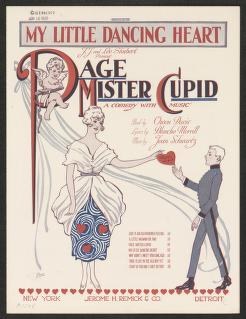
A 1920s sheet music cover presenting a romantic courtship through dance. A woman in a flowing, translucent gown—rendered in delicate line work with her skirt billowing in an exaggerated silhouette—bends backward in a dramatic arc. A man in formal evening dress (tuxedo) reaches toward her with one arm extended. The composition places the woman's heart at the center, literally illustrated as a red organ with decorative flourishes. Below them, a decorative border of small red hearts frames the composition. The title and credits appear in art deco lettering in shades of red and black. The entire image is rendered in a commercial illustration style typical of sheet music covers and popular print media of the period—clean line work, limited color palette, and an emphasis on silhouette and gesture over anatomical detail.
The dancing
The woman's body is arched dramatically backward, her spine extended in a posture of abandon or surrender, while the man leans forward in a supporting or protective gesture. His posture suggests he is guiding or catching her. The two figures are positioned close together, their bodies relating through a partnered dynamic. The woman's extended leg and the flow of her drapery suggest movement, though the pose is frozen in a moment of heightened theatrical tension rather than captured mid-step. The rendering emphasizes the silhouette over precise anatomical detail, which is typical of commercial illustration of this era.
The dance depicted
This appears to depict a moment from early twentieth-century ballroom or theatrical social dance, most likely a waltz or one-step—the dominant partner dances of the 1920s. The backward arch and supporting partner grip are characteristic of theatrical or exaggerated versions of smooth ballroom hold. The dramatic pose suggests theatrical presentation rather than strict ballroom competition—the kind of moment one might see in a cabaret, musical theatre production, or popularized dance demonstration of the era. The image communicates sensuality and intimacy, which aligns with how 1920s popular dance was marketed to middle-class audiences through song and spectacle.
How it was made
This is a commercial lithograph or color printing process (likely chromolithography), standard for sheet music covers of the 1920s. The technique is evident in the clean registration of the red and black inks, the simplified color palette, and the reliance on bold line work and silhouette. The printing method allowed rapid, affordable mass production of sheet music covers that could be displayed in homes, sheet music shops, and music halls. This technical accessibility made the image a window into popular dance culture and courtship ideals of the period.
About this work
This sheet music cover from 1920 captures a moment of romantic ballroom dance at the height of the Jazz Age. The image serves as both a visual advertisement for the song and a cultural artifact of how dance was understood and marketed to the mass public in the early twentieth century. The dramatic, slightly exaggerated poses reflect theatrical conventions of ballroom display—the kind of movement that excited audiences and sold sheet music to aspiring dancers in homes across America. The work belongs in a dance gallery precisely because it reveals what dance meant to ordinary people in this era: romance, modernity, sensuality, and the promise of social connection through fashionable movement.
How to look at it
Notice the dramatic backward arch of the woman's body—this is the moment of maximum display and vulnerability, a frozen instant of theatrical height rather than a naturalistic pose from dancing. The artist chose a moment of extreme silhouette, not a balanced step. Observe how the red heart at the center of the composition is not metaphorical but literal—it grounds the romantic narrative in the body. The decorative border of small hearts reinforces this; the image is a commercial visual poem about emotion rather than a documentary of how ballroom dancers actually moved. The color choices—red for passion, black for formal sophistication—encode the message: this dance is both respectable and thrilling.
The artist
The artist is not recorded. The work is a professional commercial illustration, likely created by a staff or freelance designer working for a music publisher. The style is consistent with American sheet music cover design of the 1920s—simplified, bold, and designed for visual impact at small scale. The anonymity of the creator is typical; sheet music covers were treated as promotional objects rather than signed artworks, and illustrators often remained uncredited.
The period
In 1920, ballroom dance was at the height of its popularity as a participatory social practice in America. The waltz and one-step dominated respectable dance floors, while jazz dances and more daring movements were emerging in cabarets and speakeasies. Sheet music was the primary vehicle for promoting new dances and songs to the middle class; covers served as visual instruction manuals and aspirational images. The 1920s saw an explosion of dance instruction, dance crazes, and commercialized dance culture. Simultaneously, modernist artists were beginning to engage with movement and the body; this commercial work sits at a distance from that experimentation, but both emerge from the same cultural moment of intense interest in the body in motion.
Where it lives
The source is the Library of Congress, which holds extensive collections of sheet music covers as cultural documents. This work is a commercial printed object designed for mass circulation, not a fine art print.
Dance in this work
Questions about this work
Is this a photograph or a drawing?
This is a commercial lithograph or chromolithograph—a printed image, not a photograph or hand-drawn artwork. It was created as a design for a sheet music cover, reproduced in color using printing plates. The technique and clean line work are typical of 1920s commercial printing for mass-market sheet music.
What dance are they doing?
The pose most closely suggests a theatrical version of the waltz or one-step, the popular ballroom dances of the 1920s. The backward arch is more exaggerated than actual ballroom technique; the artist has dramatized the pose for visual impact on a sheet music cover. This reflects how dance was marketed to the public—as thrilling and romantic, rather than as a precise technical practice.
Why is there a giant heart in the middle?
The heart is the emotional and visual center of the composition. Sheet music covers of this era used symbolic imagery to communicate the feeling of the song. By placing a literal anatomical heart between the dancers, the artist is visualizing the song's subject—romantic love—while also emphasizing the sensuality and intimacy of the dance.
What does this tell us about how people danced in 1920?
Sheet music covers document popular imagination and commercial fantasy, not necessarily how people actually danced. This image shows what audiences wanted to believe about ballroom dance: that it was passionate, partnered, and romantic. In reality, most social dancing in 1920 was much more restrained and formal. The cover reflects the aspirational side of dance marketing.
More dance artwork





