49 works in this view — arrow keys or swipe to move between them.
Dance in Art · 1958
The Incomparable Marina Semenova.
Unknown artist
- Source:
- Library of Congress
- Rights:
- Public domain — free to use, share and adapt.
- Recorded as:
- Public Domain
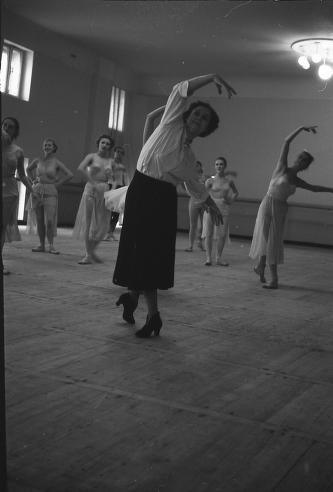
Marina Semenova was one of the twentieth century's most celebrated prima ballerinas. This photograph, if correctly identified, documents her not as a performer but as a teacher—a significant phase of her career that extended the influence of Russian Imperial ballet technique into the later twentieth century. The image provides rare documentary evidence of how classical ballet was actually taught and transmitted in studios of this era.
What you are looking at
A black and white photograph of a ballet studio during class or rehearsal. A woman in a white shirt and dark skirt stands prominently in the center-foreground with her arms raised in an overhead stretch, her body weight shifted to one side. Behind her, a group of female dancers in white practice clothes and pointe shoes stand at various stages of attentiveness, some watching the central figure, others in conversation or waiting. The studio is a large, bright room with tall windows on the left admitting daylight, a chandelier visible overhead, and what appears to be a polished wood floor. The composition captures a moment of instruction or demonstration rather than performance—a working studio space.
The dancing
The central figure demonstrates a classical ballet arm port de bras with both arms elevated overhead in an elongated arc, her torso held upright. Her weight appears to shift onto one leg, suggesting preparation for movement or the completion of an exercise. The surrounding dancers stand in relaxed postures, many with arms at their sides, indicating a pause in activity. Their scattered positions and casual groupings suggest this is documentation of a teaching moment rather than a choreographed arrangement.
The dance depicted
This is ballet, specifically a documentation of a studio class or rehearsal. The clothing—practice leotards, skirts, and pointe shoes—confirms classical ballet training. The raised arm position and upright carriage are fundamental to ballet pedagogy. The photograph captures what appears to be either a teacher demonstrating technique or an advanced student showing a port de bras exercise to the group. The informal arrangement and teaching context indicate this is professional ballet instruction rather than a performance.
How it was made
This is a black and white photograph, likely a documentary or archival image. The clarity of detail and professional quality suggest it was taken by a photographer with access to the studio, possibly for institutional records or press documentation. The photographic medium captures the unposed reality of studio work—the casual spacing and varied attention of the dancers—in a way that painting or sketch could not, providing direct evidence of teaching methods and studio practice circa 1958.
About this work
This photograph documents a moment in a ballet studio, capturing a female dancer or instructor demonstrating classical technique to a group of young dancers. Dated to 1958, it records the physical reality of ballet training in the mid-twentieth century: the studio space, the uniform practice clothes, the pointe work, and the relationship between instructor and students. The catalogue identifies the central figure as Marina Semenova, the Russian prima ballerina, suggesting this may document her teaching or a master class she conducted. The image belongs in a dance archive both as evidence of Semenova's later career as a teacher and as documentation of ballet pedagogy of the period.
How to look at it
Attend to the raised arm position of the central figure: the slight curve of the arms overhead, the alignment of the shoulders, and the straightness of the spine—these are hallmarks of classical ballet training that students would study. Notice how the other dancers' gazes are directed toward the demonstration, establishing the teaching dynamic. The studio setting—the natural light, the wooden floor, the scale of the space—shows the conditions under which professional ballet technique was developed and transmitted. The black-and-white photography reveals anatomy and line without distraction, making clear the shapes the body must hold.
The artist
The photographer is not recorded. The image was sourced from the Library of Congress, suggesting it may have been part of a press archive, institutional documentation, or collection of dance photography from the mid-twentieth century. Such studio photographs were typically commissioned by ballet schools, companies, or taken by press photographers documenting significant figures or training sessions.
The period
In 1958, ballet was undergoing significant transformation. The Soviet ballet system, which had produced dancers like Semenova, was gaining international prominence, and the Cold War was bringing Soviet techniques and pedagogies into contact with Western ballet schools. Semenova, who trained in the Imperial Russian system and became a leading Soviet ballerina, was by 1958 likely teaching and passing on the methods of her classical training. The photograph reflects the mid-century moment when the Russian school's emphasis on clean technique, turnout, and precise port de bras was becoming an international standard.
Where it lives
The photograph is held in the Library of Congress. It is catalogued simply as 'The Incomparable Marina Semenova' dated 1958, with no photographer credited. Its presence in the LOC suggests it was part of a press archive, documentation of Semenova's activities, or a collection of twentieth-century dance photography.
Dance in this work
Questions about this work
Who was Marina Semenova?
Marina Semenova (1911–1986) was a Russian prima ballerina trained in the Imperial Russian ballet system who became a leading Soviet dancer and pedagogue. She represented the continuity of classical technique from the Imperial era into the Soviet period. By 1958, when this photograph was taken, she was in her late career and active as a teacher, transmitting the rigorous methods of Russian classical training to younger generations.
What is this photograph documenting?
This appears to be documentation of a ballet class, rehearsal, or master class conducted by or featuring Semenova. It captures a moment of instruction—either a teacher demonstrating technique or a principal dancer showing the correct execution of a port de bras exercise to students. The informal arrangement and teaching context distinguish it from performance photography.
Why does the image matter for dance history?
The photograph provides rare documentary evidence of how classical Russian ballet technique was taught in the studio, and specifically documents Semenova's role in transmitting this pedagogy. It shows the actual spatial arrangement of a mid-century ballet studio, the dress codes, the physical positions expected of students, and the direct demonstration method of teaching that was central to classical training.
What can we learn from Semenova's arm position?
Her raised arm position shows the classical port de bras—the way the arms move through space in ballet—executed in the Russian Imperial style: precise, controlled, with a slight curve rather than rigidity, and coordinated with the alignment of the torso. This is exactly the kind of detail students would study and replicate, making it a teaching moment frozen in time.
More dance artwork





