45 works in this view — arrow keys or swipe to move between them.
Dance in Art
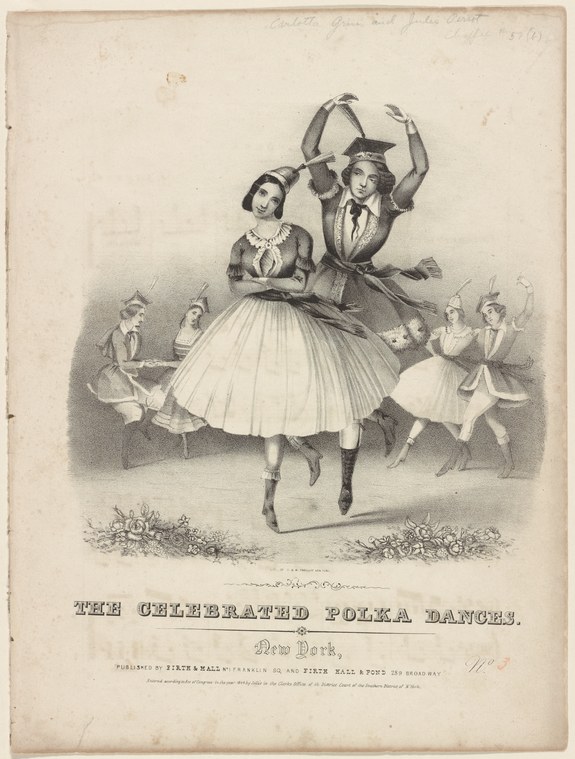
The celebrated polka dances
Unknown artist
- Medium:
- Lithograph
- Dance:
- Polka
- Era:
- Late 1800s (Victorian Ballroom)
- Source:
- New York Public Library
- Rights:
- Public domain — free to use, share and adapt.
- Recorded as:
- public_domain
The polka was the first globally successful social dance of the modern era, and this print is a direct window into how it was experienced and marketed. For dance historians, the image clarifies the visual codes of mid-century ballroom dance: the posture, the energy, the couple relationship, and the cultural meaning of a woman's visible, energetic movement. The work also documents the polka's trajectory from Bohemian folk roots to Victorian ballroom staple—a pattern that would repeat with later dances, making the polka a prototype for how dances circulate and are consumed.
What you are looking at
A lithographed theatrical scene of exuberant polka dancers, arranged in a dynamic composition that captures the whirling energy of the ballroom. At center, a couple dominates: the woman wears a full, bell-shaped white skirt caught mid-spin, her upper body in a dark bodice with an ornate necklace, her expression animated and confident. Her partner, in tailcoat and top hat, lifts his arms overhead in a gesture of celebration or triumph. Around them, smaller couples and individual figures populate the scene—some in the background seated or standing, others dancing or watching. The setting is a ballroom rendered in atmospheric shading; the foreground shows scattered floral garlands or wreaths on the floor, adding festive detail. The composition radiates movement: skirts billow, bodies tilt, limbs extend in the energetic, tilting angles characteristic of social dance illustration of the 1840s–50s. The lithograph's tonal range—from dense black in the figures' silhouettes to delicate grays in the architectural space—creates depth and focuses attention on the central couple while suggesting a crowded, lively event.
The dancing
The central female dancer is shown at the apex of a spin, her torso upright but her skirt thrown horizontal by centrifugal force—a moment of maximum visual drama. Her male partner stands nearly upright, his arms raised in an open, celebratory gesture rather than in a closed dance hold. The subsidiary figures vary in pose: some couples appear to be in closed or semi-closed holds typical of the period; others stand in attitudes of observation or conversation. The artist has rendered the bodies with elongated proportions characteristic of popular dance prints of the era, emphasizing the vertical stretch of the figures and the theatrical exaggeration of movement. No footwork detail is visible, but the overall posture—chests lifted, limbs extended—conveys the buoyant, springing quality of the polka.
The dance depicted
This is the polka, the most internationally successful social dance of the mid-19th century. Originating in Bohemia in the 1830s, the polka reached Paris, London, and New York by the 1840s and became a dominant ballroom dance through the 1860s. The scene illustrates the polka's characteristic style: rapid, energetic movement in closed couple formation, with a hopping or springing action and frequent turns. The title "The Celebrated Polka Dances" suggests either a specific famous performance or a generic celebration of the dance's popularity. The central image—the woman spinning, the man with arms raised—captures the exhilaration and showiness that made the polka so appealing to Victorian audiences; the dance was modern, lively, and permitted a degree of visible physical excitement that earlier court dances had not.
How it was made
This is a lithograph, a print technology that allowed rapid, affordable reproduction for mass circulation. The artist drew directly onto a stone or metal plate using a greasy crayon or ink, then chemically treated the surface so ink would adhere to the drawn areas and repel from blank areas. Lithography was ideal for theatrical and social subject matter: the medium's tonal range permitted both fine detail and bold silhouettes, and the process was fast enough to capitalize on fads. This print was published in New York (as noted in the inscription), indicating distribution to an American urban audience. Lithographs of dance were often sold individually as prints, bound into theatrical programs, or featured in illustrated periodicals, making them a primary source for how dance was marketed and understood in the 19th century.
About this work
This is a mid-19th-century American lithograph celebrating the polka, the decade's most fashionable ballroom dance. The print captures the dance's visual signature—rapid spinning, buoyant carriage, and the spectacle of a woman's skirt in full motion—and broadcasts its appeal to an urban audience hungry for up-to-date dance imagery. The scene is theatrical and somewhat idealized: the figures are elegant, the setting refined, and the moment frozen at the peak of excitement. Yet it also documents a real social phenomenon: the polka's brief but intense reign as the defining social dance of the 1840s–50s, before the waltz and later dances superseded it. The work belongs in a dance history archive because it shows how the polka was visualized and sold—not as a folk dance or a technical accomplishment, but as a symbol of modernity, joy, and urban sociability.
How to look at it
Attend first to the central female figure and the moment the artist chose: she is captured mid-turn, her skirt at maximum extension and her face in three-quarter view, looking out toward the viewer with a broad expression. This is the moment of greatest spectacle and visibility—not a preparation, not a landing, but the peak of the spinning action. The artist has frozen the polka's essential visual quality: the upward lift and outward fling that made it so different from the smoother, more gliding waltz. Notice also how the artist has positioned the male partner: rather than in a closed embrace shown from the side (the conventional perspective for ballroom prints), he stands nearly upright with raised arms, presenting himself as celebratory and released from formal constraint. This compositional choice—emphasizing exuberance over technical precision—tells us that the polka was being sold to audiences as fun, modern, and emotionally uninhibited, not as a refined technical accomplishment.
The period
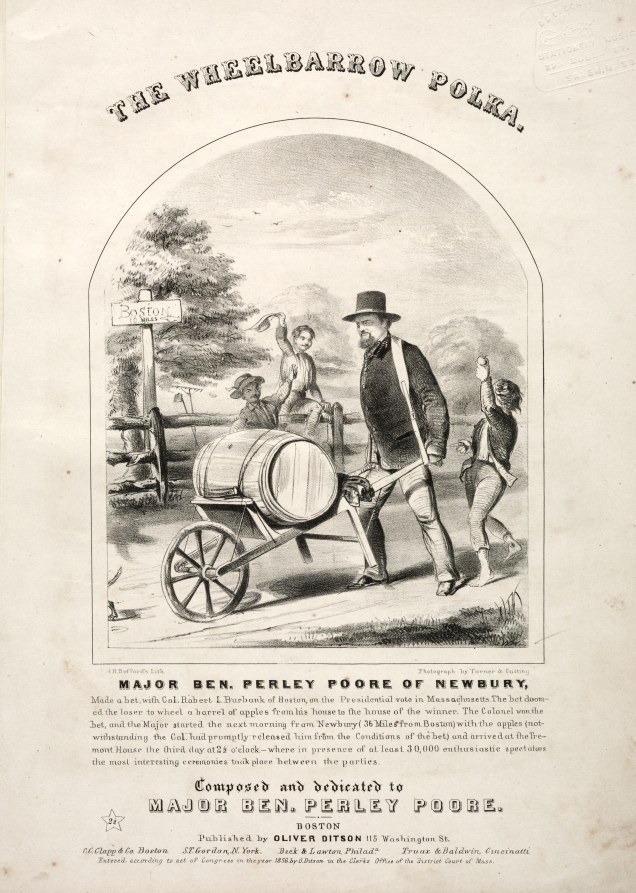
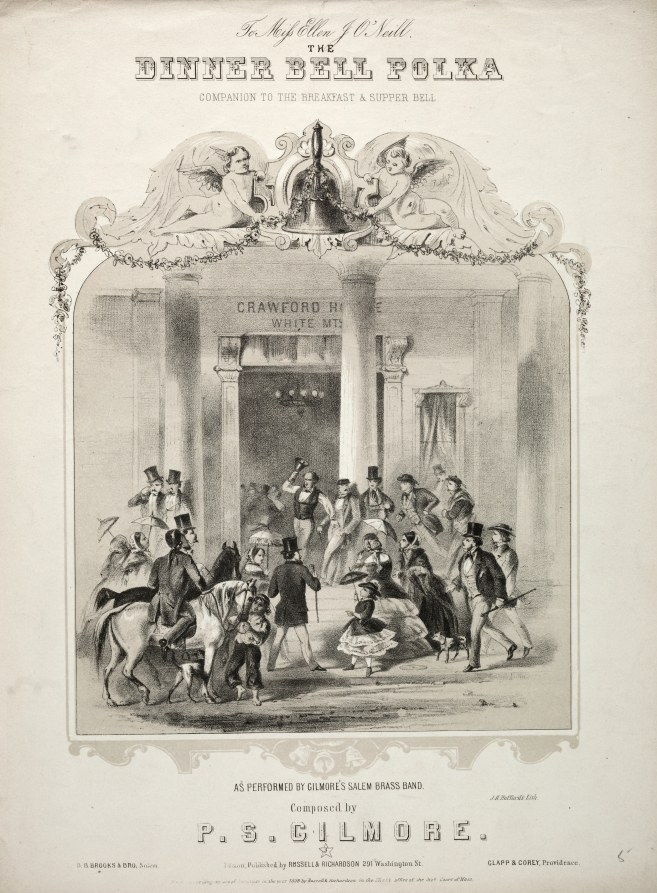
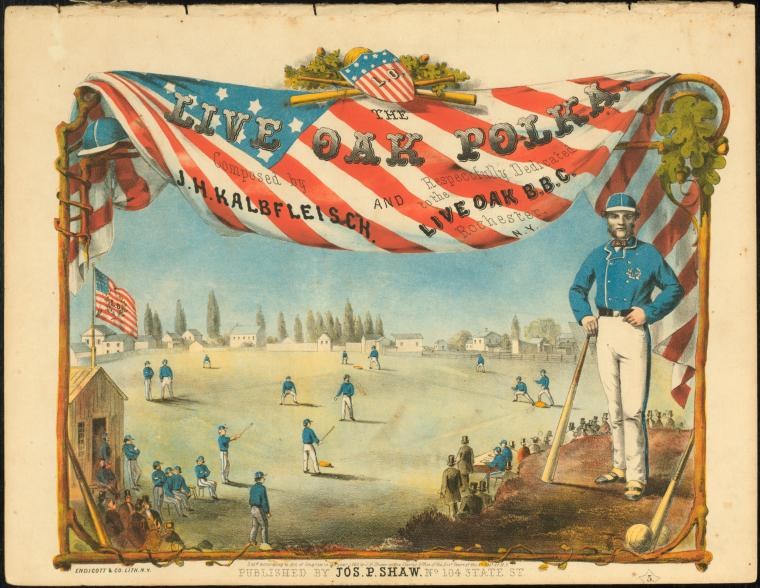
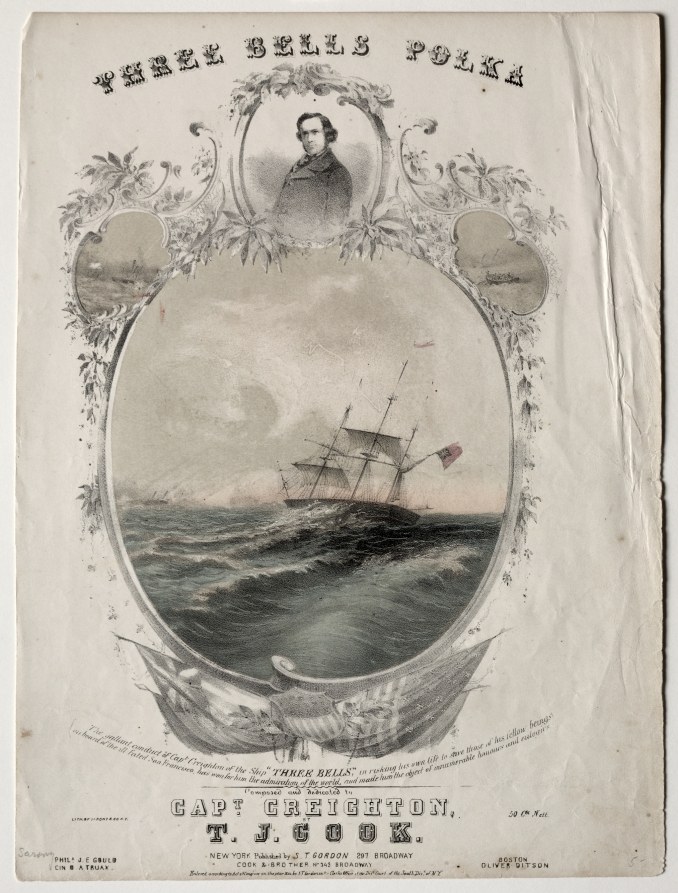
The polka emerged in Prague around 1830 as a folk or popular dance among the Czech-speaking working and middle classes, and by the early 1840s it had been imported to Paris by dancers and choreographers seeking novelty. The Parisian ballrooms adopted it enthusiastically; from there it spread to London and to the United States, where it arrived around 1844–45 and became the defining social dance of the next fifteen years. Lithographs like this one were produced in response to the craze: American publishers capitalized on the polka's fame by selling prints, sheet music covers, and theatrical advertising that featured the dance. The polka coincided with the rise of commercial ballroom culture in America, the expansion of urban public assembly rooms, and an increasing appetite for illustrated popular prints. By the 1850s, the polka was beginning to wane in fashionable circles, displaced by the waltz and other dances, but its impact on ballroom dancing and on the visual representation of dance remained substantial.
Where it lives
The print is held in the New York Public Library collection, as noted in the source attribution. It is one of many popular theatrical and dance prints in American institutions from the 19th century, most of which served as advertising, keepsakes, or illustrations in periodicals rather than as fine art objects. The inscription indicates it was published in New York by Firth, Hall & Pond (a music and theatrical publishing firm), situating it within the commercial entertainment infrastructure of the mid-19th-century American city.
Dance in this work
Questions about this work
What is the polka, and why was it so famous?
The polka is a couple dance in 2/4 time with a characteristic hopping or springing action, originating in Bohemia in the 1830s. It became the most popular ballroom dance internationally between roughly 1844 and 1860, particularly in Paris, London, Vienna, and American cities. Its appeal lay in its speed, energy, and accessibility—it was easier to learn than earlier court dances, permitted visible exertion and excitement, and felt modern and cosmopolitan. The polka was also marketed as fashionable and continental, making it attractive to urban middle-class dancers seeking to participate in up-to-date society.
How do you dance the polka?
The polka is danced by a couple in a closed or semi-closed position (similar to the waltz position) and moves in a rotating traveling pattern around the ballroom. The basic step is rapid—typically one-two-three-hop—executed with a springing or bouncing action rather than the gliding motion of the waltz. Dancers rise and fall on the balls of the feet, and the rhythm is quick and percussive. The polka's speed and bounciness meant it was physically demanding and visually exciting, qualities that made it thrilling to perform and watch.
Why are so many polka prints from America?
The polka arrived in the United States around 1844–45 and became a craze by the late 1840s. American cities—New York, Boston, Philadelphia—had large, prosperous middle-class populations eager to participate in fashionable social dancing, and publishers quickly capitalized on the demand by printing sheet music, theatrical advertising, and dance prints. American lithography was highly developed and commercially competitive, making it profitable to produce images that advertised new dances. This print is part of that commercial wave.
Is this a real dance scene or idealized?
It is both. Lithographs of popular dances were commercial products designed to appeal to purchasers—so the figures are elegant, the setting is refined, and the moment is chosen for maximum visual impact. However, the image does accurately represent the polka's visual character: the rapid spinning, the open postures, the energy, and the prominence of the female dancer's skirt are all consistent with eyewitness accounts and dance descriptions. The print is idealized in composition and proportion, but truthful in what it shows about how the polka was danced and experienced.
More Polka artwork