49 works in this view — arrow keys or swipe to move between them.
Dance in Art · 1894
Flower dance
Unknown artist
- Source:
- Library of Congress
- Rights:
- Public domain — free to use, share and adapt.
- Recorded as:
- Public Domain
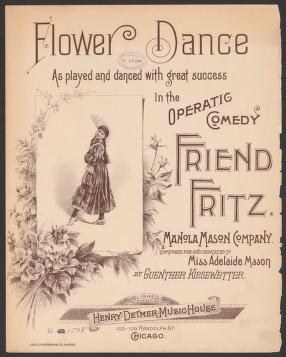
This poster is evidence of how dance existed within operatic comedy and musical theater at the end of the 19th century in America—a repertory now largely lost to history. The "Flower Dance" exemplifies the type of specialty solo or character piece that was used to showcase a performer's talents and draw audiences, a convention central to American popular theater of the period.
What you are looking at
This is a printed theatrical advertisement or poster for an operatic comedy titled *Friend of the Ritz*, produced by the Mabela Mason Company and featuring Miss Adelaide Mason. The image shows a single female dancer in an elegant costume dominating the composition. She wears a long, fitted dress with a full skirt in what appears to be a floral or patterned fabric, with a narrow waist and long sleeves—typical of 1890s fashionable dress. Her posture is refined and upright, with one arm raised gracefully. The figure is framed by decorative Art Nouveau–style floral borders on the left and right sides of the composition, featuring climbing vines and blossoms that were characteristic of poster design of the period. The title "Flower Dance" appears at the top in ornamental lettering, and the text indicates the dance was performed with "great success" in this operatic comedy. The overall aesthetic is that of a theatrical promotion aimed at advertising the production and the featured performer's talents.
The dancing
A single female figure occupies the center of the composition, standing in an upright, dignified posture. Her right arm is raised to shoulder height with the hand positioned delicately, while her left arm hangs at her side. Her head is tilted slightly, suggesting a moment of elegant repose or graceful contemplation rather than dynamic movement. The figure's body shows no extreme extension or dramatic torsion—the pose is refined and contained within a vertical frame. The long skirt falls smoothly to the floor, with no visible indication of footwork or turn. The overall frame is one of restrained elegance rather than acrobatic or virtuosic display.
The dance depicted
The "Flower Dance" appears to have been a choreographed solo within an operatic comedy production, likely performed in a theatrical rather than ballroom context. The title and the Art Nouveau floral framing suggest a light, decorative character piece—possibly a pantomime or interpretive dance common to musical theater of the 1890s. The pose and styling do not indicate classical ballet vocabulary (no turned-out positions, pointe work, or tutu); instead, the costume and deportment suggest a contemporary social or theatrical dance in the idiom of musical theater or operatic entertainment. Without additional documentation, the specific choreography and its origins remain unknown, but the work's success and commercial promotion indicate it was a popular audience favorite.
How it was made
This is a lithographic print, evident from the characteristic line work, tonal gradation, and color application visible in the image. The printing technique allowed for theatrical posters to be produced efficiently and distributed widely, making it an ideal medium for advertising performances and performers. The decorative Art Nouveau border and ornamental lettering were well suited to lithography's capacity for fine detail and flowing, organic forms. The presence of this promotional material suggests a well-established theatrical production with sufficient backing to commission professional poster design and printing—a marker of the work's commercial significance and the performer's prominence.
About this work
This is a theatrical poster advertising a "Flower Dance" performed by Miss Adelaide Mason in the operatic comedy *Friend of the Ritz*, produced by the Mabela Mason Company and staged in Chicago in 1894. The work is a document of late 19th-century American musical theater, a period when operatic comedies and light comedies were major entertainment forms, and when individual dancers and performers were marketed to audiences through illustrated posters. The image preserves not only a record of a specific performance and performer but also the aesthetic conventions of 1890s theatrical promotion—the emphasis on elegant costuming, the integration of decorative design, and the framing of the performer as a central attraction.
How to look at it
The viewer should attend to the stillness and composure of the figure, which suggests a posed moment rather than captured movement—characteristic of theatrical portraiture and promotional imagery of the period. The decorative floral frame is not merely ornament but thematically tied to the dance's title, suggesting a visual metaphor or symbolic correspondence between the performer and nature. The elegance and restraint of the pose reflect the social conventions and aesthetic ideals of the 1890s, where dignified bearing and refined costume were paramount markers of theatrical respectability and appeal.
The artist
The artist is not recorded. The poster was published by Henry Derkum Music House of Chicago, a music publisher and theatrical promoter active in the 1890s.
The period
The 1890s saw a flourishing of operatic comedy and musical theater in America, a period between the dominance of classical ballet in Europe and the emergence of modern dance in the early 20th century. Theatrical dance during this era often took the form of specialty numbers within operatic or comedic narratives—dances tied to character, mood, or plot rather than to a coherent dance vocabulary. The lithographic poster was the primary means of theatrical advertisement, and the Art Nouveau style visible in this image was at the height of its influence in commercial graphic design. Chicago, where this production was staged, was a major center of theatrical production outside New York.
Where it lives
The poster is held by the Library of Congress. It is a commercial theatrical advertisement, typical of the promotional material generated by theatrical productions and published by local music and ticket distributors.
Dance in this work
Questions about this work
Was this a ballet?
No. The costume, pose, and theatrical context indicate this was a musical theater or operatic comedy piece, not a classical ballet. There is no evidence of ballet vocabulary in the image—no turned-out positions, pointe work, or tutu. It was likely a solo character piece or specialty dance.
Who was Adelaide Mason?
She was a theatrical performer featured in the Mabela Mason Company's production of *Friend of the Ritz*. Beyond her appearance in this 1894 production, biographical details are not recorded in the poster or the Library of Congress record.
What was a 'Friend of the Ritz'?
It was an operatic comedy produced by the Mabela Mason Company in Chicago in 1894. The *Ritz* hotel was a symbol of luxury and modernity in the 1890s, and the title likely played on contemporary fascination with high society. The 'Flower Dance' was one of the featured musical numbers in the production.
Why was this poster made and distributed?
Theatrical posters were the primary advertising medium for stage productions in the 1890s. They were displayed in public spaces, in theater lobbies, and in print shops to attract audiences and build interest in upcoming performances. This poster was designed to promote both the production and Adelaide Mason's talents as a performer.
More dance artwork





