49 works in this view — arrow keys or swipe to move between them.
Dance in Art · 1772
A treatise on the art of dancing
Unknown artist
- Source:
- Library of Congress
- Rights:
- Public domain — free to use, share and adapt.
- Recorded as:
- Public Domain
For dancers and historians, this work is evidence of how 18th-century dance instruction was visualised and transmitted. It shows that dancing was understood as a teachable, demonstrable skill with rules and proportions that could be illustrated—part of the systematic codification of dance that defined the era. It also captures the social ritual surrounding dance: the distinction between dancer and spectator, the formality of the setting, the public dimension of what might seem like private accomplishment.
What you are looking at
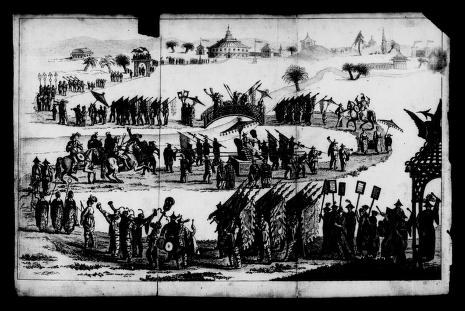
This engraving depicts a large outdoor gathering organized around formal dance instruction or demonstration, likely from the mid-to-late 18th century. The composition is structured in horizontal tiers showing different groups: in the foreground, a dense cluster of figures in formal dress (coats, tricorn hats, long skirts) observe or participate in dancing; in the middle ground, pairs and small groups perform coordinated movements in open space; in the background, further spectators, musicians, and architectural structures (a building and what appears to be a pavilion or reviewing stand) establish the scale of the event. The entire scene unfolds in bright, even light across the full width of the composition. Flags or standards are visible at right, suggesting a formal or ceremonial occasion. The density and organisation of the crowd suggests this is a public or semi-public demonstration of dancing as a refined accomplishment—not an intimate performance but a display for an assembled gathering of the quality.
The dancing
The dancers visible in the middle ground stand in what appears to be paired formation, with upright posture and deliberate, measured spacing. Their arm positions and the geometry of their stance suggest the formal constraints of 18th-century court dance: the body held erect, arms held at a controlled height, the motion restrained and geometric rather than expansive. Several figures appear to be in the process of executing a turn or promenade. The spectators around them maintain formal dress and a clear separation from the dancing space, indicating that dancing was a skilled performance to be watched rather than a participatory social activity at this moment.
The dance depicted
The evidence points to a formal 18th-century European dance instruction or demonstration, most likely a minuet, cotillion, or similar court dance from the historic-baroque or historic-regency tradition. The title references a treatise on dancing—a didactic text—and the image appears to show such a treatise visualised as a public lesson or performance. The structured pairs, the formal spacing, the upright carriage, and the presence of what may be a master or instructor figure all align with the pedagogical dance culture of the period, when dancing masters publicly demonstrated proper technique and deportment. The minuet was the dominant courtly dance of this era, though cotillions and quadrilles also featured similar formal structures.
How it was made
This is an engraving, likely a copper plate engraving given the fine parallel line work (hatching) visible throughout, which creates tone and shadow. The technique allowed for precise linear rendering of the crowd's architecture and the articulation of individual figures across a complex, multi-figural composition. Engravings of this scale and detail were labour-intensive and expensive to produce, suggesting this image was created for a published treatise or collected prints intended for an educated, affluent audience—likely dance masters, nobility, or wealthy merchants with leisure and education. The distribution of such prints would have been limited and relatively formal; this was a medium for instruction and record rather than mass circulation.
About this work
This engraving visualises the public, formal world of 18th-century European dance instruction and performance. It appears to illustrate or accompany a printed treatise on dancing—a genre that flourished in the 1700s as dance became increasingly codified and standardised across courts and ballrooms. The image is valuable because it documents not just the dance itself but its social context: how it was taught, who watched, what role it played in the ritual and display of genteel culture. The composition's careful organisation and the engraver's attention to the formal spacing and posture of the dancers suggest this was created by someone with direct knowledge of dance pedagogy and the expectations governing refined movement in the period.
How to look at it
The viewer should attend to the careful symmetry and spacing of the composition, which mirrors the ordered, geometric quality of the dances themselves. Look at how the engraver has distinguished dancers from spectators through their positioning and the clarity with which their bodies are articulated. Notice the formality of stance and the way the figures maintain distance from one another—this restraint and geometry is fundamental to understanding 18th-century courtly dance. The presence of architectural framing and the flag standards suggest this is not a private dance but a public performance or demonstration, staged for an audience of some status.
The period
The 18th century saw an explosion of printed treatises on dancing, beginning with Raoul-Auger Feuillet's *Chorégraphie* (1700) and continuing through works by Pierre Rameau, Jean-Noël Marchand, and others. These treatises codified a system of notation and described in precise terms the steps, positions, and deportment of courtly dances—minuets, cotillions, rigaudons, and their variants. The period also witnessed the gradual democratisation of dance instruction: while dancing remained essential to nobility, it became increasingly important to the merchant and professional classes. Public dance lessons and demonstrations, like the one depicted here, were common venues where dance masters displayed their expertise and pupils demonstrated mastery. The engraving as a medium was ideal for circulating these images and instructions across geographic and social boundaries.
Where it lives
The work is catalogued as coming from the Library of Congress. The date 1772 and the title suggest it is a plate or print from a published treatise on dance, likely printed and circulated in France or another European court culture.
Dance in this work
Questions about this work
What dance is being shown here?
The specific dance is not certain, but the formal paired arrangement, upright posture, and measured spacing are consistent with a minuet or cotillion—the dominant courtly dances of the 1760s–1770s. The engraving was created to illustrate a treatise on dancing, so it may represent an ideal or typical lesson rather than a single named dance.
Why are there so many spectators?
In 18th-century court and ballroom culture, dance was a social and aesthetic performance as much as a participatory activity. Dance masters demonstrated technique and propriety, and spectators—whether aspiring dancers, patrons, or curious onlookers—attended to learn or to witness displays of refinement and skill. Public demonstrations were teaching events.
What is a treatise on dancing?
Beginning in 1700, dance masters began publishing systematic treatises that described and illustrated dances step-by-step using notation, verbal description, and engravings like this one. These treatises standardised dance across Europe and allowed knowledge to circulate in print rather than only through living instruction.
More dance artwork





