49 works in this view — arrow keys or swipe to move between them.
Dance in Art · 1908
The Banjo dance
Unknown artist
- Source:
- Library of Congress
- Rights:
- Public domain — free to use, share and adapt.
- Recorded as:
- Public Domain
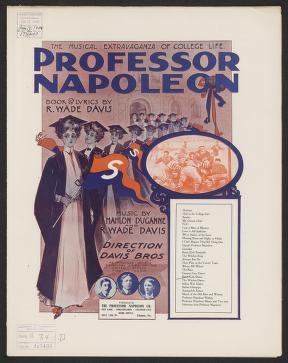
This poster documents the crucial moment when American social ballroom dance entered popular theatrical culture as a marketable subject. For dancers and historians of the Jazz Age, it provides visual evidence of how partner dancing was actually staged, held, and imagined in early twentieth-century theater. The work shows the aesthetic distance between ballroom vernacular and theatrical presentation—the vignette is stylized and energetic, but recognizably rooted in actual social practice.
What you are looking at
This is a theatrical poster advertising a stage musical set in a college environment. The composition is divided between two narrative spaces. On the left, a group of college-aged figures in formal academic dress—mortarboard caps and robes—stand in conversation, with one figure in darker clothing dominating the foreground. On the right, a circular vignette shows a lively dance scene in what appears to be a dining hall or college social space, with multiple couples in evening dress engaged in animated movement. The setting registers as 1920s American collegiate life, the kind of aspirational Ivy League world that theatrical comedies of the era celebrated. The poster uses bright primary colors—particularly the bold blue of the title lettering—to draw the eye, and the two scenes are connected visually by the overlapping composition, suggesting that the academic frame on the left leads into the social revelry on the right. The overall effect is one of youthful exuberance contained within institutional formality.
The dancing
In the college scene at left, the figures stand in upright, formal postures appropriate to academic dress, with minimal bodily engagement—these are observers and setup figures. In the dancing vignette at right, the dancers move in pairs with clear partnering: upright torsos, arms engaged in social hold positions, and a sense of forward momentum and rotation through the space. The dancers appear to be in closed or semi-closed holds, with the women in knee-length evening wear and the men in formal dinner jackets. The poses suggest energetic social dancing rather than exhibition technique—the bodies are relaxed and sociable rather than technically precise.
The dance depicted
This is almost certainly a theatrical representation of American social ballroom dancing of the 1920s era, likely the Foxtrot or a general 'college dance' style of the period. The vignette shows the kind of social partner dancing that would have been standard at American college social events—informal, partner-based, and rooted in the ballroom styles that dominated the Jazz Age. The image tells us nothing about technical execution, but everything about how such dancing was imagined and marketed to audiences: as youthful, energetic, mixed-gender social interaction, the kind of 'innocent fun' that college life supposedly offered. This is vernacular social dance framed as theatrical entertainment.
How it was made
This is a color lithographic theater poster, a commercial print medium that allowed for vibrant color reproduction and wide distribution. The technique allowed the designer to combine bold graphic lettering with illustrative scene work—notice how the blue type dominates visually while the figurative scenes below provide narrative context and mood. Lithography was the standard medium for American theatrical promotion in this period, allowing theaters to produce eye-catching lobby and street advertising at modest cost. The print appears to be in good condition, suggesting either recent preservation or careful handling since its creation.
About this work
This is a promotional poster for a musical comedy set in an American college, circa 1908, advertising the theatrical experience of college life as spectacle. The work belongs in a gallery about dance because it documents how social ballroom dancing was visually marketed to theater audiences in the early twentieth century—not as artistic performance but as the colorful backdrop of youthful social life. The dance imagery is secondary to the theatrical frame, but it is precisely this vernacular use of dance that makes the poster historically important: it shows us what ordinary dance looked like to ordinary audiences, and what cultural value was attributed to it. The poster is a document of how dance functioned in American popular culture—as the sign and substance of youth, sociability, and modern pleasure.
How to look at it
The poster uses two registers to tell its story: the formal, still world of academic life on the left, and the dynamic, circular world of dance and social pleasure on the right. The artist has chosen to freeze the dance in a moment of peak energy—couples mid-turn, bodies inclined, the scene full of motion even in stillness. Notice how the circular vignette isolates and romanticizes the dance scene, making it a dream or fantasy emerging from the academic world. The formal dress visible in both scenes—mortarboards and academic robes in one, dinner jackets and evening gowns in the other—signals that this is dancing within propriety and institution, not transgressive or bohemian. The viewer is meant to read the progression from academic formality to social dancing as natural and desirable.
The artist
The artist and designer are not recorded in the catalogue. The poster credits Dodge Brothers as producers and Davis Bros. (likely the printing firm) as the printing house, but the illustrator's identity is unknown. The design is competent commercial work, with professional understanding of lithographic color separation and poster composition, but it is typical of theatrical advertising production rather than individually authored artistic vision. Such posters were often produced by in-house designers at printing firms or theater companies, with little individual attribution.
The period
This poster dates to 1908, a moment when American theater was consolidating the musical comedy as a form, and when ballroom dancing—particularly the Foxtrot and other couple dances—was beginning its transformation from salon practice into mass entertainment. The college setting reflects broader American anxieties and fantasies about youth, modernity, and social mixing in the early twentieth century. Theater was the primary mass medium for disseminating images of dance and dancing bodies; moving pictures were still primitive and theatrical spectacle dominated. The aesthetic of the poster—bright colors, energetic figuration, narrative frame—is characteristic of the commercial chromolithographic posters that dominated American streets and theater lobbies in this period.
Where it lives
The poster is held in the Library of Congress collections, which acquired it as part of their theater poster and advertising ephemera holdings. It is catalogued as a theatrical poster (printed promotional material), one of many thousands documenting American commercial theater in the early twentieth century.
Dance in this work
Questions about this work
What is the 'banjo dance' in the title?
The title may refer to a specific musical number within the show, or it may be a period colloquialism for lively, syncopated social dancing. Without access to the show's script or music, we cannot be certain. The image shows standard ballroom couple dancing, not any recognizable dance form associated with banjos. The title may be the name of a song, a scene, or a dance number that the poster does not visually depict.
What is 'Professor Napoleont'?
This appears to be the title of the musical comedy being advertised. The professor frame suggests a pedagogical comedy—a common theatrical genre of the period, where a figure of authority (often foreign or eccentric) disrupts or improves American life. The 'Napoleon' reference suggests a foreign or continental character, which would account for the presence of dancing and social transgression in the narrative.
Who are the credited performers?
The poster credits Harold Egan, William Wade Davis, and direction by Davis Bros. (though this may be the printing firm). These names appear to refer to performers or producers, though the poster does not clearly distinguish roles. Without additional research into early twentieth-century theater archives, we cannot establish who played which part.
What style of dancing is shown?
The closed or semi-closed holds, upright posture, and formal evening wear suggest ballroom social dancing of the 1920s, most likely the Foxtrot or a generic 'modern dance' style of the period. The dancing is not exhibition or competition style, but rather the kind of social partner dancing that would have been normal at college social events. The energy and dynamism of the vignette suggests vigorous, joyful social dancing rather than technically precise ballroom technique.
More dance artwork





