49 works in this view — arrow keys or swipe to move between them.
Dance in Art
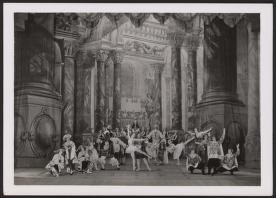
Photograph of Aurora's Wedding, n.d. (later Ballet Russe Company); Raoul Barba, Monte-Carlo
Unknown artist
- Source:
- Library of Congress
- Rights:
- Public domain — free to use, share and adapt.
- Recorded as:
- Public Domain
The Sleeping Beauty is the cornerstone of the classical ballet repertory, and The Ballets Russes was the vehicle through which the West came to know it. This photograph documents the actual stage realization of one of ballet's most iconic moments—the apotheosis—and shows how ensemble, architecture, and lighting were orchestrated to create spectacle and grandeur in the early 20th century.
What you are looking at
A grand theatrical interior—likely the palace setting of The Sleeping Beauty—is densely populated with figures in elaborate costumes arranged across a deep stage. The architecture is monumental: tall ornamental columns recede into shadow, creating a colonnade effect, with richly decorated walls and ceiling visible above. The lighting is theatrical, concentrated on the foreground where the action unfolds, leaving the architecture in chiaroscuro. In the center and mid-ground, a large ensemble of dancers and courtiers occupy the stage in what appears to be a wedding celebration: women in long, full skirts and men in formal dress move through a formal configuration. The composition is crowded and processional rather than unified in a single formation—groups cluster and separate, suggesting the pageantry of a ceremonial scene rather than a synchronized ensemble number. The photograph captures the depth and spectacle of a large-scale narrative ballet production.
The dancing
The dancers are arranged in loose spatial groupings rather than a tight corps formation. Women wear long, full-skirted gowns that would support classical ballet technique; men wear formal court dress. The postures visible are generally upright and formal, consistent with classical ballet's carriage and frame. No extreme extensions or floor work are evident; the focus is on the spatial arrangement and processional quality of movement through the architectural space. The density of figures—easily thirty or more visible—suggests a large ensemble scene typical of the grand divertissement or apotheosis of a classical ballet.
The dance depicted
This is Aurora's Wedding from The Sleeping Beauty, the apotheosis of Tchaikovsky's most famous ballet. The photograph records a production by the Ballet Russe company, staged at Monte-Carlo under Raoul Barba's direction. The scene represents the grand pas d'action and final celebration following Aurora's awakening and betrothal—a moment of pageantry and court ceremony rather than virtuosic display. The heavy use of the ensemble, the emphasis on processional arrangement, and the theatrical architecture all align with the classical Russian Imperial ballet tradition that Diaghilev's Ballets Russes inherited and performed. This is not a small-scale or intimate work but a grand spectacle dependent on corps depth, spatial composition, and dramatic lighting to create its effect.
How it was made
This is a black-and-white photograph, likely taken during a performance or dress rehearsal. The quality and grain are consistent with theatrical photography of the early-to-mid 20th century. Photography allowed the documentation of large ensemble work and spatial depth that drawing or painting alone could not easily achieve; it also captured the actual lighting conditions of a stage production. The photograph's value lies precisely in its documentary fidelity: it shows us the actual scale, density, and spatial arrangement of the scene as audiences experienced it, including the architectural setting and the coordination of large numbers of bodies across a deep stage.
About this work
This photograph documents Aurora's Wedding from a Ballet Russe Company production, capturing the grand apotheosis of Tchaikovsky's The Sleeping Beauty as realized on the early 20th-century stage. The image shows the scale and pageantry expected of the classical Russian Imperial ballet tradition: a densely populated ensemble scene set within monumental theatrical architecture, lit dramatically to emphasize both the dancers and the space they occupy. The work is a record of the Diaghilev era's approach to classical ballet—faithful to the original Russian choreography yet enhanced by the company's attention to design, lighting, and spectacular presentation.
For dancers and historians, the photograph serves as evidence of how this foundational work was staged and experienced during the Ballets Russes period, when Diaghilev's company was the primary conduit through which European and American audiences encountered classical Russian ballet.
How to look at it
Attend to the composition in depth: notice how the architecture recedes and how figures are distributed from foreground to back stage, creating the illusion of a vast ceremonial space. The lighting concentrates attention on the lower foreground while the columns and upper architecture fade into shadow, a technique that emphasizes the performers while maintaining the grandeur of the setting. Look at how many dancers occupy the stage and how loosely they are arranged—this is not the precision of a modern corps de ballet but the more processional, pageant-like quality of early 20th-century classical ballet staging. The photograph is frozen mid-action, but its power lies not in capturing an instant of movement but in documenting the spatial and dramatic architecture of the scene.
The artist
The photograph is attributed to Raoul Barba, who is identified in the record as being associated with the Ballet Russe Company production. Barba may have been the company's photographer or the stage designer; the record does not specify his role. Theatrical photography of this period was often produced by official company photographers working in major cultural centers like Monte-Carlo, where the Ballets Russes maintained a base.
The period
The Ballet Russe Company (1909–1929) inherited the classical Russian Imperial ballet tradition—including Petipa's 1890 Sleeping Beauty—and brought it to Western European and American audiences for the first time. By the 1920s, when this photograph likely dates, the company was performing Sleeping Beauty regularly alongside new work by Fokine and others, demonstrating Diaghilev's commitment to the classical repertory even as he championed modernism. The photograph reflects the interwar period's confidence in grand theatrical spectacle and the emerging art of theatrical documentation through photography.
Where it lives
The photograph is held by the Library of Congress. It is identified as documenting a Ballet Russe Company production of Aurora's Wedding, staged at Monte-Carlo, with no date or photographer clearly specified in the existing record beyond the attribution to Raoul Barba. The work is part of the LOC's theatrical photograph collection.
Dance in this work
Questions about this work
Is this from the original 1890 Sleeping Beauty, or a later production?
This is from a Ballet Russe Company production, not the original 1890 Imperial Ballet premiere. The Ballet Russe, founded by Sergei Diaghilev in 1909, performed the Petipa-Tchaikovsky Sleeping Beauty throughout its existence as a key work in its classical repertory. The company brought the work to Western audiences and performed it regularly from around 1921 onward.
What is Aurora's Wedding?
Aurora's Wedding is the final scene of The Sleeping Beauty, also known as the apotheosis. It occurs after Aurora has been awakened by the Prince's kiss. The scene is a grand celebration and a feast of classical dancing, originally featuring the four diamond variations, a grand pas d'action, and extensive corps work. It is one of ballet's most demanding ensemble moments.
Why is the stage so crowded?
The wedding scene in Sleeping Beauty is designed as a pageant and courtly celebration. The large ensemble fills the stage to create spectacle and grandeur, reinforcing the sense of an entire court gathered for the ceremony. This was (and is) the standard approach to the scene in classical Russian ballet.
What does Raoul Barba's name mean in this context?
The record is unclear whether Barba was the photographer, the stage designer, a dancer, or a company administrator. He is associated with the Monte-Carlo production, which was the Ballet Russe's home base during the 1920s. Further research in Ballet Russe archival records would clarify his role.
More dance artwork





