49 works in this view — arrow keys or swipe to move between them.
Dance in Art · 2016
Dancing
Unknown artist
- Medium:
- Source:
- New York Public Library
- Rights:
- Public domain — free to use, share and adapt.
- Recorded as:
- public_domain
This print matters because it documents dance not as a trained art form but as a lived social practice among working people, a perspective often absent from dance history. The WPA's commitment to producing and circulating such imagery means this work reached audiences far beyond concert halls and galleries, making dance culturally central rather than elite.
What you are looking at
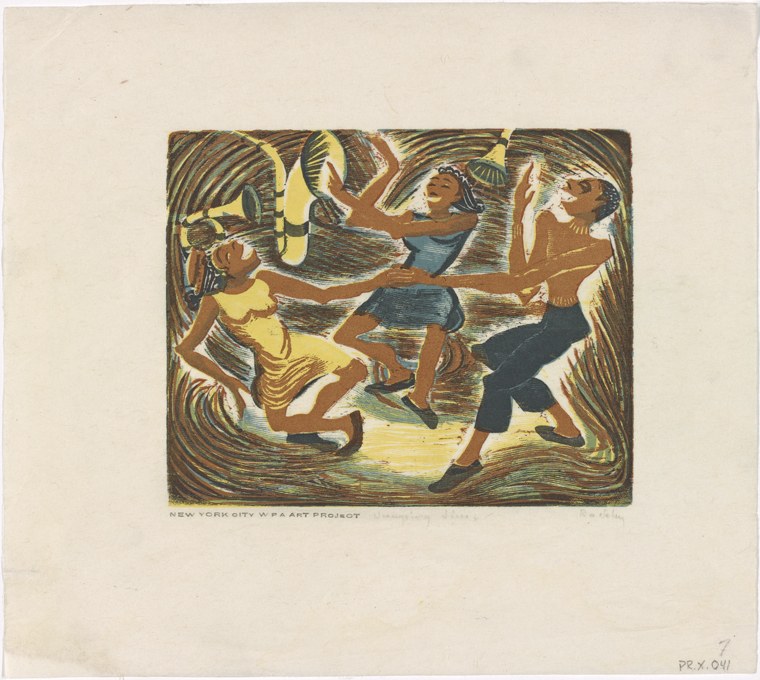
Four figures dance energetically against a background of dense, parallel hatching lines in gold and brown that suggest movement or a swirling environment. The dancers wear minimal, form-fitting clothing in contrasting colors—yellow, blue, and black—that emphasizes their bodies. All four figures are caught in dynamic, mid-movement poses with limbs extended and torsos twisted. The composition is tightly framed, with the dancers filling nearly the entire rectangular space. The style is expressionistic, with bold outlines and flattened forms characteristic of woodcut or linocut printing. The scene conveys exuberance and spontaneous joy rather than formal choreography.
The dancing
All four dancers are in open, unbound positions with no partner holds or formal frames. Their limbs are extended outward—legs kicked or striding, arms reaching upward and sideways—suggesting vigorous, unstructured movement. The dancers appear to be mid-leap or mid-stride, with bodies twisted and off-balance in ways that suggest playful improvisation rather than controlled technique. Their weight is distributed unevenly, creating a sense of abandon. The poses suggest social, folk, or vernacular movement rather than trained ballroom or theatrical technique.
The dance depicted
This appears to depict informal, joyful social dancing rather than any codified dance style. The energy and lack of formal hold suggest celebratory or recreational movement—possibly jazz-age social dancing, folk celebration, or street dance from the early-to-mid twentieth century. The artist has captured a moment of exuberance without representing the specific footwork or frame of any named style. The work documents the spirit of dance rather than its technical vocabulary.
How it was made
This is a color woodcut or linocut print, identifiable by the bold outlines, flat color fields, and characteristic parallel hatching lines. The technique allowed for expressive distortion of form and emphasized gesture over anatomical detail. The WPA Art Project credit on the print suggests this was part of a Depression-era public art initiative. This medium was chosen for its directness, visual impact, and affordability for mass circulation—appropriate for art intended to reach and represent working people.
About this work
This color woodcut print captures four figures in uninhibited, joyful movement against an abstracted, energized background. The print belongs to the WPA (Works Progress Administration) Art Project, a U.S. government initiative of the 1930s–1940s that funded artists and produced affordable artwork celebrating American life and labor. The work documents not a specific dance technique but the experience of dancing itself—the freedom, energy, and social pleasure of movement among ordinary people. It sits at the intersection of modernist formal experiment and vernacular social documentation, using the directness of the woodcut medium to convey immediate physical joy.
How to look at it
Notice the way the artist has used the woodcut's bold outlines and hatching to convey movement itself, not just the dancers' bodies. The parallel lines in the background seem to radiate outward, amplifying the sense of energy. Look at how each figure occupies a different moment in motion, creating a sense of sequential movement around a shared space. The absence of a ground line or architectural setting suggests that the dance itself—the movement and the space it generates—is the primary subject.
The artist
The work is documented as part of the New York City WPA Art Project but the artist's name is not recorded in the catalogue. The WPA employed thousands of visual artists during the Great Depression, many of whom are now unknown, though their works survive in public collections. The style—expressionist woodcut with social-documentary subject matter—was typical of WPA printmaking.
The period
This print was made during the American WPA era (approximately 1935–1943), when government arts funding made visual art a tool for representing American labor and social life. In dance, this was the era of American modern dance's emergence (Graham, Humphrey, Limón) and of swing and jazz-age social dancing at its height. The WPA's commitment to documenting everyday American experience meant that vernacular dance—street dancing, social celebration, folk movement—received artistic attention alongside concert performance. The woodcut technique itself connected the work to earlier German Expressionism and social-realist printmaking.
Where it lives
This print is held in the New York Public Library collection and is documented as part of the WPA Art Project, a federally funded initiative that produced prints, paintings, and sculptures for circulation to schools, libraries, and public buildings across the United States.
Questions about this work
Who made this print?
The artist's name is not recorded in the Library's catalogue. It was created as part of the New York City WPA Art Project, a federal employment program during the Depression. Many WPA artists remain unidentified in surviving records.
What dance style is this?
The print does not depict a specific codified style. Instead, it captures the spirit of social, recreational dancing—the kind of uninhibited movement that might happen at a community gathering, street celebration, or informal social event. The focus is on the joy of movement rather than technique.
What is a woodcut print?
A woodcut is made by carving an image into the surface of a wooden block, inking the raised areas, and pressing paper onto it. The technique produces bold outlines and flat color areas, and is well-suited to expressive, high-contrast imagery. Color woodcuts, like this one, require separate blocks for each color.
Why was the WPA making art about dancing?
The WPA's goal was to document and celebrate American life and labor. Dance—especially social, vernacular dance—was understood as part of the lived experience of ordinary Americans. Art about dancing was art about community, joy, and cultural expression.
More dance artwork