25 works in this view — arrow keys or swipe to move between them.
Dance in Art
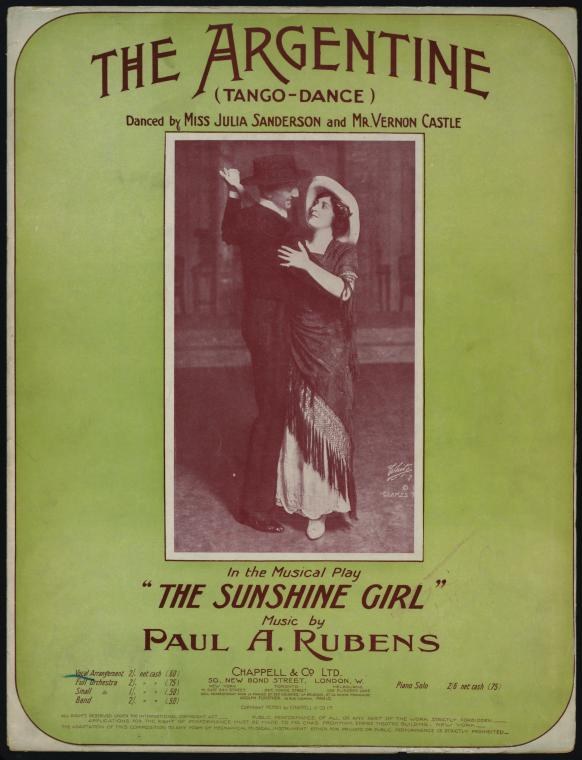
The Argentine (tango) : duet:-Delia and Lord Bicester
Unknown artist
- Medium:
- Illustration
- Dance:
- Tango
- Era:
- 1900-1920 (Ragtime/Early Jazz)
- Source:
- New York Public Library
- Rights:
- Public domain — free to use, share and adapt.
- Recorded as:
- public_domain
This image documents Argentine tango at a crucial moment of cultural translation, when the dance was being transformed from a social vernacular form into a commodity for international theatrical audiences. The photograph shows the specific staging conventions, costuming, and partnering that defined early professional tango performance, preserving visual evidence of how dancers like Delia and Lord Bicester communicated the dance to paying audiences unfamiliar with its origins.
What you are looking at
A man in dark formal evening dress and a woman in a light-colored dress with fringe detailing stand in a close dance hold against a muted interior setting. The woman wears a wide-brimmed hat and gazes upward while the man looks down at her, their bodies angled in the characteristic Argentine tango embrace. The photograph, hand-tinted in sepia and burgundy tones, captures the moment with soft theatrical lighting that emphasizes the couple's intimacy. The composition is tightly framed on the two figures, isolating them against a dark background suggestive of a stage or studio setting.
The dancing
The pair occupy a closed, proximate hold characteristic of tango: the man's right arm encircles the woman's back, his left hand extended to hold hers at chest height. Both bodies are tilted in the classic tango frame, with the woman leaning slightly back into the embrace. The woman's weight appears transferred to her back leg, a posture suggesting a moment of extension in the dance rather than active stepping. Their relative heights and the angle of the embrace suggest practiced partnership, with the woman's upward gaze contrasting the man's downward attention creating a theatrical emotional register.
The dance depicted
This is Argentine tango as performed in early 20th-century theatrical contexts. The title identifies the dancers as Delia and Lord Bicester, and the work appears to document a staged performance rather than a milonga. The image captures tango during its transition from working-class Buenos Aires ballrooms to international theatrical presentation and ballroom competition. The theatrical lighting, formal studio setting, and carefully composed embrace suggest professional dancers performing for an audience rather than social dancing. The woman's elaborate hat and evening wear indicate the glamour and fashion consciousness with which tango was marketed to Western European and North American audiences in this period.
How it was made
This is a hand-tinted photograph, likely a theatrical publicity still or promotional image for a stage production or dance tour. The sepia and burgundy toning was applied to the gelatin silver print base, a common practice for theatrical photographs in the 1900s-1920s. This technique allowed affordable mass circulation of high-quality images to newspapers, magazines, and theatre lobbies, making it a primary vehicle for promoting dance performers and productions. The soft focus and careful studio lighting were deliberate choices emphasizing the dancers' forms and emotional connection rather than technical detail.
About this work
This is a staged Argentine tango photograph from the early 20th century, documenting the dance as it was presented to Western audiences during its period of international expansion and theatrical legitimacy. The image records both the hold and aesthetic conventions of early professional tango performance, showing how the dance was packaged and promoted through theatrical and commercial channels. The formal studio setting and hand-tinted technique place it squarely within the apparatus of theatrical publicity and dance promotion that characterized the early 1900s. For historians and dancers, the photograph provides evidence of how Argentine tango was codified and aestheticized as it moved from Buenos Aires dance halls to European and American stages.
How to look at it
Observe the tango frame itself—the closed hold, the tilt, the extended line from the man's left shoulder through his arm to the woman's hand. This is the foundational geometry of tango, and the photograph freezes it at a moment of extension and emotional intensity rather than active stepping. Notice how the woman's upward gaze and the man's focused downward attention create a narrative of romantic partnership that would have appealed to Western audiences unfamiliar with tango's roots in working-class dance halls. The theatrical lighting and studio setting signal this is performance for an audience, not social dancing; the couples' formal dress and the woman's fashionable hat announce that tango has been absorbed into respectable entertainment culture.
The artist
The photograph is uncredited. Its status as a theatrical publicity image produced for commercial distribution suggests it came from a professional theatrical photography studio rather than an independent artist. Such studios produced standardized images designed for press reproduction and marketing, prioritizing clear visibility of the performers' forms and embrace over technical dance documentation.
The period
Argentine tango emerged in late 19th-century Buenos Aires as an urban working-class social dance, evolving from Cuban habanera, Uruguayan candombe, and local milonga traditions. By the early 1900s, tango had reached Paris and London through traveling performers and European interest in exotic ballroom forms. Between 1900 and 1920, tango underwent rapid transformation: initially condemned as scandalous and sexually suggestive, it was gradually legitimized through theatrical performance, ballroom standardization, and association with artistic and fashionable society. By the time this photograph was made, tango had become a vehicle for professional dancers seeking international careers, with performers like Vernon and Irene Castle popularizing it through stage shows and exhibition dancing. The theatrical presentation visible here reflects tango's successful navigation into respectable artistic contexts, its aesthetic refined for consumption by middle and upper-class audiences.
Where it lives
The image is held by the New York Public Library, suggesting it entered American theatrical archives as a promotional or press photograph. Its format and presentation as a hand-tinted theatrical still indicate it was one of many such images produced for circulation to newspapers, magazines, and theatre lobbies during the peak of tango's theatrical vogue in the 1910s-1920s.
Dance in this work
Questions about this work
Who were Delia and Lord Bicester?
The catalogue identifies them as the dancers in this image, but individual details of their careers and prominence are not recorded here. They appear to have been professional theatrical dancers performing Argentine tango during the early 20th century when the dance was being successfully marketed as a fashionable ballroom and stage form. Many such performers toured internationally and appeared in theatrical productions and dance exhibitions.
Is this social tango or stage tango?
This is clearly stage tango. The theatrical studio lighting, formal evening wear, carefully composed studio setting, and the photograph's function as a publicity image all mark this as professional performance for an audience rather than social dancing in a milonga. The posed quality of the embrace and the emotional register of the dancers' expressions are designed to communicate romantic drama to spectators.
What does the frame tell us about how tango was danced?
The closed hold, the tilt of both bodies, the extended arm line, and the proximity between partners were all foundational to tango technique. This image preserves visual evidence of the early standardized frame that professional dancers used. The moment captured—one of extension and emotional intensity rather than active stepping—shows how theatrical tango emphasized the hold and the emotional connection between partners as central aesthetic values.
When and where was this photograph made?
The catalogue dates this to 1900–1920 and the hand-tinting technique, theatrical styling, and costume design are consistent with that period. The specific location and photographer are not recorded. The image was likely produced as a promotional photograph in a major theatrical centre, possibly London, Paris, or New York, where tango was being actively promoted to fashionable audiences.
More Tango artwork
![[Les noces de trottoir, par les compagnies Tango Sumo et Vendaval. Chalon dans la rue. 2007 / photographies de Joël Verhoustraeten] by Verhoustraeten, Joël (1954-2019). Photographe](https://gallica.bnf.fr/iiif/ark:/12148/bc6p058zgkc/f1/full/800,/0/native.jpg)