46 works in this view — arrow keys or swipe to move between them.
Dance in Art · 2019
Drawing room polkas,
Unknown artist
- Medium:
- Drawing/Sketch
- Dance:
- Polka
- Era:
- Late 1800s (Victorian Ballroom)
- Source:
- New York Public Library
- Rights:
- Public domain — free to use, share and adapt.
- Recorded as:
- public_domain
This work documents what the polka meant to its audience: a fashionable, intimate, slightly risqué form of courtship conducted in the home. For historians of social dance and gender, it reveals how the polka was marketed and imagined—less as a technical challenge than as an encounter between eligible young people. It also demonstrates how dance was circulated visually in the nineteenth century, through affordable prints that helped establish and reinforce the polka's status as a symbol of modernity and romance.
What you are looking at
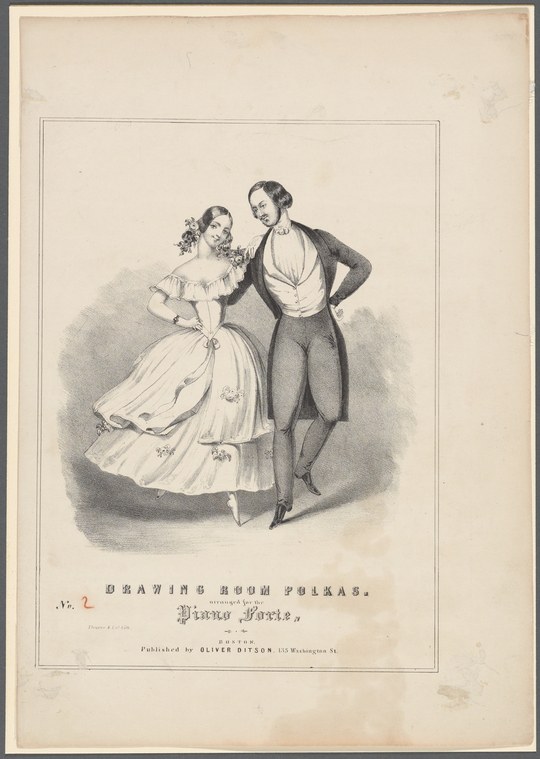
A lithograph showing a couple in an intimate moment of social dance, set against a plain background that emphasizes the figures. The woman wears a white or pale ball gown with a full skirt decorated with floral sprigs or embroidered details; her dark hair is styled in the fashion of the 1840s–50s with flowers or ribbons. The man is dressed in dark formal wear—a fitted coat and trousers—and stands beside her with his arm around her waist in a proprietary gesture. His posture and expression suggest gallantry or mild amusement; hers conveys pleasure or coquetry. The two are positioned close together in the kind of informal, flirtatious pose that belongs to drawing-room socializing rather than the formal structure of a ballroom set-piece. The composition is intimate and domestic, capturing a moment of courtship or playful interaction rather than an actual dance figure.
The dancing
The couple stand nearly face-to-face, the man's right arm clasped around the woman's waist while his left hand gestures expressively. The woman leans slightly into him, her body angled toward his, one arm raised in a gesture that suggests either flirtation or the moment just before or after taking his hand. Neither figure is in an active dance frame or hold—they are posed as if pausing within or between movements, or as if about to begin. The positioning suggests a waltz or polka embrace, but frozen in a moment of social interaction rather than kinetic movement.
The dance depicted
The title announces this as a 'Drawing room polkas' and the costume, setting, and pose all support an 1840s–50s origin when the polka was a fashionable salon dance across Europe. However, the image does not capture active polka footwork or the characteristic swaying, bouncing rhythm of the dance. Instead, it presents the social encounter around the dance—the moment of flirtation, proposal, or pause that frames the actual dancing. This is a work about courtship and drawing-room culture rather than about the polka itself, using the dance as a backdrop for romantic narrative.
How it was made
This is a lithograph, a technique evident from the soft grayscale toning, the delicate crayon or chalk marks, and the characteristic way light and shadow are rendered through layered stone. Lithography allowed for rapid, inexpensive production of multiple copies, making such images affordable for middle-class homes and periodicals. The quality and finish suggest this was a commercial print, likely from a series or published as a standalone sheet with a title printed below—the kind of domestic print that would have been sold in art shops or distributed by music publishers alongside polka compositions.
About this work
This is a lithographed scene of drawing-room polka culture in the mid-nineteenth century, a period when the polka was one of the most fashionable dances among European and American society. Rather than depicting the actual dance steps, it captures the social choreography that surrounded the polka—the moment of flirtation, invitation, or playful intimacy between a young couple in formal dress. The work is a commercial print, designed for circulation among the same audience who danced to and purchased polka music.
It belongs in a dance gallery not because it documents polka technique, but because it witnesses how the polka functioned as a vehicle for social interaction, courtship, and the rituals of middle-class leisure. The image tells us that the polka was not merely a physical accomplishment but a social event—a framework for intimacy and display in the drawing room.
How to look at it
Attend to the stillness of the pose—this is not an action shot but a moment of pause or anticipation, the kind of instant a lithographer could capture where an actual dancer in motion could not. Notice the woman's expression and body angle: she is both yielding to the man's embrace and retaining her own agency through her gesture and gaze. The composition is designed to foreground the social drama (who invites whom, how do they regard each other) rather than the footwork. The title promises dance, but the image delivers courtship.
The artist
The artist is not recorded. The print was published by Oliver Ditson in Boston, the major American music publisher of the mid-nineteenth century. Ditson's firm issued thousands of lithographed sheet music covers and prints of dances, fashions, and sentimental domestic scenes—most unsigned or attributed only to a generic 'drawn from life' or the publisher's house artists. This reflects the commercial production of such prints, where individual artistic identity was subordinate to the publisher's brand.
The period
The polka arrived in Western Europe in the 1840s and became the dominant social dance of the 1850s–60s, celebrated for its democratic, energetic character and its association with European nationalism and modernity. It displaced the staid cotillion and quadrille from the drawing room and became a symbol of youth and vivacity. At the same time, commercial chromolithography and sheet music publishing were expanding rapidly, creating a mass market for sentimental prints of fashionable life. This image dates to the height of the polka's vogue, when the dance was at the center of middle-class courtship, leisure, and self-presentation.
Where it lives
The print comes from the New York Public Library collection and was published by Oliver Ditson of Boston, a leading music publisher. It is a commercial lithograph, likely dating to the 1850s based on the costume and style. The holding and cataloguing suggest it was part of a series or miscellaneous group of dance prints and sheet music covers that Ditson distributed nationally.
Dance in this work
Questions about this work
Is this showing an actual polka dance?
No—the couple are posed as if in or near a dance moment, but the image does not show active footwork or the characteristic movement of the polka. Instead, it focuses on the social encounter and flirtation that surrounds dancing, the moment before or after the actual steps.
Who is the artist?
Unknown. The print was published by Oliver Ditson, a major Boston music publisher, but the artist is not credited. Such commercial prints were often produced by house artists or engravers whose names were not recorded.
Why would someone buy this print?
Prints like this were inexpensive, fashionable images sold alongside sheet music. A young woman might have pinned it to her wall as an image of the social world she moved in or aspired to; a household might have purchased it as decoration that advertised its knowledge of current styles and leisure practices.
What does the title 'Drawing room polkas' mean?
It identifies the polka as a drawing-room dance—a social dance for the home or domestic salon, as opposed to ballroom dances performed at public events. By the 1850s, the polka had become ubiquitous in middle-class homes as both a fashionable activity and a symbol of modern, informal sociability.
More Polka artwork