41 works in this view — arrow keys or swipe to move between them.
Dance in Art · 1911
Come and dance with me
Unknown artist
- Source:
- Library of Congress
- Rights:
- Public domain — free to use, share and adapt.
- Recorded as:
- Public Domain
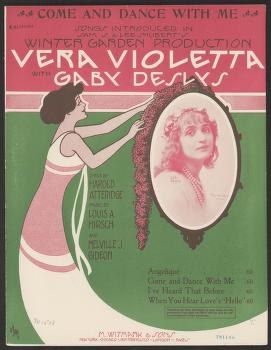
Sheet music covers are primary sources for understanding what dances were popular, how they were marketed to the public, and what aesthetic values dance was understood to embody. This image shows how commercial culture sold ballroom dance to early 20th-century audiences: not as technique or skill, but as beauty, elegance, and the promise of romantic connection. The integration of the performer's photograph alongside the idealized illustrated figure reveals the star system that was already central to popular dance by 1911.
What you are looking at
A stylized promotional image from 1911 advertising sheet music, divided into two halves. On the left, a woman in a flowing pale pink or rose-colored dress dances in an elegant, languid pose, her body arched gracefully and one arm extended. Her posture suggests a waltz or ballroom movement, weight shifted onto one leg with the other extended. The composition emphasizes flowing fabric and sinuous body line. On the right, an oval portrait frame contains a photograph of a woman's face in profile, labeled as one of the performers. The entire design uses the color palette of pale pink, deep rose, and soft green, typical of early 20th-century commercial lithography. The title "Come and Dance with Me" appears prominently at the top, framed by decorative flourishes.
The dancing
A single dancer, depicted in a moment of turning or pivoting rather than in a closed partnership hold. Her body is elongated and graceful, with one leg supporting her weight while the other extends through space. Her arms frame her body with a raised elbow and extended arm—characteristic of ballroom form—but the isolation of the figure and the emphasis on the body's line suggests this is more about the aesthetic appeal of movement than the technical execution of a specific step. The photograph beside her documents an actual performer of the piece.
The dance depicted
This is promotional material for a popular song from the early 1910s, a period when dance music and theater dance were closely linked through vaudeville, music halls, and commercial sheet music. The image advertises a ballroom or social dance number rather than a staged ballet or specialized dance form. The posture and carriage suggest the waltz, foxtrot, or other American smooth ballroom styles that were dominant in this era. The work is not a record of choreography but an advertisement designed to sell the song and create desire for the dance experience.
How it was made
This is a color lithograph on paper, characteristic of commercial sheet music covers from the early 20th century. Lithography allowed for rapid, relatively economical reproduction in color, making it the standard medium for popular music marketing. The technique's capacity for soft color gradation and flowing linework perfectly served the art nouveau and early modernist aesthetic that shaped commercial design in this period. The combination of illustration and integrated photograph is typical of theatrical and musical promotional materials from 1911.
About this work
This is a commercial sheet music cover from 1911, a moment when popular dance and theatrical dance occupied the same cultural space. The image advertises a ballroom dance number or musical theater piece, using the visual language of contemporary commercial art to promote both the music and the performers. As a document of early 20th-century popular dance culture, it records not the technical forms of ballroom dancing but the emotional and aesthetic values associated with it—grace, elegance, the beauty of a woman's moving body, and the promise of social connection and pleasure. The work sits at the intersection of dance, music, theater, and commercial visual culture, a hybrid form that defined how ordinary people encountered dance in their lives.
How to look at it
Attend to the posture and line of the dancing figure: the elongated body, the extension of the limb away from the supporting leg, the position of the arms and head. This is not technical precision but rather the creation of visual elegance and flow. The oval photograph beside the illustrated figure performs a dual function—it authenticates the image as based on a real performer while also creating a contrast between the idealized, stylized body of the dance and the documentary reality of the woman's face. The soft color palette and flowing linework create a mood of romance and pleasure rather than virtuosic display.
The artist
The artist is not recorded. The work is characteristic of commercial lithography studios in New York and other major American cities that produced thousands of sheet music covers in this era, many by now-anonymous designers. The art nouveau and early modernist influences visible in the flowing lines, stylized composition, and color palette were standard for commercial theatrical material of the period.
The period
By 1911, ballroom dancing had become a major popular entertainment in urban America. The foxtrot and other American smooth styles were emerging and would dominate the 1910s. Sheet music covers were central to how dance crazes spread; a popular song, a well-designed cover, and a striking performer could make a dance a national phenomenon. This image dates to the moment when dancing was transitioning from a participatory social activity confined to formal occasions to a spectator entertainment consumed through performance, theater, and film. The prominence of the female performer reflects the era's focus on women's dancing bodies as objects of visual pleasure.
Where it lives
This work is held by the Library of Congress. It is a sheet music cover, part of the vast collection of American commercial and popular music documentation. Sheet music covers are classified as graphic design, commercial art, and theater history, and constitute one of the most extensive archives of visual culture from the early 20th century.
Dance in this work
Questions about this work
Who is the woman pictured in the portrait?
The catalogue record does not identify her. The oval portrait contains a photograph of a woman in profile, presumably a performer associated with the song or number, but her name is not recorded in available documentation. Sheet music covers often featured performers' photographs, but many identities have been lost.
What dance is actually being shown?
The posture and carriage suggest ballroom dancing of the American smooth family—a waltz, foxtrot, or similar style popular in 1911. However, this is promotional imagery rather than a technical record of choreography. The artist's goal was to convey elegance and grace, not to document how the dance was actually performed.
Why is there both an illustration and a photograph?
This is characteristic of theatrical and musical advertising from the early 20th century. The illustrated figure creates an idealized, fantasy version of the dance and performer, while the photograph provides documentary evidence that a real performer existed. Together, they bridge the gap between imagination and fact that advertising depends on.
What was the purpose of sheet music covers?
Sheet music was a major form of home entertainment and instruction in the early 20th century. A popular song with a striking cover could drive sales of both the music itself and performances of it in theaters and music halls. The cover was essential marketing; musicians and singers bought and performed songs they saw advertised on attractive covers.
More dance artwork





