39 works in this view — arrow keys or swipe to move between them.
Dance in Art · 1969
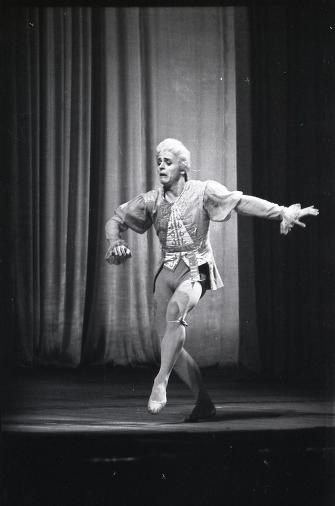
Mikhail Baryshnikov in the Role of Vestris.
Unknown artist
- Source:
- Library of Congress
- Rights:
- Public domain — free to use, share and adapt.
- Recorded as:
- Public Domain
This photograph documents one of the greatest male ballet dancers of the modern era performing a role rooted in dance history itself, making it a record of how classical ballet tradition perpetuates and reinterprets its own past. The image shows the direct line of technique and aesthetic from 18th-century court dance to 20th-century ballet, embodied in a single extended line and gesture. For anyone studying the history of male ballet technique, the development of the classical vocabulary, or Baryshnikov's career, this image is essential.
What you are looking at
A male dancer in 18th-century costume stands alone on a darkened stage, captured mid-movement against a backdrop of heavy curtains. He wears a ornate silk jacket with decorative embroidery, a patterned waistcoat, knee breeches, and white stockings with dark shoes—the formal dress of the ancien régime. His white hair or wig is styled in the period fashion. His body is animated in a pose of virtuosic display: one leg extends behind him in a sharp line, the torso leans forward with dynamic energy, and his arms are spread open in a gesture of theatrical showmanship. The dramatic stage lighting catches the fabric of his costume and casts strong shadows, emphasizing the sculptural quality of his extended limbs. The photograph is a black-and-white studio image, formally composed with the figure roughly centered against the curtain backdrop.
The dancing
A single male dancer in a strongly asymmetrical pose: weight appears to be on the supporting leg while the other extends sharply behind or to the side, creating a dynamic diagonal line through the body. The torso is inclined forward with considerable extension, and both arms are spread open in an expansive frame characteristic of noble port de bras. The pose suggests a moment of rapid traveling movement or an allegro enchainement. The dancer's turnout and the precision of the line suggest highly trained classical technique and an aristocratic bearing suited to court dance.
The dance depicted
This is a photograph of a male classical ballet dancer performing in a role styled after Auguste Vestris, the celebrated 18th-century dancer and choreographer known as 'le dieu de la danse.' The catalogue identifies the performer as Mikhail Baryshnikov, the Soviet-American ballet superstar. The costume and movement evoke the historical Vestris—the silhouette, the white wig, the silk coat—but the photograph captures a theatrical recreation of that historical figure, likely from a 20th-century ballet production that reimagined or paid homage to the legendary dancer. The pose itself demonstrates the classical technique that links baroque court dance to modern ballet, with emphasis on extension, turnout, and dynamic use of the upper body.
How it was made
This is a black-and-white photograph, likely a professional stage or studio photograph from the late 1960s. The image shows technical command of theatrical lighting and composition: the dramatic backlighting and side-lighting emphasize form and create visual separation from the background curtains, a standard technique in dance photography of the period. The photograph preserves a single moment from a live performance or rehearsal, allowing study of the dancer's line, costume detail, and carriage in a way no other medium could. The quality and formal framing suggest it was produced for theatrical publicity or archival documentation.
About this work
This is a photograph of Mikhail Baryshnikov as the character of Vestris, the legendary 18th-century French ballet dancer. The image captures a moment of classical male ballet technique within the frame of historical costume and character. It represents both an act of homage to dance history—recreating the legendary Vestris in theatrical form—and an exhibition of contemporary (1960s) ballet technique at its highest level. The photograph documents a specific moment in which Baryshnikov, one of the greatest male dancers of the late 20th century, inhabited the historical role of one of dance's founders, merging past and present through the classical vocabulary that connects them.
The work belongs to a long tradition of dance history presented on stage: choreographers and dancers have repeatedly returned to the figure of Vestris as a symbol of masculine brilliance in ballet, and Baryshnikov's assumption of the role shows how the classical technique developed from 18th-century court dances persists as living practice. The photograph is evidence of both historical consciousness in ballet and the technical continuity between baroque noble style and modern classical training.
How to look at it
Attend to the moment the photographer chose: this is not a position of rest or classical alignment, but a moment of maximum extension and dynamic travel, with the weight and momentum driving the body diagonally across space. The open arms and inclined torso show the baroque legacy of noble port de bras—the carriage and arm work of aristocratic 18th-century court dance—adapted into the fully turned-out, extended classical technique of modern ballet. Notice how the photograph uses light and shadow to sculpt the body: the pose only reads as virtuosic because the lighting makes every line visible. This is theatrical ballet in the service of historical character.
The period
In 1969, when this photograph was taken, Baryshnikov was a leading dancer with the Kirov Ballet in Leningrad (now St. Petersburg), before his defection to the West in 1974. The late 1960s saw a surge of interest in ballet history and in male dancing as a primary subject; this was the era of Nureyev's ascendancy and of choreographers like George Balanchine and Jerome Robbins expanding the technical and dramatic possibilities for male dancers. Revivals and imaginative recreations of historical roles—particularly the roles of legendary male dancers—were part of this cultural moment. The costume and character of Vestris fit into a broader 20th-century fascination with the 18th-century origins of ballet and the myth of the male virtuoso.
Where it lives
The photograph is held in the Library of Congress (source: LOC), indicating it is part of the American public cultural record. It was likely produced by a theatrical or dance photography studio as documentation of a performance or rehearsal.
Dance in this work
Questions about this work
Who was the historical Vestris?
Auguste Vestris (1760–1842) was a legendary French ballet dancer and choreographer, widely celebrated as one of the greatest male dancers of the 18th century and often called 'le dieu de la danse' (the god of dance). He was the son of Gaétan Vestris, also a celebrated dancer, and he danced in Paris and London, leaving an enormous influence on the development of classical ballet. Though no video survives, accounts of his technique emphasize exceptional elevation, speed, and brilliant footwork.
Why did 20th-century choreographers create roles called Vestris?
Choreographers have repeatedly created roles named after the historical Vestris to honor dance's foundational figures and to frame roles for exceptional male dancers. By naming a role 'Vestris,' a choreographer invokes the historical dancer's legendary technique and virtuosity, and invites audiences to see a contemporary performer as the heir to that tradition. It is a way of placing a modern dancer within history.
How does 18th-century court dance differ from the ballet shown here?
The baroque court dances of Vestris's youth emphasized turned-out legs, elegant arm carriage, and traveling steps performed in rigid court etiquette, but with much less extension and elevation than modern ballet demands. The classical ballet technique visible in Baryshnikov—the full turnout, the high extensions, the traveling speed—developed gradually through the 19th century as ballet moved from court to theater. Baryshnikov's costume evokes the historical Vestris, but his technique is modern.
When did Baryshnikov dance this role?
The catalogue date is 1969. Baryshnikov was with the Kirov Ballet in Leningrad at this time. He would not defect to the West until 1974, so this photograph documents his practice before his international fame. The specific production or choreography is not identified in the record.
More dance artwork





