36 works in this view — arrow keys or swipe to move between them.
Dance in Art · 1919
Have a dance with me
Unknown artist
- Source:
- Library of Congress
- Rights:
- Public domain — free to use, share and adapt.
- Recorded as:
- Public Domain
This work is essential evidence for how ballroom dance was marketed, visualized, and celebrated in early 20th-century American mass culture. It shows the ballroom as a space of female agency and desire, not passivity—a corrective to accounts that treat women's dance history solely through the lens of chorus lines or male-choreographed spectacle. The sophisticated Art Deco style also demonstrates that dance, when rendered in modern graphic design, was understood as the epitome of contemporary glamour.
What you are looking at
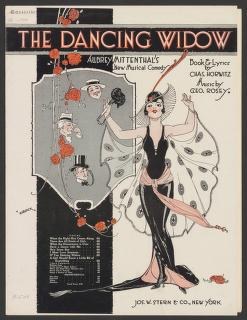
A fashionable woman in an elegant black evening dress stands at the center of this Art Deco illustration, her body turned in a dynamic contrapposto pose. She wears a sleeveless, low-backed gown with a handkerchief hem that sweeps asymmetrically, and her arms are positioned with one raised and one extended, suggesting invitation or movement. The composition is split vertically: on the left, a geometric pattern of dancing couples in silhouette or simplified form fills a tall rectangular panel, their bodies interlocked in various ballroom positions; on the right, the central figure dominates, her pose echoing and elaborating on the smaller dancers behind her. The palette is restrained—black, white, flesh tones, and warm ochre—with strong linear definition typical of commercial illustration of the period. Typography frames the scene: the title "THE DANCING WIDOW" appears at top in bold serif capitals, and publication information is visible at the base. The overall effect is one of sophisticated urban gaiety and the promise of social pleasure.
The dancing
The central figure is portrayed in a classic ballroom frame: her weight is shifted onto one leg, the body angled away from the viewer with the hips clearly marked. Her raised arm is bent at the elbow with the hand at shoulder height; the other arm extends lower. This posture suggests the promenade or turning phase of a standard ballroom dance—the body is not in closed hold with a partner, but rather in a solo or presentation pose that reads as both invitation and demonstration. The silhouetted dancers in the left panel show multiple closed holds: upright frame, one pair with the woman's skirt clearly visible mid-swing, another with more compressed, intimate positioning. The scale difference between the central figure and the background dancers creates a narrative hierarchy—this is the widow herself, larger and more fully realized than the dance scene that surrounds her.
The dance depicted
The work depicts ballroom or social dance of the 1920s cocktail era, most likely a foxtrot, waltz, or similar standard ballroom style. The title and the formal evening dress, combined with the silhouetted dancing couples and the woman's poised, partnered-dance posture, place this squarely in the world of urban social dancing and nightlife during Prohibition or the early post-Prohibition period in America. The "widow" (whether widowed or merely a woman dancing alone) is shown as an active, desiring participant in that world—not a passive spectator. The image conflates her with the dance itself, her body becoming the visual embodiment of the social pleasure and allure of the ballroom.
How it was made
This is a commercial illustration, printed as sheet music cover art or theatrical lobby card. The medium appears to be lithography or chromolithography—a process that allowed for flat areas of bold color, strong black outlines, and the reproduction of intricate Art Deco patterning. The geometric patterning in the left panel (the silhouetted dancers) was likely drawn as a repeating unit, exploiting the symmetry and formal order that lithography could render with precision. The technique allowed broad distribution to theaters, music halls, and homes, making this a work of mass culture and commercial entertainment rather than fine art. The style—simplified forms, strong graphic impact, legible from a distance—is characteristic of design intended for posters and printed ephemera.
About this work
This is a commercial illustration for a theatrical production or musical composition titled "The Dancing Widow," dating to 1919 or the early 1920s. It belongs to the history of ballroom dance in American popular culture—specifically the era when dance became a symbol of modernity, female independence, and urban sophistication. The widow of the title is shown not as a figure of grief but as a woman actively engaged in the pursuit of pleasure and social connection through dance. The image is a visual argument for the respectability and desirability of women's participation in public ballroom dancing, a topic of considerable social debate in the period. It sits at the intersection of theater history, music publishing, and the social history of dance.
How to look at it
Attend first to the silhouetted dancers in the left panel: the variety of holds and the clarity with which ballroom frame is rendered, even in miniature. Notice how the central figure's posture echoes and enlarges that of the dancers behind her—her raised arm and extended leg mirror the positions of the couples in the background pattern. This creates a visual pun: the woman *is* the dance; she embodies it. Look also at the asymmetrical handkerchief hem of her dress, which adds movement and a sense of mid-turn even though her pose is static. The graphic design principle at work is one of abstraction and repetition: the ballroom is reduced to a geometric pattern of bodies, while the individual woman is rendered with full figural presence. This contrast between the patterned dancers and the presented woman creates a hierarchy of meaning—she is the subject, they are the context.
The artist
The artist is not recorded. The style and production values are consistent with the work of commercial illustrators and graphic designers active in New York during the 1915–1925 period—a generation trained in Art Nouveau but moving toward the cleaner lines and flattened forms of Art Deco. Such designers worked for music publishers, theater producers, and sheet music distributors, often anonymously. The integration of typography with figural and geometric imagery, and the sophisticated handling of the female form in a pose that conveys both elegance and movement, suggest training in academic drawing combined with exposure to European modernism.
The period
In 1919–1920, ballroom dancing in America was undergoing rapid transformation. The waltz and formal quadrille were being displaced by faster, more sexually charged dances—the foxtrot, the Charleston, and various "jazz" dances—that moved from the elite ballrooms to public dance halls and cabarets. Women's participation in public dancing became a visible marker of postwar social change: the flapper, the modern woman, was defined partly by her dancing. At the same time, moral anxiety about dance persisted; clergy and social conservatives continued to condemn public dancing as a threat to morality. This image sits within that contested space: it presents dancing as glamorous, modern, and respectable, while also acknowledging (in the title) the social transgression of a widow in public pursuit of pleasure. The Art Deco style itself—with its celebration of geometry, machinery, and streamlined modernity—was closely associated with dance as a symbol of the twentieth century.
Where it lives
This work is held by the Library of Congress. It is catalogued as theatrical or commercial illustration, most likely sheet music cover art, a lobby card, or a printed advertisement for a stage production. The title, date, and artistic style are consistent with Broadway or off-Broadway entertainment of the early 1920s.
Dance in this work
Questions about this work
What dance is being shown?
The work does not specify a single dance, but the postures and dress point to a standard ballroom dance of the 1920s—most likely a foxtrot, waltz, or a generic 'ballroom' style. The silhouetted dancers show recognizable closed holds and frames from ballroom technique. The title is theatrical, not technical, and the image is designed to evoke the idea of ballroom dancing rather than to document a specific choreography.
Why is she called a widow?
The title likely refers to a theatrical production or song of the same name, of which this is promotional art. In the context of 1920s entertainment, a widow dancing in public was a mildly transgressive figure—socially more independent than a young unmarried woman, possibly more sexually available. The title plays on that implication while the image presents her as elegant, desirable, and fully in control of her own pleasure.
Is this a photograph or a drawing?
This is a commercial illustration, most likely produced via lithography or chromolithography—a printing process that allowed for bold colors, strong outlines, and geometric patterning. It is not a photograph, though it draws on conventions of fashion illustration and portrait drawing. The flat areas of color and the strong linear definition are characteristic of printed graphic design of the period.
What does the pattern on the left represent?
The left panel shows multiple dancing couples in silhouette, rendered as a repeating geometric pattern. Each couple is in a different ballroom hold or position, creating a visual encyclopedia of the various frames and close positions used in ballroom dance. Together, they form an abstract pattern that symbolizes the variety, energy, and interlocking forms of the ballroom itself.
More dance artwork





