35 works in this view — arrow keys or swipe to move between them.
Dance in Art · 1975
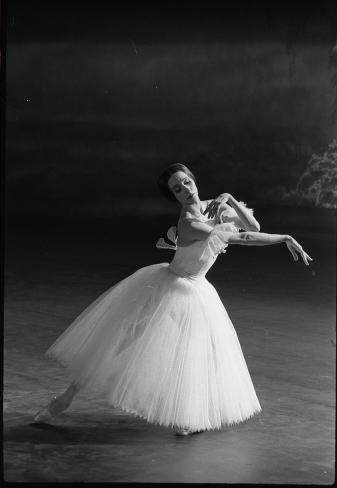
Giselle. Natalia Bessmertnova.
Unknown artist
- Source:
- Library of Congress
- Rights:
- Public domain — free to use, share and adapt.
- Recorded as:
- Public Domain
Bessmertnova was one of the finest interpreters of Giselle of her generation, and her performances at the Bolshoi were influential in establishing the style and emotional vocabulary of the role in Soviet classical ballet. For dance historians and performers, this photograph offers a direct record of how a celebrated artist embodied one of ballet's foundational characters. The image preserves the silhouette, line, and technical vocabulary of romantic ballet as it was performed in a major institutional setting during a period when that tradition was being codified and transmitted globally.
What you are looking at
A female ballet dancer in a white tutu and fitted bodice stands alone on a dark stage, captured mid-movement in a three-quarter pose. She faces upstage and to the right, her body arched slightly backward in a classical romantic attitude. Her left arm is raised and extended, while her right arm rests across her torso. The tutu—full and multi-layered in the style of mid-20th-century classical ballet—catches the stage light, creating volume and dimension. The surrounding darkness is nearly absolute, focusing all attention on the solitary figure. The photograph appears to have been taken during a performance or staged studio session, likely from the 1970s based on the image quality and lighting technique. The dancer wears the pointe shoes standard to classical ballet.
The dancing
The dancer's weight appears centered, with a slight forward inclination of the torso balanced by the arch of her back. The raised arm shows the soft, rounded port de bras characteristic of romantic-era ballet technique. Her leg position suggests she is holding a balancé or similar traveling step, with the working leg engaged and the supporting leg straight beneath her. The pose demonstrates control and elongation through the spine, neck, and limbs—the hallmarks of classical training. The spatial isolation of the single figure emphasizes the soloist's virtuosity and the intimate scale of a principal's variation.
The dance depicted
This is Natalia Bessmertnova dancing Giselle, one of the central roles in the romantic ballet repertory. Giselle is a three-act work by Adolphe Adam and Jules Perrot (1841) that tells the story of a peasant girl who becomes a spirit after death. The photograph captures a moment from the ballet, likely from Act I or the famous mad scene, when Giselle is still alive. Bessmertnova was a celebrated prima ballerina at the Bolshoi Ballet in Moscow, and Giselle was one of her signature roles. The romantic tutu style and the softness of the arm port de bras are consistent with 20th-century Soviet interpretations of this quintessentially romantic ballet.
How it was made
This is a black-and-white photograph, likely taken in a theater or studio with theatrical lighting. The photographer has used directional stage lighting to create a stark silhouette and highlight the architecture of the dancer's body and the volume of the tutu. The photographic technique—sharp focus on the dancer, near-total darkness of the background—was standard for theatrical documentation in the 1970s and makes the image suitable for archival recording of performances. The tonal range and grain suggest this is a scan of an original gelatin silver print or similar period-appropriate photographic negative.
About this work
This is a theatrical photograph from the 1970s documenting Natalia Bessmertnova, a prima ballerina of the Bolshoi Ballet, in one of the most celebrated roles in classical ballet. Giselle, created in 1841, remains a cornerstone of the international ballet repertory and a showcase for leading dancers. Bessmertnova's interpretation was admired for its musicality, pathos, and technical mastery. The photograph belongs to a tradition of theatrical documentation—preserving performance through still imagery at moments of peak expressiveness. It is evidence of both the Soviet ballet school's prominence in the late 20th century and the romantic ballet aesthetic that has persisted across continents and decades.
How to look at it
Pay attention to the dancer's spinal alignment and the relationship between her upper and lower body—the slight arch of the back is held against a lifted, elongated torso, creating the characteristic romantic ballet line. Notice how the tutu is shaped by the dancer's leg position and the stage lighting; the multiple layers of fabric create depth and movement even in a still image. The arm position—soft and rounded rather than angular—is characteristic of romantic ballet's aesthetic vocabulary. The darkness surrounding the figure is not empty: it emphasizes the dancer's isolation and amplifies the emotional content of the pose. The photograph was likely taken at a moment of particular dramatic or lyrical significance within the ballet.
The artist
The photographer is not recorded in the catalogue, but the image is characteristic of mid-20th-century Soviet theatrical photography—a professional practice of documenting performances by leading artists for institutional archives, reviews, and cultural promotion. The Bolshoi Ballet's photography program was rigorous and purposeful, creating an extensive visual record of the company's repertory and principal dancers.
The period
In the 1970s, Giselle was being performed by ballet companies worldwide, but the Soviet interpretation—shaped by the Vaganova school and the Bolshoi tradition—held particular prestige. Romantic ballet had been sustained and evolved in the USSR through the 20th century in ways that Western European ballet had sometimes set aside. This photograph documents a moment when Bessmertnova and the Bolshoi were at the forefront of international ballet, and when theatrical photography was becoming an essential record of dance history. The technical and aesthetic standards visible in this image reflect decades of pedagogical refinement and institutional continuity.
Where it lives
The source is identified as the Library of Congress (loc), which suggests this is part of the American Memory collections or the Performing Arts collections housed there. The image was likely contributed to the LC as part of a donation, purchase, or acquisition from a Russian archives or international arts collection.
Dance in this work
Questions about this work
Who was Natalia Bessmertnova?
Bessmertnova (1941–2014) was a principal ballerina of the Bolshoi Ballet for four decades. She was celebrated for roles in classical and contemporary ballet and was known for emotional depth and musical sensitivity. She was also a founder of the Bessmertnova Ballet Academy in Moscow.
What is Giselle and why is it important?
Giselle (1841) is one of the oldest ballets still in the active repertory. It tells a romantic story of love and supernatural redemption and is a test piece for prima ballerinas because it demands both classical technique and dramatic acting. It originated the full-length narrative ballet format.
Why photograph dance this way?
Theatrical photography uses stage lighting and a dark background to isolate the dancer and document the precise moment of a movement. For institutional and archival purposes, such photographs are essential records of performances and the physical capabilities of major artists.
What is a romantic ballet tutu?
The romantic tutu is a calf-length skirt made of multiple layers of tulle, creating an ethereal silhouette. It originated in the 1830s–1840s and is associated with ballets about sylphs, spirits, and otherworldly characters. It contrasts with the shorter, stiffer classical tutu of later periods.
More dance artwork





