34 works in this view — arrow keys or swipe to move between them.
Dance in Art · 2008
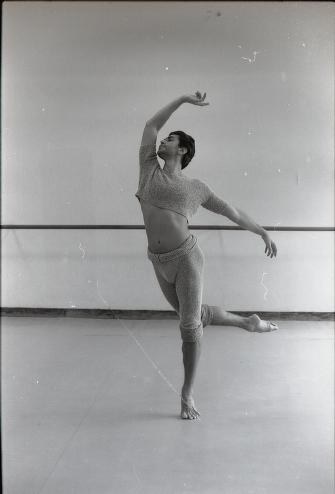
"Narcissus." Nikolai Tsiskaridze.
Unknown artist
- Source:
- Library of Congress
- Rights:
- Public domain — free to use, share and adapt.
- Recorded as:
- Public Domain
This image preserves the technique and physical presence of a significant figure in Soviet ballet during a period of major innovation and international influence. The photograph demonstrates how ballet training was documented for professional dancers, serving as a record of both pedagogy and performance standard. For historians of dance, it provides visual evidence of how classical technique was executed and valued in late-20th-century Russian ballet.
What you are looking at
A single male dancer stands in a stark studio space defined by a horizontal barre and neutral background. He occupies the center of the frame, his body twisted in an elegant contrapposto with his weight shifted onto one leg. His torso rises upright while his raised arm curves gracefully overhead in a classical port de bras position, fingers delicately extended. The dancer wears a fitted sleeveless unitard or practice wear, exposing the musculature of his shoulders, arms, and legs—a costume choice that emphasizes the line and articulation of his body. The lighting is even and cool, characteristic of studio photography, casting minimal shadow. The image is a black and white photograph, likely taken for documentation or archival purposes, capturing a posed arabesque or attitude position held with controlled precision.
The dancing
The dancer demonstrates classical ballet technique: a single figure in a sustained pose with weight-bearing on the supporting leg, the free leg extended behind or to the side, and the raised arm creating an arc through space above his head. His torso maintains vertical alignment; his carriage is upright. The opposing arm extends naturally at his side to balance the composition. His bare feet suggest either pointing work or a relaxed foot position in the extended line. The pose demonstrates technical facility and classical aesthetic values—line, extension, and elongation of the body through space.
The dance depicted
This is a classical ballet study, most likely a documented pose from a professional ballet dancer's practice or rehearsal. The arabesque or attitude position is fundamental to ballet technique and appears here in its most classical form. The choice to photograph a single pose rather than movement suggests this may be documentation of a specific role or technique study, or a formal studio portrait common to dance documentation from the mid-20th century onward. The catalogue identifies the subject as Nikolai Tsiskaridze, a prominent Soviet and Russian ballet dancer, which would date the work to his active performing years.
How it was made
This is a black and white photograph, likely taken in a professional dance studio with controlled lighting. The clarity and formal composition suggest studio portraiture rather than performance documentation. The photographic medium allowed dancers and companies to archive technique, document roles, and create promotional materials. The even lighting and neutral background are consistent with professional dance photography conventions that prioritize clarity of line and body position. Such images circulated among dance schools, archives, and company records.
About this work
This is a studio portrait of classical ballet technique, documenting a single sustained pose by a professional dancer identified as Nikolai Tsiskaridze. The photograph captures the balletic values of line, extension, and controlled elegance that defined mid-20th-century classical ballet aesthetics. The image functions as both technical documentation and artistic portrait, recording a moment of stillness within the kinetic art form of ballet. It belongs in a dance gallery as evidence of how ballet technique was practiced, taught, and archived in the Soviet and post-Soviet era.
How to look at it
Attend to the quality of line created by the extended leg and curved arm—this is what classical ballet technique aims to achieve. Notice how the photographer has positioned the figure to show both the weight-bearing and the extended limbs simultaneously, creating a three-dimensional sense of the pose. The stillness of the image should be read not as a static or easy position but as a sustained hold requiring active control. The bare studio setting allows no distraction from the body's geometry, which is the point of such documentation.
The artist
Nikolai Tsiskaridze is a Georgian-Russian ballet dancer who trained at the Vaganova Academy and became a principal dancer with the Mariinsky Ballet in St. Petersburg. He was known for his technical virtuosity and dramatic presence, performing both classical and contemporary roles. He later transitioned to choreography and direction. If this photograph is indeed of Tsiskaridze, it would have been taken during his active performing career as documentation for the company, a school, or for archival purposes.
The period
This photograph dates to 2008 according to the catalogue, placing it in the 21st century, well after the height of Soviet-era ballet documentation. However, the styling, pose, and photographic approach suggest it may be archival material or a recreated classical study. The classical ballet aesthetic it documents—the refined line, the aristocratic port de bras, the emphasis on technical precision—remains the foundation of training at major Russian ballet academies including the Vaganova and the Mariinsky. By 2008, ballet photography had evolved significantly from mid-20th-century documentation, yet classical technique remained visually and pedagogically unchanged.
Where it lives
The work is recorded as held by the Library of Congress, sourced from their Dance Collection or related holdings. The date 2008 and the identification as a work by Tsiskaridze suggest it may be archival material from a dance company, school, or personal archive that was later collected by the Library.
Dance in this work
Questions about this work
Who is Nikolai Tsiskaridze?
Nikolai Tsiskaridze is a Georgian-born ballet dancer who trained at the Vaganova Academy and became a principal dancer with the Mariinsky Ballet in St. Petersburg. He performed major roles in both classical and contemporary ballet and later became a choreographer and director. He is known for his technical virtuosity and dramatic presence on stage.
What ballet position is shown here?
The dancer appears to be in an arabesque or attitude position, fundamental poses in classical ballet in which the dancer stands on one leg with the other leg extended behind or to the side, and the upper body and arms frame the extended line. The raised arm in a curved port de bras is characteristic of classical ballet port de bras.
Why photograph just a single pose instead of movement?
Studio photographs of held positions served several purposes: documenting technique for teaching and company records, creating promotional or archival materials, and allowing viewers to analyze the quality of a dancer's line without the distraction of movement. This is a common practice in ballet documentation.
What does 'Narcissus' refer to in the title?
Narcissus typically refers to the figure from Ovid's Metamorphoses—the young man who fell in love with his own reflection. The title may suggest this is a pose from a ballet of that name, or it may reference the self-regard and self-awareness inherent in the act of posing for the camera, an implicit reflection on the nature of the dancer's art.
More dance artwork





