47 works in this view — arrow keys or swipe to move between them.
Dance in Art
Auriol polka
Unknown artist
- Medium:
- Lithograph
- Dance:
- Polka
- Era:
- Late 1800s (Victorian Ballroom)
- Source:
- New York Public Library
- Rights:
- Public domain — free to use, share and adapt.
- Recorded as:
- public_domain
The polka was a democratizing force in ballroom culture—a dance accessible to all classes and both sexes, and this image captures the euphoria and physical freedom it promised its practitioners. For historians of dance and fashion, the print documents the silhouette, the costume design, and the physical aesthetic of mid-nineteenth-century ballroom performance, showing how bodies were meant to move and be seen.
What you are looking at
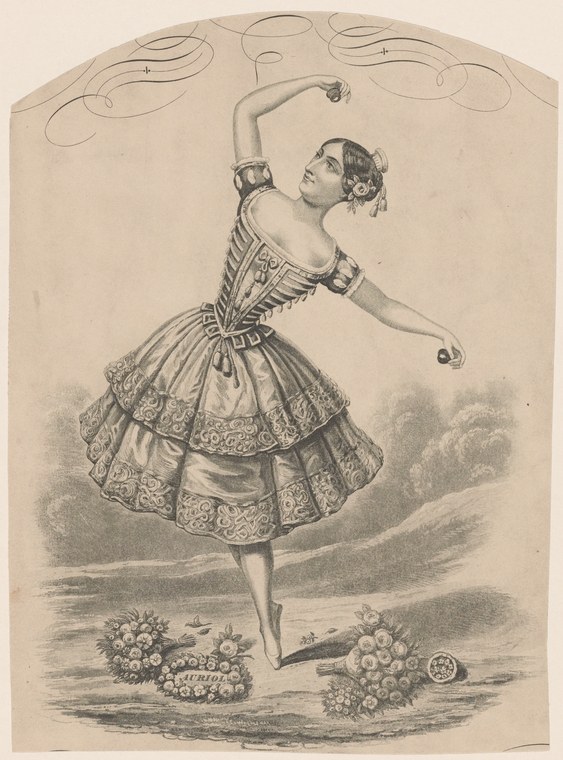
A young female dancer in mid-performance, captured in a moment of exuberant movement. She wears a lavishly decorated dress with a fitted corset bodice and full skirt composed of multiple layers of patterned fabric—each tier displays ornate designs suggesting embroidery or appliqué. The skirt is caught mid-swirl, spreading outward in a characteristic silhouette. Her left arm extends upward in a graceful arc, while her right arm curves downward; her head tilts back slightly, gazing upward, conveying joy and abandon. She balances on one leg in a light, springing pose. The background is minimal—soft shading suggests a stage floor or ground plane—with decorative swirls or scrollwork at the top of the composition. At the base of the figure, stylized floral or leaf motifs appear, possibly indicating a stage set element or decorative frame. The overall effect is one of lightness and motion, capturing the energy of social dance performance.
The dancing
A single dancer stands in a characteristic polka pose: one leg supporting her weight in a springing, nearly balletic position, while the other leg extends beneath her. Her upper body twists slightly, with her spine arched backward and her head thrown back in an expression of delight. Her arms are held in an open, expansive frame—the left arm raised to shoulder height or above, the right lower—rather than in a closed partner hold. This suggests either a moment between couples or a solo exhibition, with the body language emphasizing the upward lift and buoyancy fundamental to polka technique.
The dance depicted
This is a representation of the polka, a couple dance and social phenomenon that swept through European and American ballrooms in the mid-nineteenth century. The polka is characterised by rapid hopping steps on a 2/4 beat, typically performed by a couple in closed position, though this image captures a moment of virtuosic individual expression—possibly a solo turn or exhibition moment, or the moment a dancer breaks free from or returns to her partner. The exaggerated arch of the spine, the upward gaze, and the springing elevation of the supporting leg are consistent with the physical vocabulary of ballroom polka as it was performed and celebrated in Victorian entertainments. The title 'Auriol polka' suggests this may depict or commemorate a celebrated dancer of that name.
How it was made
This is a lithograph, a planographic printing process in which an image is drawn on stone and printed. Lithography allowed for rapid multiplication and distribution of images, making it ideal for the promotional and souvenir market of Victorian theatrical entertainment. The technique is visible in the careful use of line work for the dancer's form and the cross-hatching used to model the fabric and create shadow and depth. The relatively fine detail and the subtlety of tone suggest a work of some skill and investment, indicating this was likely a commercial or semi-official print commemorating a well-known performer rather than a quick sketch.
About this work
This lithograph celebrates the polka, one of the most popular ballroom dances of the Victorian era. It depicts a young woman in a moment of exuberant performance, her body lifted and buoyant, her expression one of pure pleasure—the very image of the polka's promise of lightness, speed, and social joy. The elaborate costume and theatrical presentation suggest this may record a specific celebrated dancer, or at least represents the polka as it was mythologised in popular visual culture. The work belongs to a vast archive of dance prints, fashion plates, and theatrical souvenirs produced for middle-class consumption in the second half of the nineteenth century, when the polka was at the height of its fashionable dominance. It shows how dance was commodified, circulated, and imagined in the domestic and commercial sphere.
How to look at it
Observe the moment the artist chose: not a step in progress, but a moment of suspension and release—the dancer at the height of a hop, weightless and exalted. Note how the corseted waist remains rigid while the skirt billows outward, creating the visual drama of the dance. The upturned face and raised arms signal not technique but emotion—the polka was sold as a dance of joy and freedom, and this image exemplifies that marketing. The decorative flourishes at top and bottom frame the figure as a kind of ornament or emblem, elevating the dance and the dancer to the status of fine art.
The period
The polka originated in Bohemia in the 1830s and reached London, Paris, and New York by the 1840s, where it became an absolute craze. Unlike the stately waltz or the formal quadrille, the polka was fast, playful, and encouraged a kind of theatrical exuberance; it was embraced by all social classes and was particularly associated with the aspirations and pleasures of the rising middle class. In the visual arts, the polka generated an enormous market for prints, fashion plates, and souvenir images—lithographs like this one were sold to commemorate famous dancers, to serve as records of costume and movement, and to fuel the dance's glamour and appeal. The lithographic medium was perfectly suited to this market: cheap enough for popular purchase, fast enough to capitalize on fashionable enthusiasm, and capable of the tonal subtlety needed to render fabric and the body in flattering light.
Where it lives
This lithograph is held in the New York Public Library collection, indicating its circulation as a public or commercial print in nineteenth-century America. It is the kind of image that would have been sold as a souvenir at performances, distributed in theatrical programmes, or purchased by amateurs as a record of fashionable dance and dress.
Dance in this work
Questions about this work
What is the polka and why was it so popular?
The polka is a fast, energetic couple dance in 2/4 time, originating in Bohemia in the 1830s. It reached peak popularity in the 1840s–1850s across Europe and America because it was relatively easy to learn, socially inclusive (unlike some dances, it welcomed all classes and genders equally), and promised fun and liberation rather than formal decorum. It was the first truly mass-market ballroom dance.
Who was Auriol and why does the print bear her name?
The record does not identify Auriol, but the title suggests this print commemorated a celebrated dancer or performer of that name, possibly a professional entertainer who demonstrated or popularized the polka in a major theatrical venue. The print may have been sold as a souvenir of her performance.
Why is the dancer alone, not with a partner?
Although the polka is a couple dance, this image likely captures a moment of individual exhibition—a dancer breaking free from her partner, taking a solo turn, or being shown off in performance. Alternatively, the artist may have chosen to isolate the figure for the sake of clarity and focus, emphasizing the physical beauty and exuberance of the dance rather than its social mechanics.
What does the costume tell us?
The elaborate tiered skirt, fitted corset, and decorative fabric suggest both the fashion and the theatrical conventions of mid-nineteenth-century ballroom dress. The costume is ornate enough to indicate either a professional dancer or a woman of substantial means, and the care lavished on rendering the fabric suggests that dress was as much a part of the polka's appeal as the movement itself.
More Polka artwork