26 works in this view — arrow keys or swipe to move between them.
Dance in Art · 1934
Ballet Fedre
Unknown artist
- Source:
- Library of Congress
- Rights:
- Public domain — free to use, share and adapt.
- Recorded as:
- Public Domain
This photograph documents a moment in ballet history when the form was being fundamentally challenged and reimagined. The 1930s saw experimental choreographers rejecting classical vocabulary entirely in favor of movement that was angular, group-oriented, and spatially adventurous—a shift visible here in the stance, the formation, and the dramatic use of the stage plane. For anyone studying the prehistory of contemporary ballet or the dialogue between modern dance and ballet in the twentieth century, this image is a rare record of how these experiments actually looked.
What you are looking at
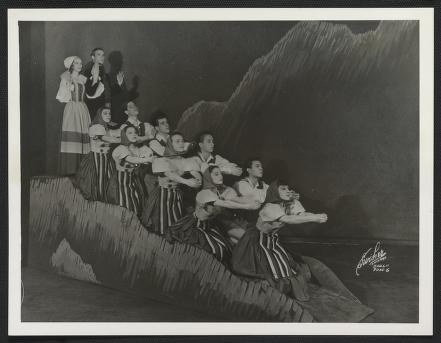
A dramatic scene of multiple figures arranged on a steeply angled, textured surface suggesting a mountainside or cliff. In the foreground and middle distance, a line of dancers in light-colored, short skirts descends the slope in a diagonal formation, their bodies leaning into the incline. At the upper left, two figures in darker clothing stand elevated—one appears to be gesturing or conducting. The composition uses strong chiaroscuro, with the figures picked out in light against a dark background, creating a theatrical, almost expressionistic mood. The sketch-like quality of the rendering, particularly the hatched shading of the mountainous ground, emphasizes movement and instability. The overall effect is of a processional or choreographed descent, with the elevated figures possibly directing or observing the action below.
The dancing
The descending figures maintain a consistent silhouette: upright torsos with arms held at varying angles, moving in what appears to be a synchronized or at least parallel fashion down the slope. Their skirts are short and practical, suggesting modern dance or theatrical costume rather than classical ballet tulle. The two figures at top left occupy a distinct spatial and gestural plane—one standing with an apparent commanding posture. The dancers' weight appears committed to the downward movement, their legs extended in the direction of travel rather than in classical turnout positions, suggesting a looser, more naturalistic movement vocabulary.
The dance depicted
This is almost certainly a scene from Phaedre (also Phèdre), a work that circulated in modernist dance circles of the 1920s–1930s. The title in the catalogue record—*Ballet Fedre* (likely a variant spelling)—points to a classical dramatic source adapted for theatrical dance. The composition suggests a narrative or mythological theme enacted through group choreography. The steep diagonal composition and the sense of a directed procession are characteristic of 1930s modernist stagecraft, where geometric forms and dramatic spatial relationships replaced classical symmetry. The exact dance vocabulary cannot be determined from the image alone, but the informal leg extension and the use of unison or canon suggest contemporary modern dance or early ballet modernism rather than classical technique.
How it was made
This is a black-and-white photograph, likely a stage or production photograph of a theatrical performance. The image shows tonal range, shadow detail, and the particular quality of theater lighting—strong directional light creating silhouettes and dramatic modeling. The photograph appears to be a gelatin silver print or similar process. As a production photograph, this functioned as documentation and promotion for the work, circulating among dance critics, historians, and theater professionals. Its survival in a public archive (Library of Congress) suggests it had some significance in contemporary critical or historical discussion.
About this work
This is a production photograph documenting what appears to be a modernist or avant-garde dance work titled *Ballet Fedre* (or *Phaedre*), created or performed in 1934. The image captures a choreographed scene of multiple dancers descending a steeply angled stage, supervised or conducted by elevated figures above. It exemplifies the 1930s moment when ballet was being radically reimagined by modernists who rejected the formal language of classical technique in favor of more angular, geometric, expressionistic compositions. The photograph itself is a key historical document of how this work was staged, lit, and presented to audiences and critics.
For historians of early modernist dance and for those studying the intersection of visual art and dance in the early twentieth century, this photograph offers evidence of how narrative and myth were being theatricalized outside the conventions of classical ballet. The composition—the dramatic use of level, the group choreography, the expressive distortion of the human figure through staging—reflects broader modernist aesthetics in visual art and theater.
How to look at it
Attend to the diagonal composition itself—the artist has chosen to stage the movement along a pitch, so that gravity, effort, and direction are all visually legible. Notice how the dancers' bodies are not arranged in a unified symmetry (as classical ballet would demand) but rather in a staggered, processional formation that feels like action captured mid-motion. The elevated figures at top left are crucial: they suggest observation, direction, or possibly participation in a narrative. The theatrical lighting is doing interpretive work—it is not simply illuminating the figures but creating a mood of drama and alienation through shadow and silhouette. This is not a photograph of classical ballet; it is a photograph of a deliberate departure from it.
The period
The 1930s were a period of radical ferment in dance. In Europe and America, choreographers including Mary Wigman, Laban, and others were developing movement systems and aesthetic principles entirely outside the classical ballet tradition. Simultaneously, ballet companies were under pressure to modernize—the Ballets Russes had collapsed, and a new generation of choreographers (Ashton, Robbins, and others) was beginning to reshape what ballet could be. Soviet theater, particularly the work of Vsevolod Meyerhold and his pupils, was experimenting with geometrically stylized movement and non-naturalistic staging. The photograph's date of 1934 places it at a peak moment of this experimentation, before the consolidation of what would become neoclassical ballet.
Where it lives
This photograph is held by the Library of Congress and is catalogued as part of dance documentation from the early twentieth century. Its presence in a public archive and its assignment to the year 1934 suggest it was either a press photograph, a company record, or material acquired as part of a theater collection. The artist/photographer is not recorded in the accessible catalogue.
Dance in this work
Questions about this work
Is this classical ballet?
No. The stance, the leg extension, the group formation, and the spatial composition all suggest modernist or avant-garde dance. The informal, downward-directed movement and the rejection of symmetry are characteristic of 1930s experimental dance, not classical technique.
What is Phaedre/Fedre, and why does it matter?
Phaedre is a classical tragedy about desire and fate. Adapting it for modernist dance made the mythological narrative available to contemporary choreographers and audiences while distancing it from conventional operatic or classical ballet treatments. This image shows how modernists used myth as a vehicle for formal experimentation rather than romantic spectacle.
Why is the stage tilted?
The angled plane creates multiple visual and kinetic effects: it makes the dancers' descent literal and visible, it breaks the convention of the horizontal stage, and it adds expressionistic energy and instability to the composition. This is a deliberate modernist staging choice, not an accident of photography.
Who are the figures at the top left?
They are likely principal dancers or a narrator figure, positioned above and apart from the descending group. Their elevated placement and apparent gesture suggest authority or observation, possibly indicating a hierarchical narrative relationship. Without a cast list or review, their exact role cannot be determined.
More dance artwork





