48 works in this view — arrow keys or swipe to move between them.
Dance in Art · 2019
Auriol polka
Unknown artist
- Dance:
- Polka
- Era:
- Late 1800s (Victorian Ballroom)
- Source:
- New York Public Library
- Rights:
- Public domain — free to use, share and adapt.
- Recorded as:
- public_domain
This print documents a crucial moment in dance history: the incorporation of folk and social-dance forms into theatrical performance by trained, professional dancers. It shows how the mid-nineteenth-century stage drew on popular ballroom crazes and spectacularized them through costume, technique, and presentation. For historians of dance and costume, the image is a detailed record of how the polka was performed and dressed in the 1840s–1870s.
What you are looking at
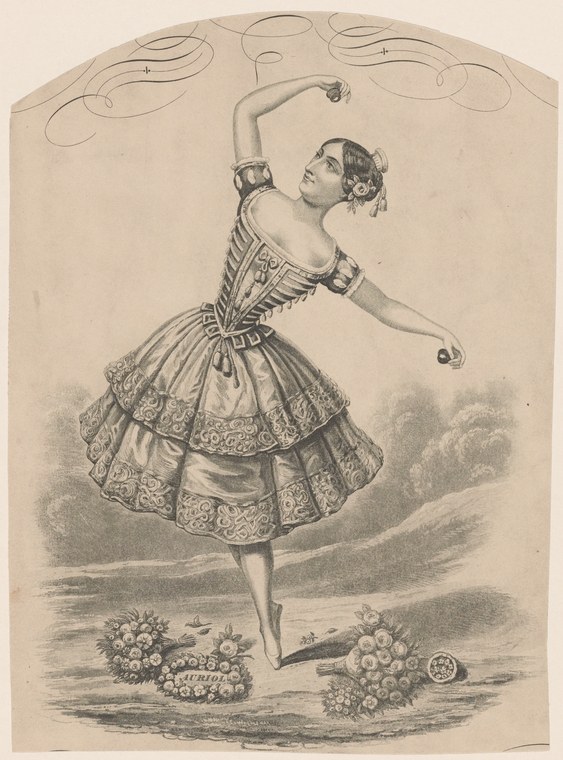
A young female dancer in mid-leap dominates the composition, her body captured in a moment of suspension against a pale background. She wears a corseted bodice with horizontal striping and a voluminous skirt decorated with embroidered panels arranged in tiers—the skirt is lifted and splayed outward by the force of her movement, showing multiple layers of fabric. Her left arm extends upward in a graceful arc while her right arm reaches outward; her head tilts back in profile, dark hair styled in ringlets typical of the mid-nineteenth century. Her legs are extended in a balletic pose, with pointed feet suggesting trained technique. The lower portion of the composition shows scattered on the ground what appear to be decorative rosettes or badge-like ornaments (marked "AURIOL" on at least one), suggesting this may be promotional material or a souvenir. The entire composition is rendered in pencil and shading, with elegant scrollwork decorative frames at the top and bottom of the page.
The dancing
A single dancer is shown in an elevated leap or bound, her torso vertical and elongated. Her arms are positioned in a romantic-era frame—one raised overhead, one extended to the side—with soft, rounded port de bras. The pointed feet and the height and extension of the jump indicate trained ballet technique. Her body weight appears suspended, with no foot contact with the ground. The corseted, structured bodice contrasts with the weightless buoyancy suggested by the floating skirt and elevated position.
The dance depicted
This is a polka, as confirmed by the title and the era label. The polka was a sprint-based social dance of couple or group formation that became extremely popular in the 1840s–1870s, especially in ballroom and theatrical contexts. This image shows a soloist—likely a professional dancer named Auriol or a member of a dance company—performing a theatrical or exhibition version of the polka rather than a social-dance variant. The height and balletic articulation of the jump, combined with the romantic-era costume and professional finish of the image, suggests this is a stage version of the polka, one that incorporated elements of ballet technique and spectacle. The decorative rosettes at bottom may indicate this was distributed as a souvenir or promotional print for a specific performance or performer.
How it was made
This is a lithograph or engraving rendered in pencil and fine shading on paper. The technique allows for precise reproduction of fine detail—the embroidery of the skirt panels, the texture of the fabric, the delicate scrollwork framing—and was well suited to theatrical promotion and mass distribution. The print's even tone, fine line work, and soft gradations suggest lithographic stone printing, which would have made this affordable and widely available to audiences attending dance performances. Such prints were common promotional materials for celebrated dancers and theatrical events.
About this work
This is a mid-nineteenth-century promotional print documenting a theatrical polka performance by or featuring a dancer named Auriol. The polka was one of the most popular social and stage dances of its era, spreading rapidly from Central Europe across European ballrooms and into theatrical performance. This image captures the moment of highest lift and extension in the dance—a moment of spectacle that shows how the simple, bouncy steps of the ballroom polka were transformed into a vehicle for trained dancers and athletic display when performed on stage. The image is valuable as a record of how a social dance was adapted for professional performance and how it was marketed to audiences through widely distributed prints.
How to look at it
The artist has frozen the moment of maximum elevation and extension—the highest point of a jump that would have lasted only a fraction of a second in performance. This choice emphasizes the athleticism and training involved in the theatrical polka, making it readable as a feat of skill rather than a simple step. Notice the careful balance between the rigid structure of the corseted bodice (suggesting training, discipline, confinement) and the explosive, floating motion of the skirt and limbs (suggesting freedom, lightness, joy). The scrollwork framing at top and bottom signals that this is a fine-art print, not a simple advertisement—a form that dignified theatrical performance as worthy of artistic attention.
The artist
The artist is not recorded in the catalogue. The technique and style suggest a mid-nineteenth-century theatrical print maker, likely working in Paris or another major European theatrical center, producing promotional materials for dancers and theatrical events. The fine draftsmanship and attention to costume detail indicates a professional illustrator with knowledge of theatrical dress and the anatomy of dance.
The period
The polka emerged in the 1840s and became a dominant social and theatrical dance across Europe by the 1850s–1870s. It represented the most modern and exciting dance form of the era, with its faster tempo, livelier steps, and more accessible structure compared to the formal quadrille or cotillion. At the same time, the Romantic ballet was at its height, featuring dancers like Marie Taglioni in ethereal, supernatural roles. This print sits at the intersection of those two worlds: it shows a professional dancer taking the popular polka and performing it in a balletic style, with the lifted, extended technique and the spectacular costume associated with theatrical rather than social dance. Lithographic prints of celebrated dancers were a major form of theatrical marketing and fan culture in this period.
Where it lives
This print comes from the New York Public Library collection. It is a lithograph or engraving from the mid-to-late nineteenth century (the record gives only 'Late 1800s,' though the costume and style suggest the 1850s–1870s range). It was created as a theatrical promotional print, likely distributed to audiences or sold as a souvenir.
Dance in this work
Questions about this work
Who was Auriol?
The catalogue does not identify Auriol beyond the title. Auriol may have been the dancer's stage name or surname, or the name of a specific choreographed piece or variant of the polka. Without additional information, her identity and career cannot be established from this print alone.
Is this a photograph or a drawing?
This is a lithograph or engraving—a printed image made from a stone or metal plate, not a photograph or hand-drawn picture. The technique allowed the artist to create a detailed, finely shaded image that could be printed many times and distributed widely. The soft pencil-like shading is characteristic of lithographic printing.
What is the polka?
The polka is a lively, bouncy social dance in 2/4 time that originated in Bohemia in the 1840s and became wildly popular across Europe and America by the 1850s. It was typically danced by couples or groups, with quick hops and a simple step pattern. Theatrical versions, like the one shown here, incorporated ballet technique and spectacle.
What do the rosettes at the bottom mean?
The rosettes or badge-like ornaments at the bottom of the print are likely marks of distinction, commemorative badges, or decorative elements associated with the performance or performer. One appears to be labeled 'AURIOL.' They may indicate this was a souvenir or program material, or they may be purely decorative framing elements typical of theatrical prints of the period.
More Polka artwork