49 works in this view — arrow keys or swipe to move between them.
Dance in Art · 2015
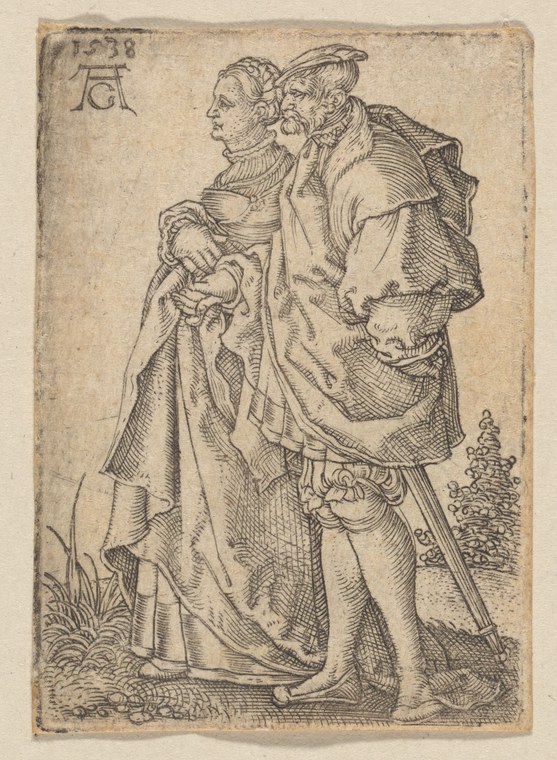
Dancing Couple
Unknown artist
- Medium:
- Source:
- New York Public Library
- Rights:
- Public domain — free to use, share and adapt.
- Recorded as:
- public_domain
The engraving reveals how dance functioned in Renaissance society not as a discrete performance but as a socially sanctioned form of intimate contact between men and women. The title 'Dancing Couple' applied to figures not actively dancing suggests that the *idea* of dance—its association with courtship and permitted closeness—mattered as much as the practice itself. For researchers of Renaissance social history and the semiotics of dance, the work documents how the period understood the relationship between movement, gender, and social permission.
What you are looking at
An engraving showing two figures in Renaissance or early modern dress, positioned in three-quarter view against a plain background with minimal setting detail. The figure on the left, seen in profile, wears a long gathered gown with fitted bodice and an elaborate headdress, and holds what appears to be a small child or infant. The figure on the right, leaning inward toward the first, wears a voluminous cloak or robe with deep folds, a feathered or plumed hat, and holds a long staff or walking stick. Their bodies incline toward each other in a gesture suggesting courtship, alliance, or intimate conversation. A small tree or shrub appears in the lower right corner, the only landscape element. The composition is intimate and frontal despite the profile view, with the two figures nearly touching, their relationship the sole focus.
The dancing
The two figures stand close but do not touch, their posture suggesting conversation or flirtation rather than formal dance partnering. The woman's body is upright, constrained by her fitted dress; the man leans forward and inward, his weight shifted toward her. Neither figure shows the lifted carriage, extended line, or deliberate positioning of trained dancers. The woman holds an infant, complicating any reading of the moment as a pure dance gesture. The man's staff is held casually, not as a dance prop but as an accessory of dress or status.
The dance depicted
This engraving does not depict dance in any formal sense, despite the title. The two figures are engaged in courtship, alliance, or social interaction—a moment of connection between a man and woman of means—but their stance and gesture belong to portraiture or narrative genre rather than to choreographed movement. The closeness and inclination of their bodies may reference dance-adjacent social rituals—the proximity and intimacy permitted by dancing partners in court society—but no actual dance is being performed. The title 'Dancing Couple' may be a later attribution or a metaphorical description of the relationship depicted.
How it was made
This is a line engraving or etching, identifiable by the regular hatching used to model form and shadow, the fine parallel lines in the drapery, and the characteristic bite of the burin or needle into paper. The technique is precise and controlled, with a focus on linear detail in costume and texture rather than atmospheric effect. Engravings of this type were produced for circulation among educated collectors and served as portable records of artistic invention, social types, or costume studies. The artist's monogram or mark appears in the upper left, indicating a print made for sale or distribution rather than a unique work.
About this work
This engraving presents two figures in Renaissance dress in a moment of courtship or social interaction, titled 'Dancing Couple' but depicting not dance itself but the intimacy and proximity that dancing could permit in Renaissance court society. The work belongs to a broader tradition of engraved costume and figure studies that documented social types, fashions, and the rituals of courtship. It is valuable not as a record of how dance was performed but as evidence of how the proximity of dancing—the permission it granted for closeness between men and women—was understood and represented in early modern visual culture.
The engraving sat at the intersection of several Renaissance print traditions: the costume study, the allegorical or narrative figure print, and the portrait. Its title suggests that 'dance' carried a metaphorical weight in the period, standing for courtship, alliance, or intimate social connection. For dance historians, the work serves as a reminder that dance in the Renaissance was not always an autonomous art form but a social practice embedded in courtship, diplomacy, and the regulation of proximity.
How to look at it
The viewer should attend to the closeness and inclination of the two bodies, which communicates intimacy and connection without any overt gesture of dancing. Notice how the artist has positioned the figures to emphasize their relationship—turned toward each other, nearly touching, their eyes and gazes directed inward. The woman's constraint within her fitted dress contrasts with the man's more expansive cloak and posture, a gender distinction typical of the period. The small child she holds complicates the reading: this may be a portrait of a specific couple (bride and groom, or mother and suitor) rather than a generic type. The engraving's precision and fine detail invite close viewing; the hatching in the drapery creates a sense of texture and luxury that situates these figures in a world of wealth and leisure.
The period
This engraving belongs to the tradition of Northern European Renaissance printmaking, likely 16th century, when engravings of costume, social types, and narrative scenes circulated widely among educated collectors. The style and dress suggest the German or Flemish tradition of figure studies. In this period, dance was a central accomplishment of court life and a primary mode of courtship, but it was also increasingly documented and theorized. Dancing masters published treatises; artists created prints of dances and dancers; and the social significance of dancing—its role in courtship, diplomacy, and the display of grace—became a subject of representation and reflection.
The costume in the print—the woman's fitted gown and elaborate headdress, the man's plumed hat and voluminous cloak—places the scene in the courts of Renaissance Europe, where dance was a marker of nobility and refinement. The engraving's title suggests that by this period, 'dancing couple' had become a legible type or formula in visual culture, shorthand for courtship and social bonding even when the figures depicted were not in motion.
Where it lives
The work is catalogued in the New York Public Library collection. The catalogue record identifies it as a print with the title 'Dancing Couple,' but provides no artist attribution, date, or further provenance. The monogram in the upper left corner may allow identification by specialist print databases.
Questions about this work
Is this actually a dance scene?
No, not in any formal sense. The two figures are not in motion or in a dance hold. Their closeness and inclination suggest courtship or intimate conversation. The title 'Dancing Couple' likely refers metaphorically to the social and romantic connection between them, exploiting the Renaissance association of dancing with courtship and permitted intimacy between the sexes.
Why would a courtship scene be titled 'Dancing Couple'?
In Renaissance culture, dancing was the primary sanctioned mode of interaction between unmarried men and women of the nobility. A 'dancing couple' became shorthand for a courting couple or a couple in alliance. The title may be a later attribution, or it may deliberately evoke the social meaning of dance even in a moment when the figures are standing still.
What does the child add to the image?
The presence of the infant complicates any straightforward reading of courtship. This may be a portrait of a specific couple—perhaps a husband and wife, or a mother with a suitor—rather than a generic type. Alternatively, the child may symbolize fertility, legitimacy, or dynastic continuity in a marriage alliance.
What is the engraver's monogram?
A monogram or mark appears in the upper left of the print but is not identified in the catalogue record. Consultation with specialist databases of Renaissance prints may allow identification of the artist.
More dance artwork