49 works in this view — arrow keys or swipe to move between them.
Dance in Art
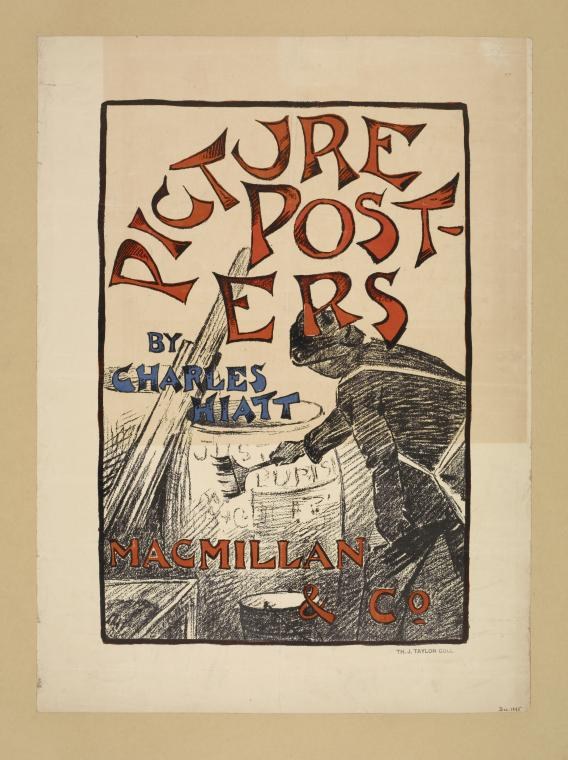
Picture posters.
Unknown artist
- Source:
- New York Public Library
- Rights:
- Public domain — free to use, share and adapt.
- Recorded as:
- public_domain
This work demonstrates how early 20th-century commercial design—book covers and posters—mobilized expressive human gesture to convey drama and movement. Artists used the body's kinetic potential not only in dance but across all visual media, suggesting a broader cultural investment in bodily expressiveness and modern dynamism. The image documents the aesthetic values of its moment: emotional intensity conveyed through physical urgency.
What you are looking at
This is a book cover or poster design for *Picture Posters*, published by Macmillan & Co., attributed to Charles Hiatt. The composition uses bold Art Nouveau typography with decorative lettering for the title in rust-red and cream. Below the text sits a figure in dark clothing—a man in formal dress (coat and trousers)—depicted in black ink with crosshatching. He is shown in profile or three-quarter view, hunched or bending forward at the waist with his head tilted down, one arm extended as if grasping or reaching toward something out of frame. His posture suggests physical exertion or dramatic gesture rather than stillness. The background is plain cream paper with a bold black border frame. The overall aesthetic is distinctly early 20th-century design, with the figure's gestural quality and the typography's decorative flourishes characteristic of the 1900s–1920s period.
The dancing
A single male figure in formal dress (dark jacket and trousers) occupies the lower half of the composition. He is depicted in a pronounced forward lean or collapse, with his upper body bent sharply at the waist and his head dropped. His right arm extends downward and forward, fingers splayed as if grasping or clutching. The weight appears to shift forward through the torso, suggesting either exertion, distress, or a dramatic theatrical moment. The posture is unbalanced and kinetic rather than posed—the body reads as in mid-movement rather than at rest.
The dance depicted
This image does not depict dance as such. The figure's posture and gesture are theatrical and expressive, but the positioning—forward-hunched, reaching, off-balance—suggests either physical distress, theatrical drama, or character portrayal rather than any identifiable dance form or social dancing. The image is a design for a book about pictorial art (posters), not a choreographic scene. The figure may be illustrative of the kind of expressive gesture found in dramatic or theatrical art rather than depicting actual dance movement.
How it was made
This is a wood engraving or relief print, executed in black ink on cream paper. The technique employs bold linear hatching and solid black forms to create tonal depth, characteristic of early 20th-century book and poster design. The decorative typography is integral to the composition, suggesting this design served as a cover or promotional material for commercial circulation through the Macmillan publishing house. The clarity and crisp register of the black lines indicate a medium suitable for mass reproduction, making this work accessible as a book cover or poster.
About this work
This is a book cover or poster design for *Picture Posters* by Charles Hiatt, published by Macmillan & Co. The design employs Art Nouveau typography and a single expressive male figure in formal dress depicted through bold wood engraving. While the work originates from a text about pictorial art, the figure's theatrical gesture and compressed posture convey movement and emotional intensity through gestural rather than choreographic means. The work is an example of early 20th-century commercial graphic design in which the human figure serves as a vehicle for dramatic expression and visual interest.
The piece belongs in a gallery about dance in art not because it depicts dance itself, but because it exemplifies how artists of the period represented the body in motion and emotional intensity. The expressive potential of the human form—even when not engaged in dance—informs the visual language of theatrical and contemporary art of this era. The figure's urgent, off-balance posture shares aesthetic territory with the dynamic physicality sought in modern and theatrical dance of the same period.
How to look at it
Attend to the posture of the figure: the forward pitch of the torso, the downturned head, the splayed fingers of the reaching hand. These create a sense of urgency and off-balance energy. Notice how the artist has used crosshatching and solid blacks to model the figure's form and suggest three-dimensionality despite the flat surface. The theatrical or distressed quality of the pose—rather than a portrait-like stillness—was exactly what early 20th-century designers used to signal modernity and emotional intensity. The bold typography frames and reinforces the figure's drama, making them work together as a unified visual statement.
The artist
Charles Hiatt (1870–1908) was a British designer, illustrator, and writer associated with the Arts and Crafts movement and Art Nouveau design. He contributed to *The Studio* magazine and worked in book design, illustration, and poster art. His practice bridged fine and applied arts at a moment when that distinction was being actively questioned. Hiatt was part of a generation of designers who elevated the poster and commercial book design to serious artistic status.
The period
This work dates to the early 1900s, a moment of intense formal experimentation in graphic design and visual culture. Art Nouveau typography and figuration were at their peak; simultaneously, modern dance was emerging (Isadora Duncan began performing in 1895; the Ballets Russes formed in 1909). The expressive use of the human body—whether in dance, theatre, or visual art—became a central concern of the period. Publishers and designers competed for attention through bold visual language, and the human figure's gestural intensity became a key tool for communicating dynamism and modernity.
Where it lives
The work is held by the New York Public Library and derives from their collection of printed ephemera and graphic design. It represents the kind of commercial book cover and poster material that Macmillan & Co. produced and distributed in the early 1900s, making it a document of period publishing and design practice.
Questions about this work
Is this figure dancing?
No. The posture suggests theatrical distress, exertion, or dramatic character portrayal rather than any recognizable dance form or social dancing. The gesture is expressive and kinetic, qualities shared with dance, but the specific positioning does not correspond to a dance technique or style.
Why is this in a gallery about dance?
The work exemplifies early 20th-century use of the expressive, moving body as a vehicle for artistic and commercial communication. Though not depicting dance, it reflects the period's broader cultural investment in bodily expressiveness—a context in which modern dance emerged and flourished. It shows how artists across media understood the body's potential for conveying emotion and modernity.
Who is the artist?
The catalogue record does not record an artist, but the cover credits the book itself to Charles Hiatt. Whether Hiatt also designed the cover, or whether another designer executed it based on his text, is not established by the source material.
What is the book about?
The title *Picture Posters* suggests a volume on poster art and design. Charles Hiatt wrote on design and aesthetics; this work represents Macmillan's commercial presentation of the subject through the expressive visual language typical of the period.
More dance artwork