49 works in this view — arrow keys or swipe to move between them.
Dance in Art
Posters.
Unknown artist
- Medium:
- Poster
- Source:
- New York Public Library
- Rights:
- Public domain — free to use, share and adapt.
- Recorded as:
- public_domain
This work is valuable as evidence of how dance and theatre were presented to the public through graphic design in the early 20th century. It shows the influence of avant-garde modernism on theatrical imagery and the standardization of costume and character through reproducible visual forms.
What you are looking at
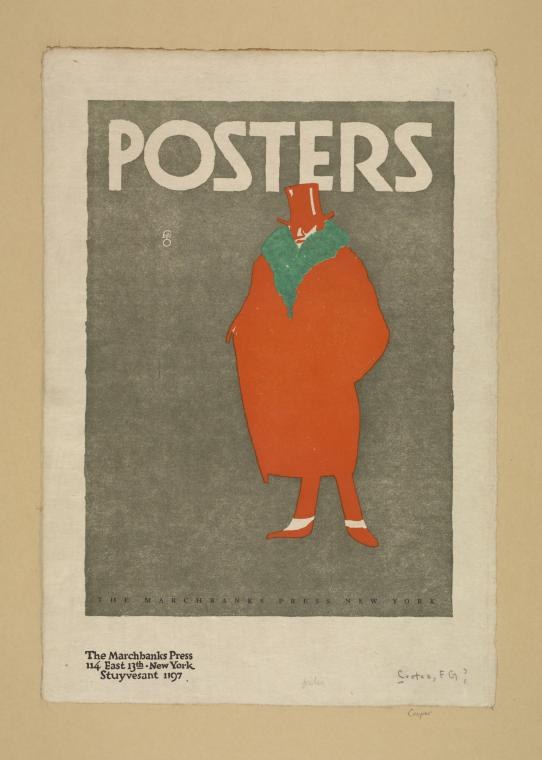
A stylized figure stands alone against a muted gray-green background in a composition of stark geometric simplification. The dancer wears a voluminous orange-red coat or cape that dominates the frame, its heavy fabric rendered as a solid, almost architectural form. Beneath it, a small pointed head emerges, crowned with a red hat or headdress, with hints of green (possibly feathering or a collar) at the neck. The figure's legs, clad in orange-red, taper to small feet. The artist has chosen an absolutely frontal, symmetrical stance—no movement is suggested, no weight is shifted. The composition is intensely static and graphic, exploiting the blank ground to maximum effect. The work reads as a pattern or template rather than a captured moment of dance.
The dancing
A single figure occupies the center, rendered with pronounced geometric reduction. The body is presented full-front, with no articulation of limbs beneath the voluminous outer garment. The posture is upright and immobile—there is no twist, lean, or weight distribution visible. The proportions are highly stylized: the coat forms a simple trapezoid, the head is small and abstract, and the arms are either hidden or barely suggested. This is a presentation of a figure in costume rather than a depiction of bodily action or dance technique.
The dance depicted
The work does not depict dance in motion or any recognizable choreography. What appears instead is a figure in theatrical or performance costume—the substantial coat, the head covering, and the formal frontality suggest costume design or a theatrical character study rather than a record of dancing bodies. The image is closer to a fashion plate or character design than to a scene of movement. Without inscription or context, the specific dance tradition cannot be identified.
How it was made
This is a printed poster in a modernist graphic style, likely produced by lithography or a related printing process, given the flat color areas and bold outlines characteristic of early 20th-century poster art. The technique—bold simplification, high-contrast color, stark geometry—was the signature of avant-garde graphic design of the 1920s and 1930s. Posters of this type were designed for public display and mass circulation, reaching broad audiences and influencing commercial and artistic taste. The printing method allowed for affordable reproduction and the bold graphic language was suited to street visibility.
About this work
This is a stylized costume or character design rendered as a modernist graphic poster. The figure is presented as an abstracted form in performance dress rather than as a dancer in motion, aligned with early 20th-century developments in theatrical design and graphic modernism. The work belongs in a dance history context not because it captures dancing, but because it documents how dance costumes and theatrical characters were imagined and circulated through visual culture—specifically, how avant-garde designers translated the human form into pure graphic symbol. The poster format and stark modernist language place it within the emergence of art as public communication and the increasing convergence of fine art, theatre design, and commercial graphics in the interwar period.
How to look at it
Notice the complete absence of motion: the figure stands as a static, symmetrical block. The viewer should observe how the artist has reduced the human figure to its costume—the coat is the figure, not vice versa. Pay attention to how the flat graphic treatment transforms something functional (a stage garment) into a pure design object. The poster presents an ideal or type rather than an individual dancer or a captured moment; this is the grammar of modernist theatre design, where the costume becomes a vehicle for character and concept rather than a frame for physical virtuosity.
The period
This poster dates from the early 20th century, when modernism was reshaping visual culture across Europe and America. The Marchbanks Press, a New York publisher, issued this work in 1907, a moment when theatrical design was becoming professionalized and when poster art had become a major artistic medium in its own right. The graphic language here—bold reduction, geometric simplification, flattened color, stark frontality—reflects the influence of Art Nouveau and the emerging Constructivist and Art Deco movements. During this period, theatrical costume was increasingly understood as a graphic and spatial problem as much as a practical garment, influenced by innovations in scenic design and the rise of modern dance. The poster's abstraction suggests an artist thinking about theatre design as pure form.
Where it lives
The work is held in the New York Public Library collection. It is printed with publication information: The Marchbanks Press, 164 East 38th Street, New York, with a date notation of Stuyvesant 1907. As a poster from a commercial press, it was originally produced for display and public circulation.
Questions about this work
Is this person dancing?
No. The figure stands in a static, frontal pose with no indication of movement, weight shift, or physical action. The work is a costume or character design presented as a graphic form, not a record of choreography or dance technique.
What is the figure wearing?
A large orange-red coat or cape that obscures the body, topped with a red pointed hat and what appears to be green feathering or a collar at the neck. The outfit is theatrical in character, suggesting a stage costume or character role rather than street dress.
Why is this in a dance archive if no one is dancing?
Because dance history includes not just the documentation of movement, but the visual cultures, costumes, and theatrical contexts in which dance was performed and circulated. This poster shows how early 20th-century theatre designers and graphic artists imagined dance and performance characters for public audiences.
More dance artwork