49 works in this view — arrow keys or swipe to move between them.
Dance in Art · 2023
La polka
Unknown artist
- Medium:
- Lithograph
- Dance:
- Polka
- Era:
- Late 1800s (Victorian Ballroom)
- Source:
- New York Public Library
- Rights:
- Public domain — free to use, share and adapt.
- Recorded as:
- public_domain
The polka was one of the first dances to blur boundaries between folk origins and high-society fashion, and popular prints like this one shaped how the dance was understood and imitated. For historians of dance and social history, the image documents both the polka's dominance in mid-19th-century ballroom culture and the ways popular media constructed narratives around fashionable dances—as markers of modernity, sites of courtship, and occasions for social observation and satire.
What you are looking at
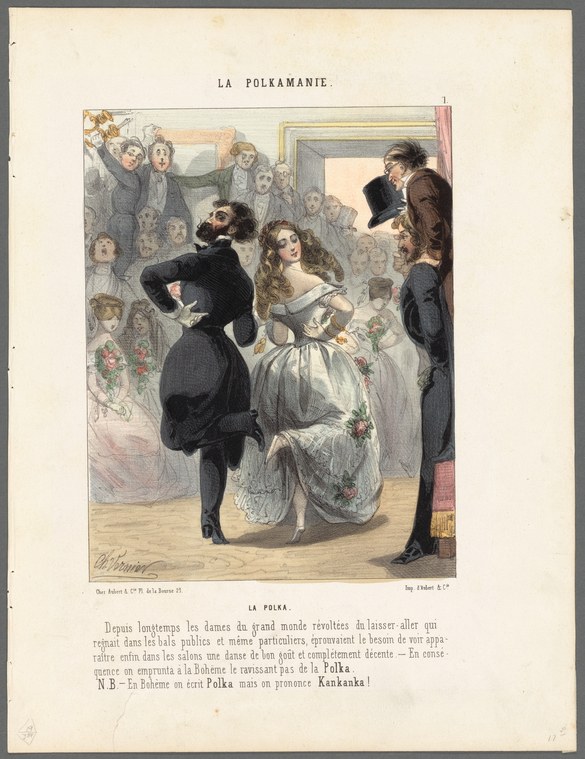
A crowded ballroom scene rendered in color lithograph, with a polka in full swing. In the foreground, a couple occupies the center: a man in black tailcoat and trousers faces a woman in an off-shoulder white ball gown with a floral corsage, their bodies angled toward each other in active conversation or flirtation rather than dance. Behind and around them, dozens of spectators line the room—men in dark formal dress, women in pale gowns—crowded against the walls and filling the background. A large doorway with ornate molding frames the right side of the composition. The lithograph employs hand-coloring with soft washes of cream, gold, and flesh tones against the printed black linework, typical of mid-to-late 19th-century commercial prints. The room itself is suggested by minimal architectural detail: the focus is entirely on the figures and their social interaction rather than spatial recession.
The dancing
The central couple is poised but not yet in closed dance hold: the man's weight is on one leg with his body angled, while the woman faces him with her body slightly turned, her long skirt occupying considerable visual space. Neither figure shows the upright frame or locked arm position of a formal ballroom hold. Around them, the crowd of onlookers—mostly static, watching—creates the sense of a spectacle being observed rather than a participatory group dance. The composition emphasizes social display and courtship ritual over the technical execution of footwork.
The dance depicted
The title and setting identify this as depicting the polka, the social dance that swept European and American ballrooms from the 1840s onward. The polka was danced in closed position with a distinctive bounce and traveling step, typically to lively 2/4 music. What this lithograph captures is not the dance itself in motion, but the social moment surrounding it—the approach, the flirtation, the moment before or between dances. The crowded ballroom, the spectating throng, and the emphasis on the couple as objects of attention are characteristic of how the polka was represented in popular prints, often used to comment on courtship and social ambition.
How it was made
This is a hand-colored lithograph, a process in which an image was drawn on stone, printed in black, and then selectively colored by hand—a labor-intensive but economical method for producing colored prints in quantity. The technique allowed for rapid distribution of fashionable images to a middle-class audience interested in contemporary social life. The signature visible at lower left ("Alophe" or similar) and the publication line ("Chez Arnoux et Cie") indicate this was a commercial print from a Parisian publisher, part of a series documenting ballroom dances and fashionable social scenes. The style and execution place it firmly in the mid-19th-century tradition of satirical and observational social prints.
About this work
This hand-colored lithograph documents a moment from the polka craze that dominated European ballrooms in the mid-1800s. Rather than depicting the polka as pure movement, the print captures the social choreography surrounding the dance—the approach, the attention of the crowd, the performance of courtship. The woman's elaborate white gown, the man's formal tailcoat, and the packed ballroom all mark this as a scene of fashionable society, where the polka served not only as entertainment but as a stage for social aspiration and courtship display. The work belongs to a rich tradition of popular prints that used dance scenes to comment on contemporary manners, morality, and the rituals of urban social life.
How to look at it
Notice the composition: the central couple is not executing a visible step, but rather pausing in social interaction—the moment before the dance or between dances. The crowd surrounding them is as important as the dancers themselves; this is a dance scene organized around spectatorship and social display rather than the movement of the dance. The woman's skirt is the most prominent element, rendered in soft wash and occupying much of the canvas—a reminder that in the 1850s-60s, a woman's dress was itself a kind of performance. The lithographic technique, with its combination of printed line and hand-applied color, creates a sense of immediacy and accessibility appropriate to a commercial print meant to circulate widely and to appeal to a broad audience.
The artist
The artist is not recorded in the catalogue, but the signature and publication information suggest a professional illustrator working for a Parisian commercial print house. The style is consistent with the mid-19th-century tradition of French social and satirical illustration, including artists like Honoré Daumier, Gavarni, and the many anonymous illustrators who produced fashion plates and ballroom scenes for mass circulation. These prints were typically made in response to current fashions and social trends, ensuring rapid production and topical relevance.
The period
The polka arrived in Paris in the early 1840s from Bohemia and became the dominant dance of the decade, sparking both enthusiasm and moral anxiety. By the 1850s-60s (the likely date of this print), the polka's novelty had faded somewhat, but it remained a staple of ballroom culture alongside the waltz and quadrille. In art and satire, the polka became a symbol of modern, energetic femininity and of the mixing of social classes—it was danced by servants and aristocrats alike. Popular prints served as both fashion guides and social commentary, allowing middle-class readers to imagine themselves as participants in fashionable ballroom society while also offering satirical perspective on the follies of social ambition.
Where it lives
The print is held by the New York Public Library, likely as part of a collection of 19th-century popular prints documenting social life and fashions. The publication line indicates it was issued by Arnoux et Cie in Paris, suggesting it was one of hundreds of similar prints produced for European and transatlantic distribution during the mid-1800s.
Dance in this work
Questions about this work
What exactly is the polka?
The polka is a lively couple's dance in 2/4 time, characterized by a bouncing step and a traveling motion around the floor. It originated in Bohemia in the 1830s and spread rapidly to Paris, Vienna, and London, becoming one of the defining dances of the 1840s-50s. Unlike the waltz, which was also popular, the polka is more energetic and less formal, and it was often danced in mixed social groups, including people of different classes.
Why are so many people watching instead of dancing?
In 19th-century ballrooms, not everyone danced at once. Balls were organized with specific dances announced in advance, and spectators would watch while waiting for their turn to dance, flirting, or socializing. The crowded margins of this print are typical of ballroom scenes—the dance floor was always surrounded by onlookers, and being watched was part of the social experience. For women especially, the decision to accept a dance partner was a significant social gesture, often preceded by a period of visible consideration.
How does this image compare to other representations of the polka?
The polka appears frequently in 19th-century art and prints, often depicted as a whirling, energetic scene with couples in motion. This print is more restrained and focused on the social moment surrounding the dance rather than the movement itself. It emphasizes the ritual of courtship and the performance of fashionable society, and reflects the way prints and satirical images often used the polka as a vehicle for commenting on social change, women's fashion, and the mixing of classes in modern urban ballrooms.
More Polka artwork