49 works in this view — arrow keys or swipe to move between them.
Dance in Art · 2023
The polka fashions
Unknown artist
- Medium:
- Lithograph
- Dance:
- Polka
- Era:
- Late 1800s (Victorian Ballroom)
- Source:
- New York Public Library
- Rights:
- Public domain — free to use, share and adapt.
- Recorded as:
- public_domain
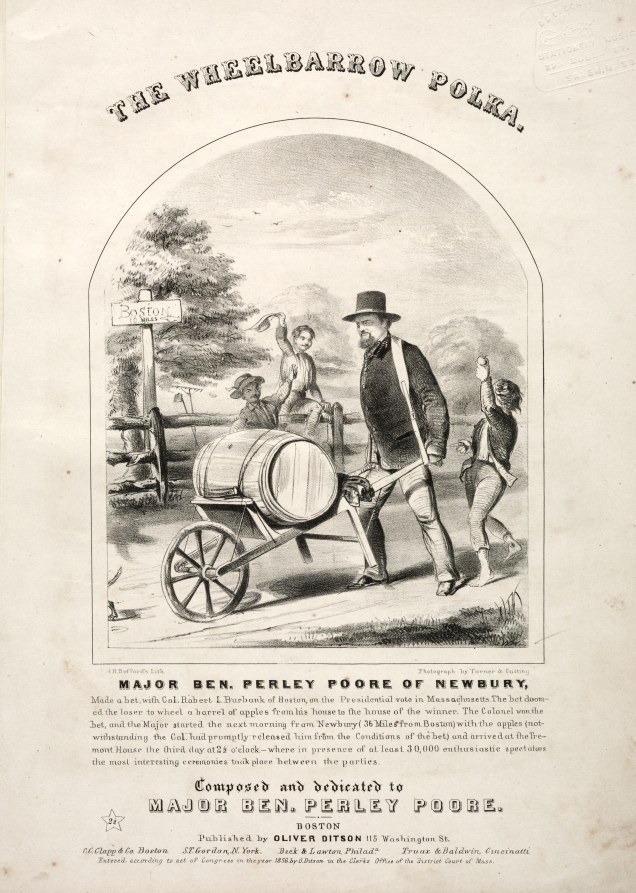
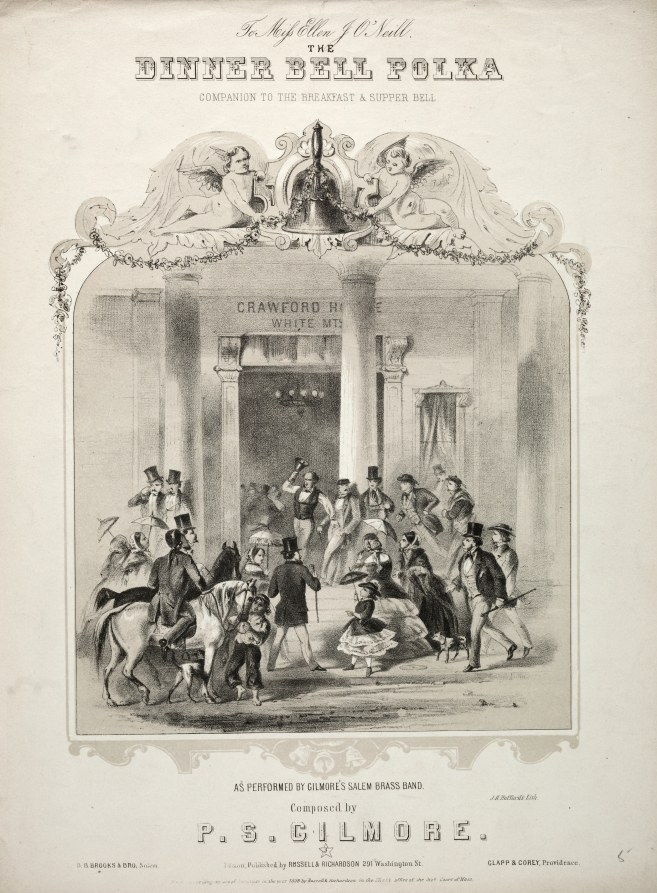
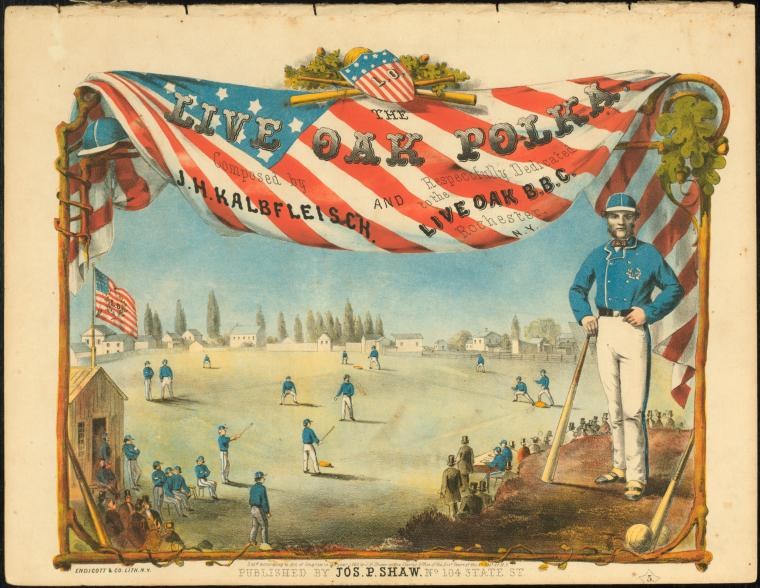
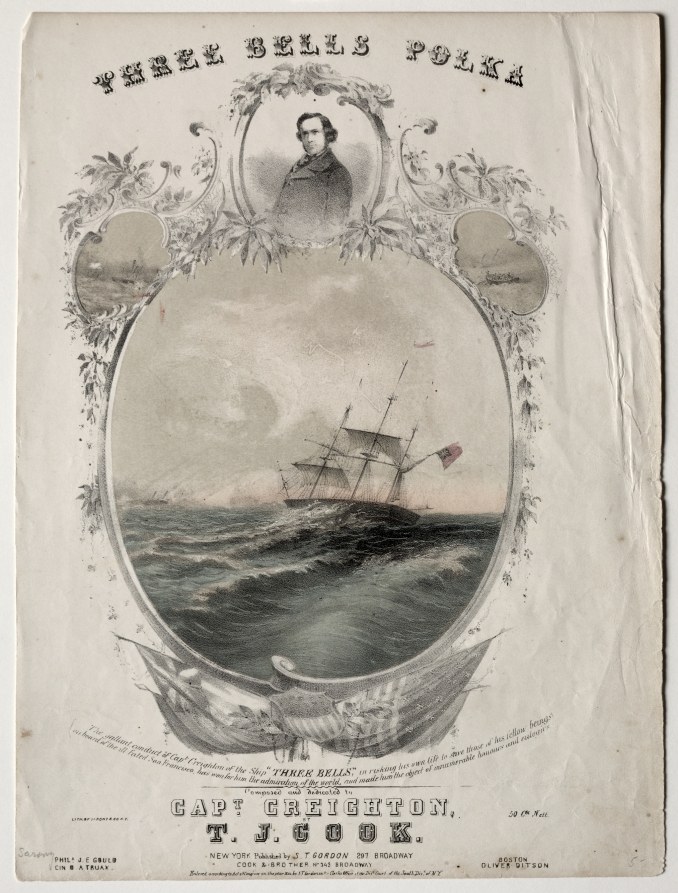
This lithograph is one of the clearest visual records of how the polka was actually performed and presented in Victorian ballrooms, and it documents the moment when a Central European folk dance was transformed into an emblem of fashionable society. For dancers and historians, it offers concrete evidence of the polka's integration into formal evening culture and shows how contemporary artists understood and communicated the dance to a broad public audience.
What you are looking at
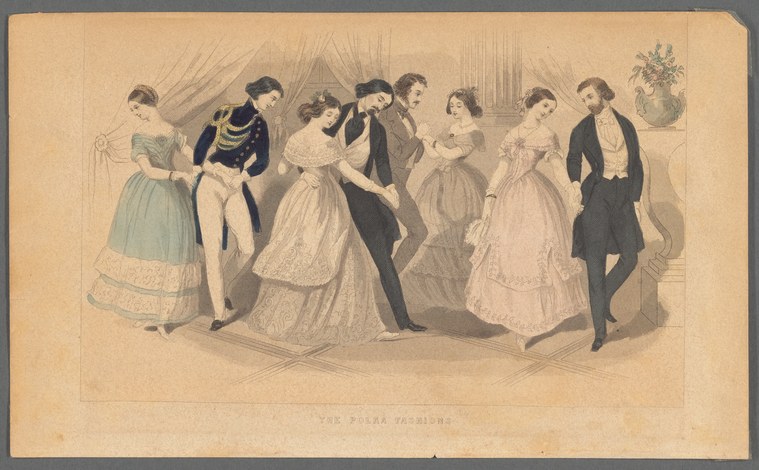
A lithograph depicting a fashionable social gathering centered on the polka, a couple dance that dominated mid-to-late Victorian ballrooms. Nine figures occupy a shallow interior space defined by vertical drapery in the background. At the center, a man in dark dress coat and a woman in an elaborate white ball gown with deep flouncing engage in the polka hold—his right hand at her waist, her left resting on his shoulder. Around them, additional couples and onlookers in formal evening dress populate the scene: a military officer in ornate uniform with gold braid stands nearby, women in pale silk gowns with fitted bodices and full skirts trimmed with lace and ribbon gather in conversation, and men in black coats and waistcoats attend to them. The women's hairstyles are dressed high and ornamented; the men sport the high collars and neatly groomed whiskers of the period. The composition is animated but orderly, capturing the moment not as frenzied energy but as elegant social performance—the polka as an emblem of fashionable leisure.
The dancing
The central couple demonstrates the standard polka frame: the man leads with upright posture and the woman follows in a position that shows her face and upper body to the viewer while her skirt billows with the motion of the dance. The supporting figures are posed in varied attitudes—some in conversation, some apparently awaiting their turn to dance, others moving in the background. The artist has rendered the women's full skirts with careful attention to the layered construction of mid-Victorian fashion, showing how the fabric responds to movement. No footwork is visible, but the distribution of weight and the angle of the torsos conveys the springing, bouncing quality the polka demanded.
The dance depicted
This is a polka, the couple dance that became one of the dominant social dances of the 1840s through 1890s. Originally a Bohemian folk dance, the polka conquered European and American ballrooms in the mid-nineteenth century and became a staple of Victorian social dancing, performed at balls, assemblies, and at-home gatherings like the one depicted here. The lithograph captures not the dance itself in technical detail but rather the polka as a fashion statement and social ritual—it is literally titled 'The Polka Fashions,' indicating the artist's primary interest in the costume and comportment of those who danced it. The image shows us how the polka was integrated into formal evening society: as a respectable, even elegant leisure activity for the middle and upper classes, danced in ballrooms among the fashionable world.
How it was made
A lithograph, a print technique that allowed for rapid reproduction and wide distribution. Lithography required drawing on stone with greasy crayon, then applying ink that adhered to the drawn areas while being repelled by wet stone, enabling multiple impressions to be pulled from a single stone. This technique was ideal for fashion illustration and social satire—relatively inexpensive to produce, capable of fine detail in dress and facial expression, and capable of reaching a broad audience through newspapers, periodicals, and independent prints. The delicate line work and subtle shading evident here suggest a skilled hand, and the subject matter (fashionable society at leisure) indicates this was aimed at a middle-class readership interested in understanding or satirizing the manners and dress codes of fashionable life.
About this work
This is a mid-Victorian lithograph documenting the polka as a fashionable social dance. It captures a moment in a formal ballroom where couples in evening dress perform the polka alongside onlookers in an ordered, decorous setting. The primary subject is not the movement of the dance itself but the costume, comportment, and social choreography of the Victorian ballroom—who danced with whom, how they dressed, how they moved within the constraints of formal etiquette. The work belongs in a dance gallery as evidence of how the polka functioned in nineteenth-century social life: not as a folk tradition but as a marker of fashion, respectability, and urban leisure. It shows us the polka through the eyes of contemporary print culture, interested equally in the dance and in the stylish world that adopted it.
How to look at it
Look first at the central couple and how the artist has positioned them: the woman's face is turned toward the viewer while her body is in motion, her skirt caught mid-swirl to show the full extent of the fabric and the vigor of the dance. Notice the careful rendering of the men's military and evening dress and the women's hairstyles and jewels—these details were as important to the original audience as the dance itself. The composition is neither chaotic nor static; the artist has arranged the figures to suggest both the order of formal ballroom etiquette and the liveliness of the dance. The vertical drapes and the shallow space compress all the action onto a picture plane that feels like a stage, emphasizing that this is a performance for an audience, not a private activity.
The period
The polka arrived in Paris and Vienna in the early 1840s and rapidly became a sensation across Europe and North America. By the 1850s and 1860s, when this lithograph was likely made, the polka had become thoroughly established in ballroom dancing alongside the waltz, cotillion, and quadrille. The dance was celebrated in music (countless polka compositions were published), in literature and satire, and in fashion and social commentary. The rise of the polka coincided with the rise of lithographic printing and illustrated periodicals, which made images of fashionable life widely available to the middle classes. This print is part of that broader culture of fashion illustration—a way of teaching people how to dress and behave in fashionable society by showing them images of 'correct' dress and deportment at social events.
Where it lives
From the New York Public Library collections. The work is catalogued as a late-nineteenth-century lithograph and represents a common type of popular print—fashion and social commentary distributed through print to a middle-class readership.
Dance in this work
Questions about this work
What is the polka and why was it so popular in Victorian times?
The polka is a couple dance in 2/4 time that originated in Bohemia. It arrived in Paris in the early 1840s and became an immediate sensation among fashionable society, where it was seen as modern, energetic, and respectable. Unlike some older dances, the polka was relatively easy to learn and allowed couples to dance in a close embrace without scandal. It remained one of the dominant social dances of the ballroom through the Victorian period and into the twentieth century.
How do we know this is a polka and not another Victorian couple dance?
The title 'The Polka Fashions' identifies it explicitly. Beyond that, the image shows the characteristic polka frame (man's right hand on woman's waist, woman's left hand on man's shoulder) and the energetic, springy bearing of the dancers, which matches descriptions and other images of the polka from the period. The couple's posture and the woman's billowing skirt convey the bouncing, hopping character of the polka, which differed from the smoother, more gliding waltz.
Who was this lithograph made for and how was it distributed?
Lithographs like this were produced for a broad middle-class audience interested in fashion, social etiquette, and entertainment. They were sold as prints, published in illustrated magazines and periodicals, and sometimes included in books on dancing or fashion. They served partly as practical guides (teaching people how to dress for a ball) and partly as social satire or commentary, reflecting and shaping public attitudes toward fashionable life.
What do the military uniform and formal evening dress tell us?
The ornate military uniform indicates that officers were regular attendees at fashionable ballroom events, underscoring that this was elite or upper-middle-class social space. The formal evening wear—black coats, white waistcoats, and elaborate ball gowns—was mandatory for such events and marked the occasion as one of importance and decorum. The precision and formality of the dress codes made the ballroom a highly codified social space.
More Polka artwork