49 works in this view — arrow keys or swipe to move between them.
Dance in Art
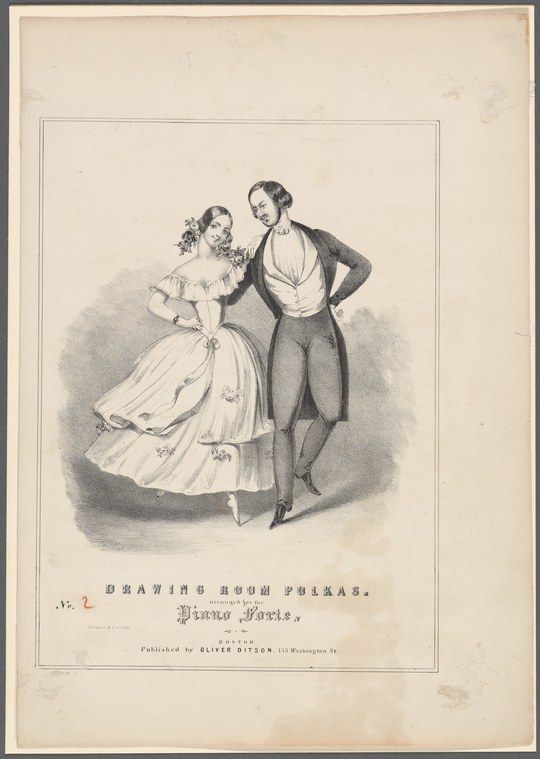
Drawing room polkas,
Unknown artist
- Medium:
- Drawing/Sketch
- Dance:
- Polka
- Era:
- Late 1800s (Victorian Ballroom)
- Source:
- New York Public Library
- Rights:
- Public domain — free to use, share and adapt.
- Recorded as:
- public_domain
This print is a rare everyday artifact of how the polka was actually danced and taught in middle-class homes, at a moment when the dance was becoming the defining social practice of its era. It shows the ballroom frame, posture, and aesthetic ideals of the Victorian period more directly than most surviving images, and its commercial origins tell us who danced, who taught, and how dance knowledge circulated in the nineteenth century.
What you are looking at
A young couple poses in an elegant drawing room setting, frozen mid-polka. The woman, in the foreground left, wears a full white ball gown with a fitted bodice and voluminous skirt decorated with floral sprigs or embellishments; her dark hair is arranged in fashionable ringlets. The man, in dark coat and trousers, stands beside and slightly behind her, his right hand at her waist, his left arm extended in the classical ballroom frame. His posture is upright and assured. The composition suggests the exact moment of the dance—neither beginning nor end, but a held gesture that captures the essential character of the movement. The background is plain and neutral, throwing full focus onto the couple and their interaction. The lithographic technique has rendered fine details in their dress and subtle modeling in the fabric through careful cross-hatching and tone.
The dancing
The couple holds a closed ballroom position: the man's right hand supports the woman's waist while his left extends to hold her right hand. The woman's left arm rests on his right shoulder. Both bodies are upright with a slight forward lean characteristic of early-to-mid nineteenth-century ballroom hold. The woman's weight appears to be on her left leg, her right foot lifted slightly, suggesting she is caught mid-step. The man's stance is grounded and leading. Their heads incline toward each other with a sense of propriety and intimate attention.
The dance depicted
This is a polka, a popular couples' dance that swept Europe and America in the 1840s and remained a ballroom standard through the Victorian era. The title "Drawing room polkas" indicates these were refined versions of the dance performed in domestic social settings rather than public ballrooms. The polka is characterized by a quick, bouncy three-beat rhythm with a distinctive hop on the third count. The image shows the controlled, upright posture and closed position standard to the polka in middle-class contexts, where decorum and elegance were paramount. The dress and setting confirm this is a parlor version of the dance, suited to the etiquette of a respectable household.
How it was made
This is a lithographic print, likely hand-colored or printed in color from multiple stones. The inscription at the bottom—'DRAWING ROOM POLKAS. Piano Polka.' and 'Published by OLIVER DITSON'—identifies it as a commercial product, probably accompanying sheet music for piano. The lithographic technique allowed for relatively inexpensive mass production and wide circulation of such images. The fine draftsmanship visible in the figures suggests the print was made from a skilled artistic design, while the reproductive method made it accessible to the middle-class households that danced the polka. Such prints commonly appeared as frontispieces to dance instruction books or sheet music, serving both as advertisement and as visual instruction in proper form.
About this work
This is a mid-nineteenth-century commercial lithograph documenting the polka as a refined ballroom dance in the Victorian drawing room. It captures a moment of controlled elegance: a young couple in formal dress, poised in the classical closed position, their bodies speaking the language of propriety and courtship ritual. The image belongs to a large body of printed dance instruction and entertainment materials that flourished in the 1840s–1880s, when the polka was at the height of its social popularity. Publishers like Oliver Ditson mass-produced such prints to accompany the sheet music for piano polkas—themselves among the most popular parlor music of the era. The work is not primarily an artistic statement but a practical document: a teacher's reference, a dancer's model, a reminder of correct form for those learning the steps at home.
How to look at it
Notice the precision of the ballroom frame: the positioning of the man's hands, the angle of the woman's arm, the upright spinal alignment that was the mark of a well-taught dancer. The woman's caught-mid-step pose is typical of dance prints of this era—the artist has chosen to show the lightness and bounce of the polka by lifting her foot, rather than showing a grounded position. Observe how the lithographer has used fine parallel lines and cross-hatching to suggest the texture and weight of the fabrics, especially the voluminous skirt. The emotional register is restrained and formal; unlike later images of dance, there is no exuberance or abandon, only controlled pleasure and mutual attention. This is dance as social obligation and courtship ritual, not as self-expression.
The artist
The artist is not recorded. The print was published by Oliver Ditson, a Boston-based music publisher who dominated American sheet music distribution from the 1830s through the late 1800s. Ditson's firm was known for producing high-quality lithographic covers and frontispieces to accompany their publications, employing skilled artists whose work was rarely signed. The style and execution suggest a trained illustrator working within the conventions of mid-Victorian commercial lithography.
The period
The polka emerged in Bohemia in the 1830s and reached Vienna by the early 1840s, where it was embraced by the aristocracy and rapidly spread to Britain and America. By the 1850s–1870s, when this print was likely made, the polka had become the quintessential couple's dance of the middle class, rivaled only by the waltz in popularity. It suited the Victorian ideal of paired, proprietary social interaction and the energetic but decorous sociability of the drawing room. The dance was taught through printed instruction books and sheet music, and visual guides like this one were essential teaching tools. Lithographic printing had made illustrated sheet music affordable and widespread, so the polka was both danced and studied visually by tens of thousands of amateur musicians and dancers in homes across the English-speaking world.
Where it lives
The print is held in the New York Public Library collection. It is a commercial product—sheet music cover or instructional print—published by Oliver Ditson of Boston, one of the major American music publishers of the nineteenth century. Such prints were widely distributed and many have survived in institutional collections.
Dance in this work
Questions about this work
What is a polka and why was it so popular?
The polka is a fast, spirited couples' dance in triple meter, characterized by a light hop on the third beat. It originated in Bohemia in the 1830s and became the defining social dance of the Victorian middle class, rivaling the waltz in popularity. Its energy, relative simplicity, and suitability for the paired courtship model made it ideal for drawing-room society, and sheet music for polkas was among the most commercially successful music published in the nineteenth century.
How do I know this is actually a polka and not some other dance?
The title printed at the bottom of the image explicitly states 'Drawing Room Polkas.' Additionally, the date and style of dress, the published sheet music connection, and the upright closed-position frame are all consistent with mid-Victorian polka practice. The pose—with the woman caught mid-step and lifted weight—is typical of how lithographers represented the polka's bouncy character.
Who was Oliver Ditson and why does his name appear here?
Oliver Ditson was a Boston-based music publisher who dominated the American sheet music market from the 1830s through the 1880s. His firm published thousands of pieces, from classical to parlor music, and was famous for the quality of its lithographic covers and instructional prints. Ditson's books and prints reached middle-class homes across America and were central to how amateur musicians and dancers learned their craft.
Is this a painting or a print? How can you tell?
This is a lithographic print, a reproductive technique that allowed for mass production. The fine parallel lines visible in the shading, the even tonal areas, and the printed text at the bottom are all characteristic of lithography. The technique was ideal for producing affordable illustrated sheet music and instruction materials for the rapidly growing market of middle-class households.
More Polka artwork