49 works in this view — arrow keys or swipe to move between them.
Dance in Art · 2019
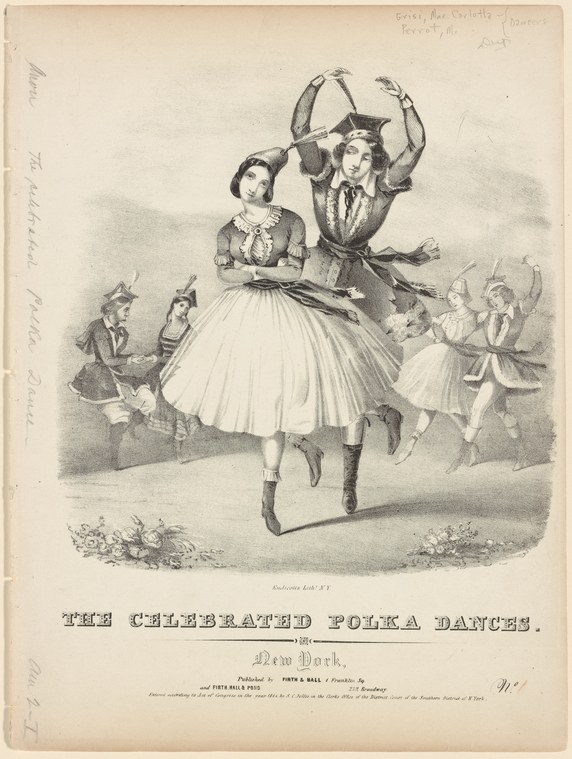
The celebrated polka dances
Unknown artist
- Medium:
- Lithograph
- Dance:
- Polka
- Era:
- Late 1800s (Victorian Ballroom)
- Source:
- New York Public Library
- Rights:
- Public domain — free to use, share and adapt.
- Recorded as:
- public_domain
This image is a primary document of polka's social meaning in the Victorian ballroom—not as a formal technique but as a moment of exuberance, informality, and social pleasure that appealed across class lines. The lithograph's commercial publication and wide circulation tell us how dance news traveled and how fashionable society consumed and celebrated new steps. For historians of ballroom dance, this is rare evidence of actual performance practice and costume as it was understood in the period, before polka became historical.
What you are looking at
A lively ballroom scene centered on a couple performing a polka. The woman wears a full-skirted white dress with a fitted bodice and short puffed sleeves; the man wears formal evening attire with a dark jacket and stands with his arms raised expressively above his head. The couple occupies the center of the composition, captured mid-motion with the woman's voluminous skirt swirling around her. Surrounding them are at least four other figures in similar formal dress, watching or participating in the dance—some clapping, others standing with raised arms in gestures of encouragement and merriment. The setting appears to be an indoor ballroom, rendered in soft gray tones typical of mid-nineteenth-century lithography. Small flowering plants or wreaths appear at the lower corners of the composition, adding festive detail. The overall mood is one of exuberant social celebration.
The dancing
The primary dancers are in a loose open position rather than a strict closed hold—characteristic of early polka performance. The man's raised arms and animated posture suggest the energetic, playful character of the dance. The woman's body is angled to show the sweep of her skirt, which was central to the visual spectacle of polka in this era. Her legs appear to be in rapid motion, suggesting the quick, bouncing steps typical of the style. The surrounding figures—some with hands raised, others gesturing—indicate a social rather than strictly formal performance context, with the audience actively participating in the celebration rather than remaining passive spectators.
The dance depicted
This is unquestionably a polka, as stated in the title and confirmed by every visual detail: the couple's informal open position, the woman's knee-length skirt and its visible motion, the man's playful raised-arm posture, and the energetic, celebratory setting. The polka was at the height of its popularity in the 1840s–1860s across Europe and North America, having spread from Bohemia as both a ballroom dance and a popular social phenomenon. The image captures not a technical demonstration but a moment of social joy—polka was danced by amateurs in public ballrooms and at social gatherings, not exclusively by professional dancers. The composition emphasizes the dance's appeal as entertainment and courtship ritual rather than as a test of skill.
How it was made
This is a lithograph, a printmaking process that allowed rapid, affordable distribution of popular imagery. Lithography's tonal capabilities are evident in the soft gray shading that models the figures and creates atmospheric depth. The technique was ideal for satirical and social commentary prints as well as celebratory images of fashionable life, meaning this work circulated widely among middle-class audiences interested in ballroom culture and current fashions. The legible signature or publication mark at the bottom (reading "Published by Fores & Hull") indicates commercial distribution. Lithographic prints of this type were affordable enough for framing in homes and were often collected as sets documenting popular dances and social scenes.
About this work
This is a celebratory print documenting the polka at the moment of its greatest social currency in the mid-nineteenth century. The work captures not the technical perfection of professional dancers but the infectious joy and social liberation the polka represented—a dance that broke with rigid ballroom convention, allowed informal dress and movement, and crossed class lines in its appeal. The lithograph's wide distribution through commercial publishers like Fores & Hull made images like this part of how urban middle-class audiences understood and engaged with contemporary dance culture. The print belongs in a dance history collection as evidence of how polka was experienced, performed, and circulated as popular culture rather than as high art.
How to look at it
Notice the woman's skirt—not just its volume but its motion, caught mid-swirl. This is what made polka visually distinctive and thrilling to Victorian audiences accustomed to the restrained waltz. The man's raised arms and open posture show joy rather than technical control; he is not executing a difficult movement but celebrating. The surrounding figures' animated engagement—clapping, gesturing, watching closely—remind us that polka was a social dance, not a performance for passive observation. The composition captures not a single step but a moment of collective pleasure, which is what the polka meant to the people who danced it.
The period
The polka arrived in Western European ballrooms around 1840, originating in Bohemia and spreading rapidly through Vienna and Paris to London and North America. By the 1850s and 1860s, when this print was likely made, the polka was the dominant social dance of the era—more popular than the waltz it had recently challenged. The dance was revolutionary in its informality: unlike the stately minuet or even the waltz, the polka allowed dancers to move with playful energy, couples could separate and rejoin, and it demanded less formal training. This accessibility made it the subject of enormous commercial interest—not only dance instruction books but also popular prints, music, poetry, and satirical commentary. The lithograph form itself was relatively new and perfectly suited to distributing images of fashionable life to the urban middle classes who could afford both ballroom attendance and the modest cost of prints.
Where it lives
This print is held by the New York Public Library, part of its collection of historical prints documenting popular culture and social history. The publisher information visible in the print (Fores & Hull) indicates commercial lithographic production and wide distribution.
Dance in this work
Questions about this work
Is this a real polka or an exaggerated caricature?
The visual details are accurate enough—the woman's high-waisted dress with knee-length skirt, the man's evening coat, their open position, the raised arms—but the composition emphasizes the exuberance and social pleasure of polka rather than technical precision. Lithographic popular prints of the era often heightened emotion and movement for effect, but this captures genuine aspects of how polka was actually performed and experienced socially.
Why is the woman's skirt such a big deal?
The polka was danced in knee-length skirts, much shorter than the floor-length gowns worn for formal balls and the waltz. The visible motion of the skirt, its swirl and bounce, was visually distinctive and shocking to conservative critics—it became the signature visual marker of the polka and was central to the dance's appeal and controversy.
Who would have danced polka in the 1850s–60s?
Unlike the waltz or quadrille, which required training and were danced by the upper-middle and upper classes, the polka appealed across class lines. It was danced at public ballrooms, at amateur social gatherings, and at fashionable balls alike. Its accessibility and informality were part of its revolutionary appeal and its rapid spread.
What does the title 'The Celebrated Polka Dances' mean?
The plural 'dances' likely refers to the many variations of polka—the basic polka, the polka galop, the polka mazurka—all of which were fashionable in this period. By calling them 'celebrated,' the publisher was capitalizing on the polka craze that swept Europe and America.
More Polka artwork