49 works in this view — arrow keys or swipe to move between them.
Dance in Art
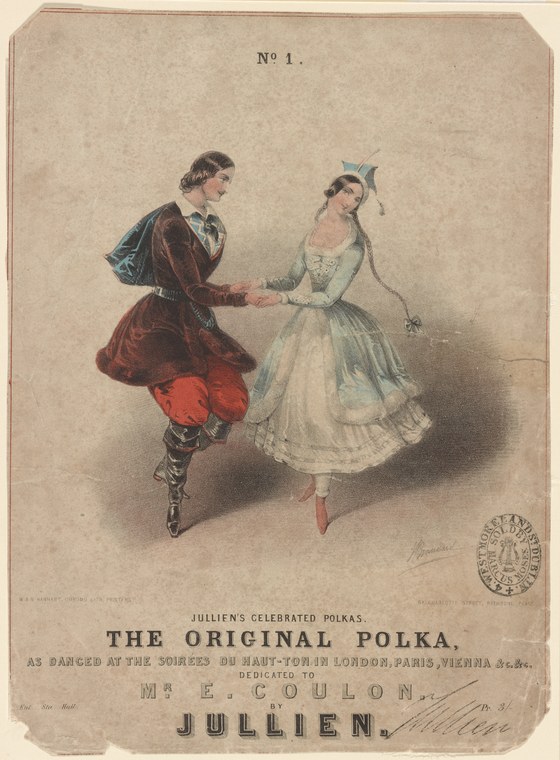
Jullien's celebrated polkas.
Unknown artist
- Medium:
- Lithograph
- Dance:
- Polka
- Era:
- Late 1800s (Victorian Ballroom)
- Source:
- New York Public Library
- Rights:
- Public domain — free to use, share and adapt.
- Recorded as:
- public_domain
The polka was the first dance craze of the modern media age, and prints like this were how most ballroom dancers encountered new dances and steps. This image shows not a professional performance but a normative ballroom scene, making it invaluable evidence of what ordinary social dancers actually wore, how they held their bodies, and what the polka looked like in practice rather than on stage.
What you are looking at
A man and woman face each other in a dance pose against a plain background. The man, on the left, wears a burgundy velvet coat with bright red breeches and dark stockings, leaning forward with one arm extended toward his partner. The woman wears a white muslin dress with a fitted bodice and full skirt caught mid-movement, her dark hair adorned with a feathered headdress. Both figures are captured mid-step, their bodies angled to suggest rapid, energetic motion. The lithograph is hand-colored with careful attention to the richness of the fabrics—the deep jewel tones of the man's coat contrasting sharply with the pale, ethereal quality of the woman's gown. The title and attribution appear below in large type, identifying this as part of Jullien's celebrated polkas and dedicating it to Mlle Gonillon.
The dancing
The two dancers are separated by a small distance and do not appear to be in contact. The man's posture is energetic and forward-leaning, with one leg extended and his torso tilted; the woman responds with a light, almost floating stance, her body angled away as if in a turning motion. Both are captured with the leg positions and weight distribution typical of polka—quick, bouncing steps rather than the smooth gliding of a waltz. The woman's dress, though full, is shown caught and lifted, revealing her stance rather than concealing it.
The dance depicted
This is unmistakably a polka, one of the most fashionable social dances of the mid-to-late nineteenth century. The polka originated in Bohemia in the 1830s and spread rapidly through Europe and America, becoming a defining dance of the Victorian ballroom by the 1850s–1880s. The energetic, bouncing character visible in the dancers' posture—the lifted legs, the forward momentum, the quick tempo implied by their arrested motion—are the signature of the polka. Jullien's Polkas were celebrated compositions, and this print advertises them as danced at the opera house in Saint-Pétersbourg, suggesting these were fashionable among elite European audiences.
How it was made
This is a hand-colored lithograph, a reproductive medium that allowed for wide distribution of dance imagery to the ballroom-dancing public. Lithography's capacity to capture gestural energy and fabric texture—the soft modeling of the woman's skirts, the gleaming richness of the man's velvet coat—made it ideal for dance prints, which were both souvenirs of celebrated performances and instructional references for social dancers learning new steps. The hand-coloring, executed after printing, was labor-intensive and marks this as a premium product, intended for customers willing to pay for color and artistry.
About this work
This is a commercial dance print from the height of the Victorian ballroom era, promoting a celebrated polka composition by Jullien, a major figure in nineteenth-century dance music. The image captures the essential character of the polka—the quick, springing steps, the energetic partnering, the fashionable dress of the ballroom—at a moment when this Bohemian dance had become the dominant social dance across Europe and America. It is both a document of how the polka was danced and dressed, and a piece of popular visual culture advertising a specific musical commodity to dancers hungry for new pieces to learn and perform.
How to look at it
Notice the dancers' feet and legs—both are clearly off the ground or in mid-stride, capturing the bouncing, hopping quality of the polka. Look at the woman's skirt: rather than hanging passively, it is caught and lifted, evidence of the vigorous movement and tempo. The man's forward lean and extended arm show the lead and follow characteristic of partnered social dance. The bright red of his breeches and the white of her skirt create sharp visual contrast that emphasizes the energy of the moment captured.
The artist
The artist is not recorded. The print is credited only to Jullien, the composer and music publisher whose name dominates the title. This was typical of commercial dance prints, where the focus was on the music or the dance itself rather than the visual artist—the lithographer was often anonymous.
The period
The polka emerged in the 1830s and dominated European and American ballrooms from the 1840s through the 1880s. Its rise coincided with the emergence of a wealthy bourgeoisie with leisure time and disposable income for entertainment, instruction books, and fashionable clothing. The Victorian period saw an explosion of dance prints, music covers, and instructional materials, all aimed at home dancers. Jullien (1812–1860) was a celebrated composer and conductor whose polka compositions were among the most popular of the era, and prints like this one served as both advertisements for his music and visual guides for dancers learning the steps.
Where it lives
This print is held in the New York Public Library collection. It is a mass-produced, hand-colored lithograph intended for sale to the ballroom-dancing public, part of a large body of similar promotional and instructional materials circulating in the nineteenth-century dance market.
Dance in this work
Questions about this work
What is a polka and why was it so popular?
The polka is a quick, bouncing partner dance that originated in Bohemia in the 1830s. It spread rapidly across Europe and America and became the dominant social dance of the 1850s–1880s because it was fun, relatively easy to learn, and energetic—a perfect fit for the new urban middle class of the Victorian era. Unlike the formal, stately dances of earlier centuries, the polka was playful and accessible.
Who was Jullien and why are his polkas famous?
Jullien (1812–1860) was a celebrated French composer and conductor who specialized in dance music, especially polkas. His compositions were among the most popular of the era, performed in ballrooms and opera houses across Europe and America. Prints like this one advertised his music and helped dancers learn and perform his pieces.
How did Victorian dancers actually learn new dances?
Dancers learned through a combination of instruction books (which included notation and descriptions), dancing masters (private or group teachers), and visual references like this print. Prints showing the proper dress, posture, and relative positions of partners were essential teaching tools and also served as aspirational images of fashionable ballroom life.
What does the woman's dress tell us about the polka?
The full skirt, caught and lifted by the energy of the dance, shows that the polka was fast and vigorous enough to move the fabric visibly. The fitted bodice and light muslin were fashionable ballroom wear of the era, designed to be both modest and mobile. The woman's headdress indicates this is a formal occasion—a ball or opera house performance, not casual social dancing.
More Polka artwork