49 works in this view — arrow keys or swipe to move between them.
Dance in Art
Polka
Unknown artist
- Medium:
- Lithograph
- Dance:
- Polka
- Era:
- Late 1800s (Victorian Ballroom)
- Source:
- New York Public Library
- Rights:
- Public domain — free to use, share and adapt.
- Recorded as:
- public_domain
The polka was one of the first dances to cross European and American social boundaries rapidly and to become a subject of popular illustration and debate. This image shows how the dance was visualized and marketed to the urban middle class as a sign of fashionable pleasure and social aspiration. For dancers today, it documents a specific moment in the history of ballroom culture and the gendering of dance as a space of controlled intimacy.
What you are looking at
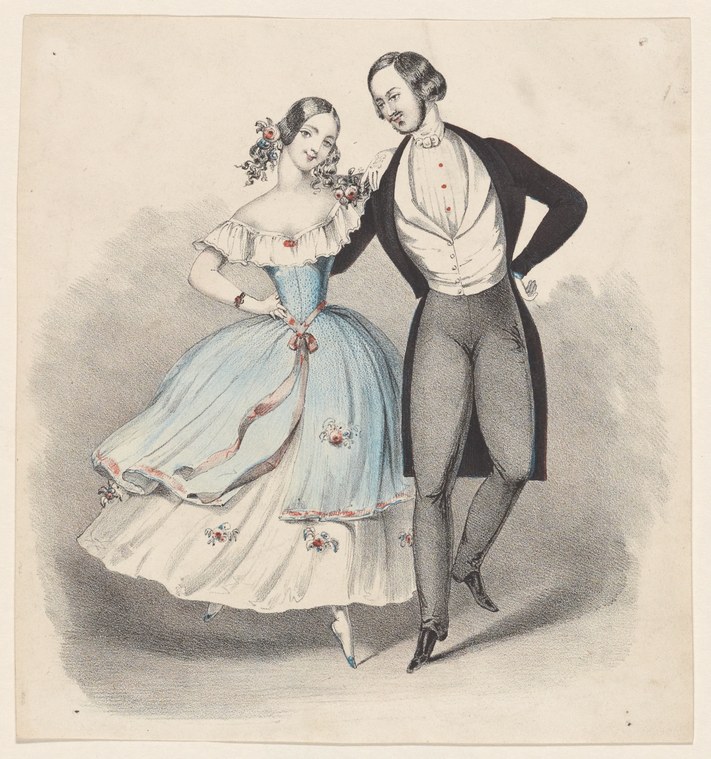
A young couple in fashionable dress perform a polka in an elegant interior. The woman wears a light blue ball gown with a fitted corset bodice and voluminous skirt trimmed with ribbon and scattered floral sprays; her dark hair is adorned with flowers. The man wears formal evening dress—a black coat with white shirt front and trousers—and assumes a confident, dapper posture. They stand close together in an animated pose that suggests mid-movement, their bodies angled toward each other in the characteristic embrace of the dance. The setting is rendered in soft tones with minimal background, emphasizing the figures against a neutral ground. The lithograph captures the fashionable leisure and courtship ritual of Victorian ballroom culture, freezing a moment of social pleasure.
The dancing
The couple hold each other in a close, upright frame typical of the polka—his right hand at her waist, her left hand resting on his shoulder or arm. Both face slightly toward each other with expressions of engagement and pleasure. Their posture suggests movement: the woman's skirt swirls around her legs, and both figures lean into the dance with the energy and lift characteristic of a lively, bouncing step. The proportions and anatomy are graceful but idealized, drawn with the precision expected of fashionable illustration.
The dance depicted
This is a polka, identified by both the title and the visual evidence of costume, hold, and the specific moment chosen—the energetic, upright frame and the woman's swirling skirt mid-turn. The polka was a central dance of Victorian ballroom culture from the mid-nineteenth century onward, danced socially by courting couples and featured in both public balls and domestic entertainments. The image shows the polka as a dance of flirtation and refinement, performed by the respectable middle and upper classes in formal dress. The artist has captured the characteristic bounce and lift of the step, and the intimate but proper closeness that made the polka controversial when it first arrived in Europe from Eastern Europe.
How it was made
This is a hand-colored lithograph, a process that allowed for the rapid production and distribution of fashionable prints. The technique enabled fine detail in the figures' faces and clothing, and the artist has used delicate shading and tonal gradation to model the fabric of the woman's gown and the texture of the background. Color is applied selectively—the dominant blue of the woman's skirt and corsage draw the eye—making this an economical but elegant object. Such prints were circulated as affordable fashion plates and entertainment imagery for a domestic market.
About this work
This lithograph documents the polka as a social dance of the Victorian era, frozen at the moment of greatest animation. It serves as both a fashion print and a record of how a particular dance was performed, dressed, and understood as a ritual of courtship and leisure. The image belongs to the tradition of ballroom dance imagery that emerged as the polka became a fixture of European and American social life in the mid-nineteenth century. For historians and dancers, it offers evidence of the social choreography of the period—the hold, the costume, the setting, and the coded meaning of the dance as a marker of modernity and refinement.
How to look at it
Notice the moment the artist chose to capture: not the beginning of a step, but the full energy of movement, with the woman's skirt caught mid-swirl and both figures leaning into the dance. The close, intimate frame and the formal evening dress signal the polka's status as a respectable social dance despite its origins and its reputation for liveliness. The idealized beauty and fashionable costume of the couple—the woman's delicate flowers and perfect complexion, the man's tailored coat—locate this image firmly in the world of fashion illustration and fantasy. The polka is shown here not as it might appear in a crowded ballroom, but as a refined, intimate performance of courtship.
The period
The polka emerged from Bohemia in the 1830s and spread rapidly through Europe and America, becoming a sensation by the 1840s-1850s. It was performed in public dance halls, private ballrooms, and theaters, and was often coupled with other fashionable dances like the waltz and the galop. The polka represented a new energy in dance—it was faster, bouncier, and more rhythmically complex than earlier ballroom dances, and it was perceived as modern and slightly transgressive. In this period, dance imagery was widely produced as chromolithographs and hand-colored prints, sold as affordable décor and as fashion plates showing the latest dances and costumes. The Victorian ballroom was undergoing rapid change as new dances arrived from Europe and the social composition of dancers shifted to include a broader urban middle class.
Where it lives
This lithograph is held in the New York Public Library collection, likely as part of a larger archive of ballroom dance imagery and fashion prints from the nineteenth century. Such prints were produced in large numbers for domestic consumption and circulation.
Dance in this work
Questions about this work
What exactly is a polka?
The polka is a lively, bouncing dance in duple time that originated in Bohemia (now the Czech Republic) in the 1830s. It spread rapidly across Europe and America, becoming one of the most popular social dances of the nineteenth century. Unlike the slow, gliding waltz, the polka is marked by a characteristic hop and by a faster, more energetic rhythm. Couples dance in a close frame, and the dance is often performed in groups circling the ballroom.
Why was the polka so popular?
The polka was seen as modern, fun, and accessible to a broad range of social classes. It arrived during a period of rapid urbanization and social change, and it became associated with urban leisure and entertainment. For middle-class dancers, it offered both the prestige of fashionable ballroom culture and a sense of liberation from more formal, stately dances. It also became a symbol of political and cultural nationalism in Europe.
How do we know this print is from the Victorian era?
The woman's dress—with its narrow corseted waist, full skirt supported by multiple petticoats, and hair adorned with flowers—is characteristic of the 1860s-1880s. The man's formal evening coat and the overall aesthetic of the print confirm this dating. The style of lithography and the hand-coloring technique were standard for fashionable prints of this period.
What was the social context of the polka?
The polka was danced in public dance halls, private ballrooms, and at theatrical entertainments. It was associated with urban middle-class life and with leisure and courtship. For respectable families, ballroom dancing was an essential skill and a crucial arena for social interaction and marriage prospects. The polka's reputation for liveliness and intimacy (the close frame was controversial) made it both desirable and slightly scandalous.
More Polka artwork