49 works in this view — arrow keys or swipe to move between them.
Dance in Art
Jullien's celebrated polkas.
Unknown artist
- Medium:
- Lithograph
- Dance:
- Polka
- Era:
- Late 1800s (Victorian Ballroom)
- Source:
- New York Public Library
- Rights:
- Public domain — free to use, share and adapt.
- Recorded as:
- public_domain
This is primary evidence of how the polka was taught, marketed, and imagined in its moment of greatest popularity, and of the role of famous dancing masters and impresarios in shaping ballroom fashion. The theatrical costume choices reveal that the polka, though danced socially by thousands, was also performed and celebrated as an art form deserving of fancy dress and professional instruction.
What you are looking at
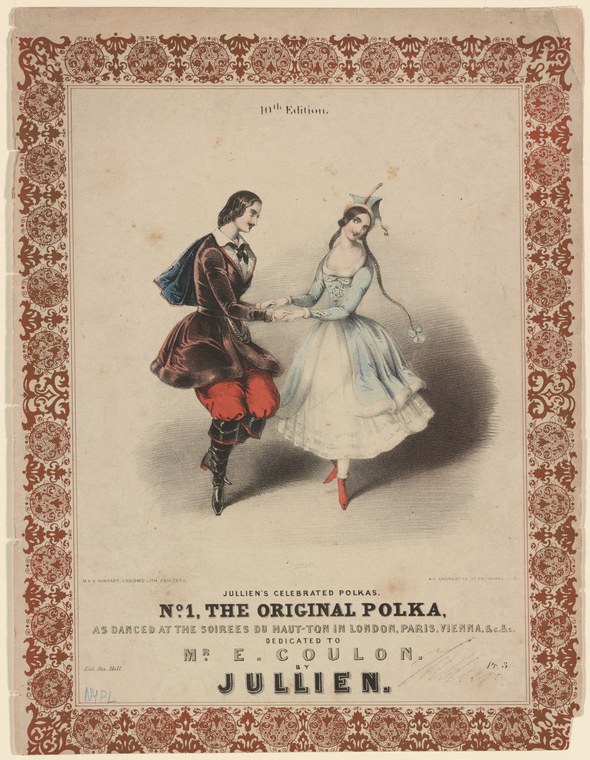
A lithographed dance instruction or promotional sheet depicting a polka being danced by a couple in profile against a neutral background. The man, positioned on the left, wears a burgundy velvet doublet with gold trim over red breeches and black shoes, cut in a style suggesting late Renaissance or theatrical fancy dress rather than Victorian ballroom wear. The woman, on the right, wears a pale blue or white tulle skirt with a fitted bodice, her hair adorned with what appears to be a decorative headdress or tiara. Both figures are caught mid-movement in an animated pose: the man leans forward with his left arm extended toward the woman's hand, his right arm raised, while the woman's body tilts back slightly, her skirts swinging outward to show the underside of the fabric. The composition is framed by an ornate red and cream decorative border typical of 19th-century printed sheet music or dance instruction materials. The title at the base identifies this as "Jullien's Celebrated Polkas, No. 1, The Original Polka, As Danced at the Soirées de Hart-Ton in London, Paris, Vienna &c. &c." with the composer credited as "Mr. E. Coulon" and "Jullien."
The dancing
The couple are in a loose ballroom frame facing each other at a slight angle. The man's extended left arm and raised right arm suggest an invitation or mid-phrase of the polka's characteristic arm patterns; the woman's corresponding posture—leaning back with arms open—indicates she is responding to his lead. Neither figure displays the rigid, closed frame of formal 19th-century ballroom hold; instead, there is a lightness and theatrical exuberance to their positioning. The woman's raised heels and the angle of her torso suggest weight is forward and momentum is present; the man's stance appears sprightly rather than grounded. The costume choices elevate this above everyday ballroom dress, marking it as either a theatrical interpretation or a haute couture version of the polka meant for elite dancing masters and their pupils.
The dance depicted
This is a polka, one of the fastest-growing and most socially significant dances of the mid-19th century. The polka originated in Bohemia in the 1830s and swept through European and American ballrooms by the 1840s, generating immense enthusiasm and spawning numerous published variations and "celebrated" versions by famous dancing masters. Jullien (likely the impresario and conductor Louis-Antoine Jullien, 1812–1860) was one of the most prominent names in mid-Victorian dance and entertainment, and crediting this polka to him with elaboration by E. Coulon (likely the famous Parisian dancing master) suggests this was a prestige version, perhaps featuring extra flourishes, syncopated timing, or theatrical styling for demonstration at elite soirées. The image itself does not show the typical rapid traveling action of a polka across the floor; instead, it freezes a moment of courtship and response—the turning-toward-each-other that gave the polka its appeal to bourgeois couples.
How it was made
This is a hand-colored or chromolithograph, a technique that allowed for mass production of colorful sheet music covers and dance instruction materials in the 19th century. The ornate decorative border, the quality of the line work in the figures, and the even color registration suggest a professional print shop, likely in London or Paris. Lithography made it economically feasible to produce dance instruction sheets and promotional prints for the sheet music industry; these were distributed widely to piano students, dancing masters, and aspiring ballroom dancers. The bright, cheerful colors and the clear figuration were designed to attract buyers and to present the dance as fashionable and accessible, even though the costume choices and the artist's style give it a flavor more theatrical than documentary.
About this work
This is a mass-produced dance instruction or promotional lithograph from the height of the polka craze in the 1840s–1860s, part of the sheet music publishing industry that made dancing accessible and fashionable to the middle and upper-middle classes. It credits the polka to the famous impresario Jullien and the dancing master E. Coulon, marking it as an elite version of the dance meant for serious pupils or theatrical performances rather than casual ballroom use. The image freezes the moment of courtship invitation that gave the polka its emotional appeal: the man extends his hand and opens his frame to the woman, who responds with her body tilting toward him, skirts flying. The theatrical costumes and the exuberant pose situate this not as a documentary record of ordinary ballroom dancing, but as an aspirational vision of the polka as a refined, even fantastical accomplishment.
How to look at it
Notice the moment chosen: not a traveling step or a pivot, but a moment of turning toward and invitation—the gesture that opens the dance and that embodies the social pleasure of the polka. The artist has frozen the couple in a state of mutual response, with the woman's body and skirts animated and the man's frame open and welcoming. Observe the theatrical costume: this is not ballroom dress but fancy dress, marking the polka as a subject worthy of style and refinement. The exuberance of the pose—the raised arms, the flying skirts, the forward-leaning torsos—conveys the energy and gaiety that made the polka so appealing to young dancers, even as the ornate border and the professional printing announce that this is a prestige publication, not a cheap broadside.
The artist
The artist is not recorded on the lithograph or in the catalogue. The work bears a printer's mark at the bottom left ("Printed by M. E. Coulon of Monmouth Street, Covent Garden") but it is not clear whether the printer was also the artist. The Coulon mark suggests London publication, and the professionalism of the execution points to a commercial print shop or a professional chromolithographic firm active in the mid-19th-century sheet music industry. Such firms typically employed skilled draftsmen and colorists whose names did not survive in attribution records; the emphasis was on the brand (Jullien, Coulon) rather than on the artist.
The period
The polka swept Europe and America between 1840 and the 1860s, becoming the first truly global dance craze of the 19th century. It was faster, more playful, and more egalitarian than the waltz, and it appealed to younger dancers and to the aspirations of the rising bourgeoisie. Dancing masters published hundreds of polka variations, mazurkas, and galops, each bearing the name of a famous composer or teacher, to capitalize on the demand. The 1840s saw a professionalization and commercialization of ballroom dance instruction via lithographed sheets, instruction manuals, and public demonstrations by famous masters. Jullien was a conductor and impresario who organized massive promenade concerts and dance events; his name attached to a polka gave it commercial and social cachet. The image belongs to this ecosystem of print, celebrity, and aspirational middle-class leisure.
Where it lives
The work is held by the New York Public Library and was accessed through their digital collections. It is part of the Library's collection of 19th-century sheet music and dance instruction materials, which document the social and commercial life of ballroom dancing.
Dance in this work
Questions about this work
Who was Jullien and why does his name appear on a polka?
Louis-Antoine Jullien (1812–1860) was a famous French conductor and impresario known for organizing grand promenade concerts and dance events. His name on a polka indicated a prestige version of the dance, likely featuring special arrangements or variations taught by his organization. Attaching the names of famous conductors and dancing masters to printed dances was a common marketing strategy in the 19th-century sheet music industry.
Why are the dancers wearing such fancy dress if this is a ballroom dance?
This is likely a theatrical or demonstration version of the polka, not a record of how ordinary couples danced at balls. The costumes elevate the dance to the status of an art form and signal that this is a prestige publication for advanced students or for performances by professional dancing masters. Such fancy dress also made the sheet music more attractive to buyers.
What is lithography and why was it used for dance instruction?
Lithography is a printing technique that allows for mass production of colorful images at relatively low cost. It was ideal for sheet music covers and dance instruction materials because it was faster and cheaper than engraving and could reproduce detailed color work. This made dance instruction accessible to the growing middle class.
How did people learn dances in the 19th century?
Primarily from dancing masters, through printed instruction manuals and step notation, and through imitation at social gatherings. Sheets like this one served as promotional materials for famous versions of dances and as memory aids for people who had attended a dancing master's demonstration or lesson. They also inspired buyers to commission lessons or purchase the sheet music for piano practice.
More Polka artwork