49 works in this view — arrow keys or swipe to move between them.
Dance in Art
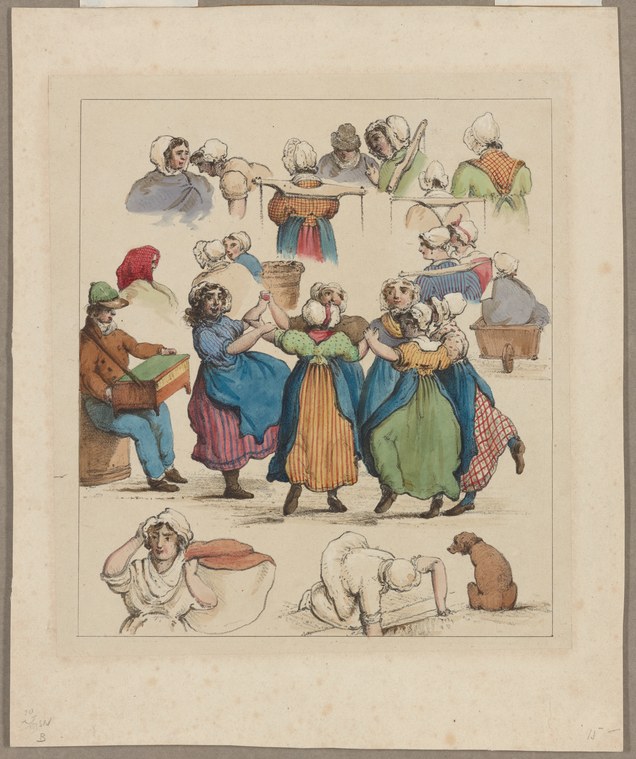
Washerwomen dancing
Unknown artist
- Medium:
- Source:
- New York Public Library
- Rights:
- Public domain — free to use, share and adapt.
- Recorded as:
- public_domain
This image is rare evidence of how ordinary people actually danced in moments of leisure and celebration, outside the codified forms taught in dancing schools and performed in theaters. It shows that social dancing was participatory, unscripted, and embodied—a form of collective pleasure that required no technique, partner position, or formal training. For historians of dance and labor, it documents both the existence of a working-class leisure culture and the kinds of movement and sociality that mattered to people whose own bodies were otherwise disciplined by labor.
What you are looking at
A lively genre scene depicting working-class women, likely washerwomen or laundresses, engaged in social dancing and merriment. The composition is organized in three distinct zones: the upper register shows a frieze of heads and torsos of onlookers or participants, some wearing white caps and colored garments, with various expressive gestures—one figure waves an arm, others gesture animatedly. The central scene is the focal point: a group of four or five women in the middle ground dance together, their bodies animated and close, wearing simple day dress in blues, oranges, and reds with white linen caps. One man in brown coat sits to the left, apparently playing music or clapping. The lower register shows two vignettes of prone or bent figures: a woman in white appears to be falling or in distress with a basin nearby, and a figure crouches beside a brown dog. The entire composition is rendered in hand-colored print, with watercolor washes in muted earth tones and bright accents, suggesting spontaneity and sketch-like immediacy.
The dancing
The dancers in the center stand close together in an informal cluster rather than in any formal hold or frame. Their bodies are loose and energetic, with bent knees and weight shifted; arms are raised, extended, and gestural rather than controlled or positioned. The movement vocabulary appears to be social and improvisatory—jumping, stamping, turning—rather than codified. The woman on the far right is captured mid-turn or twist, her skirts billowing. The standing figures around the perimeter watch and participate with open-mouthed expressions and raised arms, suggesting call-and-response or participatory dancing. The overall impression is of an unstructured, convivial moment of vernacular movement.
The dance depicted
This is a depiction of popular, working-class social dancing, likely from the 18th or early 19th century, showing the kind of informal celebration that would have occurred among servants or laborers. The dancers appear to be engaged in some form of country dancing or folk celebration—the kind that happened in kitchens, courtyards, or at festivals rather than in ballrooms. No specific codified dance style is legible from the poses or costume: there is no evidence of minuet frame, contra-dance formation, or ballet technique. Instead, this captures the vernacular, improvisatory spirit of popular dancing, probably German or Dutch in origin given the style of dress and domestic setting. The title 'Washerwomen dancing' anchors this to a specific working community and moment of rest or celebration.
How it was made
This is a hand-colored print, likely an engraving or etching given the linear precision of the composition and the clean boundaries of the forms, with watercolor or gouache washes applied afterward. The technique allowed for multiple impressions to be circulated, suggesting this was a popular or commercial print—the kind intended for a broad audience rather than a single patron. The hand-coloring was likely applied by workshop assistants rather than the originating artist, and variation in coloring suggests rapid, mass production. This was a print culture commodity, probably inexpensive, designed for prints to be bound into albums, pasted into rooms, or sold as individual sheets to amuse and instruct a middle-class or educated popular audience about the lives and customs of laborers.
About this work
This hand-colored print captures a moment of celebration among working women, rendered with satirical or sympathetic attention to the gestures, dress, and chaos of popular social dancing. It belongs to a long tradition of genre prints depicting the customs and amusements of common people—a subject that fascinated educated viewers and artists from the 16th century onward. The work is neither high art nor documentation but rather a commercial print designed to be collected and enjoyed for its observation of human nature, its humor, and its contrast to the formal dancing of the ballroom and court. It records a form of social practice—collective, improvisatory, joyful—that would otherwise leave almost no trace in the historical record.
How to look at it
Attend to the informality and density of the composition: the dancers are not arranged in a neat formation or line, but compressed and overlapping, suggesting improvisation and physical closeness. Notice how the artist has differentiated the participating dancers (central group, animatedly moving) from the spectators (peripheral figures, watching and gesticulating). The lower register—the woman falling or in distress, the dog—adds narrative complexity: this is not merely a representation of dancing, but of a social moment with its accidents, vulnerabilities, and minor dramas. The print style itself, with its linear clarity and hand-colored washes, was designed to circulate widely and be read quickly, so the composition is deliberately legible and exaggerated for comic or moralizing effect.
The period
This print was likely made in the late 18th or early 19th century, when satirical and observational prints depicting working-class life became increasingly popular in Northern Europe. Artists like Hogarth and his followers, and later printmakers responding to Napoleonic social upheaval, produced such images in large quantities. At the same time, the codification of ballroom dancing (minuet, country dance, cotillion, quadrille) was reaching its height among the educated and aristocratic classes, making the contrast between formal and popular dancing an increasingly visible social fact. The image captures a moment when dance was beginning to be understood as a marker of class, education, and social position—and when depictions of 'common' or 'folk' dancing served both to amuse and to reinforce social boundaries.
Where it lives
The work is held in the New York Public Library collection and is catalogued as a print, though the artist and date remain unrecorded. It is indexed in their digital collections, suggesting it was acquired as part of a larger assemblage of prints or as an isolated item whose provenance was not fully documented.
Dance in this work
Questions about this work
Is this a real moment or just the artist's invention?
It is almost certainly a type rather than a documentary record of a specific event. The artist is depicting a genre—'washerwomen dancing'—and showing what such a scene would typically look like. However, the costume, domestic setting, and kinds of movement shown are consistent with actual practices, so it reflects real social customs even if it is not reporting on one particular occasion.
Why is there a woman falling or lying on the ground?
The lower register of the print adds narrative complexity and probably humor: this is not a scene of pure joy but of social commotion, including accidents, excess, or disorder. The basin suggests domestic context (laundry work), while her recumbent pose may suggest drunkenness, exhaustion, or physical comedy—all common subjects in satirical prints of the period.
What dance form is this showing?
No single codified dance form is shown. Instead, this depicts social, improvisatory dancing—the kind that working people would have done together without training or formal instruction. It is closer to contemporary 'folk' or 'vernacular' dance than to the minuet, country dance, or other ballroom forms that were popular among the educated classes at the same period.
Who made this print and when?
The artist is not recorded, and the date is unknown. Based on style, costume, and composition, it was likely made in the late 18th or early 19th century in Northern Europe, possibly German or Dutch. It may be part of a larger series of satirical or observational prints depicting popular customs.
More dance artwork