49 works in this view — arrow keys or swipe to move between them.
Dance in Art
Oriental dance
Unknown artist
- Medium:
- Source:
- New York Public Library
- Rights:
- Public domain — free to use, share and adapt.
- Recorded as:
- public_domain
This print is rare evidence of how European artists and printers documented and disseminated knowledge of dance outside Europe in the 16th–17th centuries. It shows that dance was sufficiently important to distant societies to warrant visual recording and export, and that acrobatic, energetic movement with raised arms and open gestures was valued in Eastern courts and worthy of representation to European viewers. The work bridges performance history, art history, and the study of early global visual culture.
What you are looking at
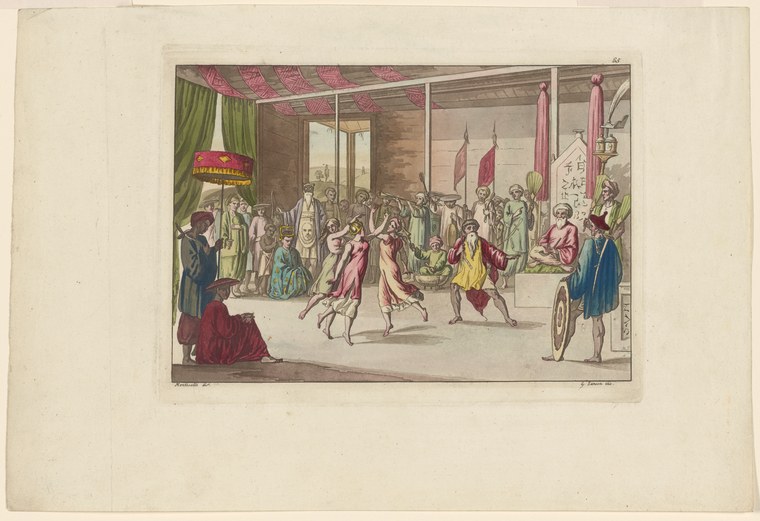
A crowded courtyard or palace interior, its ceiling draped in pink silk, fills with figures in early modern dress arranged around a central space where dancers perform. The scene is rendered in colored engraving or hand-colored print, with the architectural frame—stone walls, wooden beams, tall windows—establishing an indoor setting of formal grandeur. In the foreground left, a figure in deep burgundy robes sits or kneels in a posture of attention or reverence. The central action shows multiple dancers in motion: figures in pink, yellow, and blue silks leap, turn, and gesture with raised arms. Spectators line the walls and crowd the background, some wearing turbans and Eastern dress, others in European clothing. Banners or standards with text hang from the upper gallery. The lighting is even and theatrical, typical of print media, with color applied in flat planes rather than modeled shading.
The dancing
The dancers occupy an open floor with arms raised and extended, bodies in dynamic, vertical poses suggesting springing or lifting movements. The nearest dancers show acrobatic energy—one figure appears to leap or spring upward with legs bent. Arms are raised high and outward, not in closed partner holds but in open, celebratory or ornamental gestures. The spectators stand in relatively static poses, creating a clear division between the performing center and the witnessing surround. Multiple dancers move simultaneously rather than in unison, suggesting individual or loosely coordinated movement.
The dance depicted
The work is titled 'Oriental dance' and likely depicts a court dance or entertainment from the Ottoman or Mughal world as imagined or documented in early modern European printmaking. The mixture of Eastern and Western dress, the palatial setting with textiles and banners, and the acrobatic character of the central figures suggest either an actual diplomatic or court performance witnessed by Europeans, or a European artist's interpretation of such a scene. The leaping, elevated quality of the movement and the open arm positions are consistent with celebratory or courtly movement traditions of South Asian or Central Asian courts, though the specific dance form cannot be identified with certainty from the image alone.
How it was made
This is a hand-colored engraving or print, evidenced by the clear linear structure, the crisp outlines of figures and architecture, and the application of color in flat, bounded areas. The technique allowed wide circulation and reproducibility—such prints were collected in European Kunstkammer and served as documents of distant lands and unfamiliar customs. The hand-coloring (rather than printed color) suggests a work of moderate to high quality, meant for a patron with resources to commission or purchase a colored rather than black-and-white impression. The style and execution point to a date in the 16th or 17th century, though the catalogue offers no firm date.
About this work
This is a European engraving documenting or imagining a courtly dance performance in an Eastern setting—likely Ottoman, Persian, or Indian. The work sits at the intersection of geographical curiosity, courtly spectacle, and performance documentation; it represents how dance functioned as an exotic marker of distant societies in the early modern European imagination. The image survives in the New York Public Library collection and is a valuable record of both the dance practices it depicts and the visual language Europeans used to represent them.
The work belongs in a dance collection because it captures a specific moment of cross-cultural encounter in performance, preserved through the reproducible medium of the print. For historians, it offers evidence of what European observers noticed and valued in non-European dance; for dancers, it demonstrates the international circulation of performance imagery and the mobility of movement across cultural boundaries in the early modern period.
How to look at it
Attend to the contrast between the static, observing crowd and the dynamic central performers: the artist has chosen a moment of maximum action and lifted energy. Notice the raised arms and open postures—these are not the closed, partnered holds of contemporary European court dance, but rather celebratory, acrobatic, or ornamental gestures suggesting a different kinetic vocabulary. The precision of the architectural setting and the textile details (the draped ceiling, the banners) indicate that the location and courtly status of the performance were as important to the artist as the movement itself. The hand-coloring, particularly the bright pinks and blues, would have been striking to contemporary viewers accustomed to black-and-white prints.
The artist
The artist is not recorded. The work is characteristic of the Northern European tradition of topographic and ethnographic printmaking that flourished in the 16th and 17th centuries, particularly among Flemish and Dutch printmakers who supplied maps, travel narratives, and scenes of foreign lands to an expanding market of curious collectors. Such prints often drew on written accounts, diplomatic reports, or sketches by travelers, and were frequently based on secondhand or imaginative sources rather than direct observation.
The period
The 16th and 17th centuries saw intense European interest in the Ottoman Empire, Persia, and India, driven by trade, diplomacy, and the circulation of travel narratives. Dance in Eastern courts—particularly at the Ottoman Sublime Porte and Mughal courts—was a sophisticated courtly art form involving trained performers, musicians, and elaborate spectacle. This print reflects that European fascination and the emergence of printmaking as a medium for distributing visual knowledge of the wider world. In Europe, this period also saw the codification of courtly dance in the Renaissance and Baroque traditions, making it likely that European viewers had a framework for understanding Eastern dance as similarly refined and worth recording.
Where it lives
The work is held in the New York Public Library collection and is catalogued as a print of unknown date and artist. It entered the NYPL collection through their print holdings, which include both acquired works and donations from collectors of early European prints and topographic materials.
Dance in this work
Questions about this work
Is this a realistic depiction of an actual Eastern dance, or a fantasy?
Almost certainly a mixture of both. European printmakers of this period drew on travel accounts, hearsay, and imaginative reconstruction. The setting and dress suggest knowledge of Ottoman or South Asian courts, but the execution and composition reflect European artistic conventions and the artist's assumptions about what would interest European viewers. It is valuable as evidence of European perception rather than as a direct documentary record.
What does the text on the banners say?
The banners are too small and poorly resolved in the image to read with confidence. They may contain names, dates, or titles, but examination of a high-resolution original or an annotated historical record would be required to determine their content.
Why are some figures in European dress and others in turbans?
This likely reflects the actual composition of such courtly events—diplomatic occasions, merchant gatherings, or military courts that drew both local and foreign observers. It may also reflect the artist's attempt to signal the geographical and cultural hybridity of the Ottoman world or to make the scene legible to a European audience by including recognizable European figures as witnesses.
How does this compare to other dance prints of the period?
It is consistent with the tradition of courtly spectacle prints produced in Northern Europe, particularly prints documenting tournaments, masques, and exotic performances. However, the emphasis on Eastern dancers and the palatial setting distinguish it from the majority of surviving 16th–17th-century dance prints, which tend to focus on European court contexts. It is thus a relatively rare document of European engagement with non-European dance.
More dance artwork